
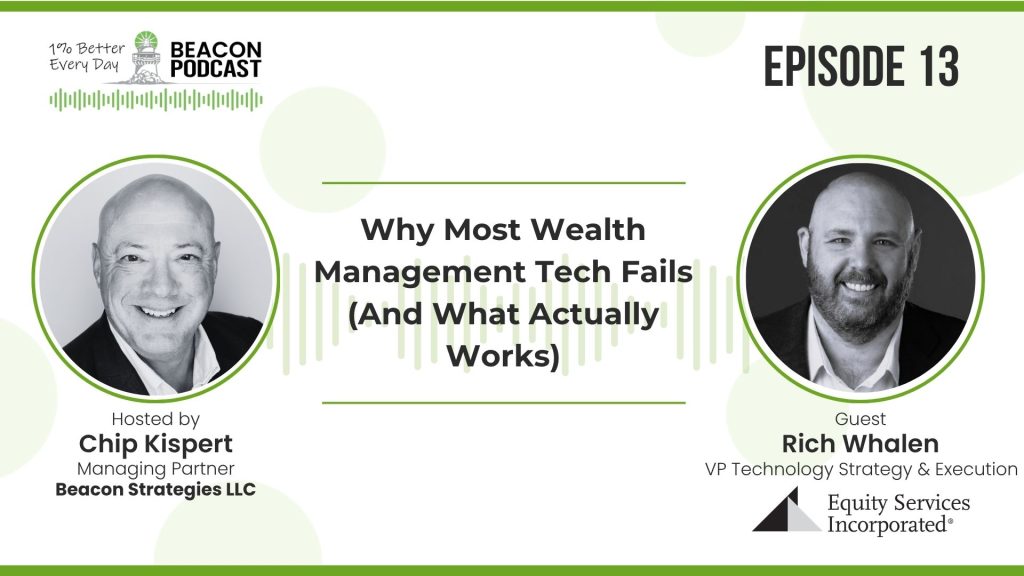
What if the real ROI of technology isn’t efficiency, but time?
In this conversation, Chip Kispert sits down with Rich Whalen, VP of Technology Strategy and Execution at Equity Services, Inc., to unpack how the right technology strategy can give advisors something far more valuable than speed: space to focus on clients. From his early days as an advisor to leading technology strategy at Equity Services, Rich shares how a single shift in workflow changed everything, and why most firms still get this wrong today.
You’ll hear how ESI approaches innovation differently, starting with data and process before tools, why advisor choice drives stronger adoption, and how AI should be approached with intention, not urgency. This episode is a grounded look at what actually works when building technology that supports real growth.
What to expect:
- Why “return on time” matters more than traditional ROI
- How better workflows can unlock 20+ hours per month
- The real reason most tech adoption fails in wealth management
- A practical framework for evaluating AI without risking trust
Connect with Rich Whalen:
About Our Guest:
Rich Whalen is the VP of Technology Strategy and Execution at Equity Services, Inc., where he leads platform development focused on improving advisor efficiency and client experience. With a background as a financial advisor, Rich brings a practical, user-first perspective to building technology that actually gets adopted and delivers meaningful impact.
[00:00:00] RJ Malyk: Welcome to Beacon 1% Better every day with Chip Kiper, founder of Beacon Strategies. This podcast is all about challenging the norms of wealth management and empowering professionals to make continuous progress and always be curious. Chip knows firsthand how small consistent improvements can lead to big breakthroughs, and that’s what we’re focused on here, helping you get 1% better every day.
We’ll dive into conversations with industry professionals, share actionable strategies. And explore the mindset needed to overcome industry challenges and create lasting change. Let’s be curious. Push beyond what’s always been done
[00:00:46] Rich Whalen: and uncover better ways together.
[00:00:51] RJ Malyk: Welcome to 1% Better Every Day. I’m RJ Mallick, your producer, and today Chip sits down with Rich Whalen, VP of Technology Strategy and [00:01:00] Execution at Equity Services, Inc.
The broker dealer and RIA member of National Life Group. Rich started his career as a financial advisor, moved into technology because he saw what it could do and has spent the last seven years building a platform at ESI. That serves home offices, advisors, and clients all at once. He calls the goal simple.
Give advisors back their time right now. Here’s Chip.
[00:01:27] Chip Kispert: Thanks rj. Rich, welcome to the show.
[00:01:31] Rich Whalen: Thank you. Pleasure to be here.
[00:01:33] Chip Kispert: We’ve worked together so many times, um, and, and collaborated on a, a number of things. Uh, I figured it was time to, to have you on the podcast and, and go a little deeper. So super excited that you’re here.
Um, you know, one of the things I, I love about you as well is that you’ve been at ESI really long enough to see. A pretty big transformation in [00:02:00] technology, uh, over your, your time there. So I lo I look forward to talking about that going forward. Um, one of the things I wanna start with, and I know RJ gave a little bit of background on you, but share a few things from your perspective, um, that are about you.
[00:02:18] Rich Whalen: Yeah. Uh, so. My name’s Rich. I love technology. I was actually just talking with someone. They were saying, oh, are you going to maybe go for this role or something that was outside of our industry? And I go, absolutely not. Uh, I love wealth management. I love the technology that we do. It’s kind of funny.
Early in my career, I basically had a Canon event in my life that put me on this trajectory. Uh, so I started my career as a financial advisor, got outta college, got my series seven, my series 66, and I was rolling. Uh, I won’t say all that great, but I, I was, I was doing it. And every morning [00:03:00] I would go through my list of actions that I had to go through and and do, and probably 50% of my action items were just following up on clients.
Hey, did you do that paperwork? Did you send it in yet? Uh, what’s going on with this sale? And so the firm I was with at that time had an initiative and they created what they called at the time. And there are many people that have called it since the rollover wizard. The first one to go through and do that was an electronic application, wasn’t client facing.
It was for me as the advisor to go through and do. And it led to what they called e purchase, which at that time was pre DocuSign, electronic signature capture through their portal. And I jumped on that so fast ’cause I, I realized very quickly that I could do an application. On the phone with them, quickly get it out to them to review and be done in probably 30 minutes, give [00:04:00] or take, uh, you know, from beginning of call to the, to the end.
And then my follow-up was done other than just making sure the money actually came in. So once I saw that and the productivity that it hit me, I was hooked.
[00:04:14] Chip Kispert: You were on the bleeding edge there?
[00:04:16] Rich Whalen: Yeah. Yep. Uh, early two thousands, technology was a thing.
[00:04:20] Chip Kispert: That’s terrific.
[00:04:21] Rich Whalen: Uh, and that is, that’s really what got me in.
So the team that built that was looking for feedback about why I wasn’t getting adopted quite as much as well as they thought. And so they came to me as one of the top users and was like, Hey, what’s going on? And me and that person, we just hit it off. And lucky to say that he’s hired me now three times as he, he’s moved on through.
But that was my introduction to technology and I haven’t looked back since.
[00:04:47] Chip Kispert: Ah, that’s terrific. That’s terrific. I love that story. I love that, uh, how you got into it, so to speak. Um, one other thing you talk a lot about is really the, the gift of time, right? [00:05:00] Um, you know, when. Most people in this business talk about efficiency and productivity as really, you know how to get the paperwork done faster.
You look at it through the lens and you just told a great story about that right? Of giving time back. And so when I look at it and you’re looking forward, right? How, how are you at. SI giving time back to the advisors, and ultimately we’ll talk about this a little later, but I want to hear and, and not right now as I said, um, but how you think about that within your decisions of, of choosing different tools and putting different processes in.
But, but again, you know, how are you helping give that time back to advisors Today at ESI.
[00:05:55] Rich Whalen: We do it in, in a lot of different ways. I think, uh, the talk of ROI [00:06:00] is all is kinda talked about with AI right now. I like to think of it as ROT, the return of time or return on time that we’re doing within there. So for me, what’s important is that we’re always starting with the end of mind.
We’re trying not looking to say, oh, what can we fix? It’s what’s the problem? Or what can we do to. Speed things up so the advisor can spend more time with their client and less time doing things. So if that means, for example, uh, clients talking to us or advisors talking to us and saying, you know, rich, I spent a bunch of time going back and forth just trying to schedule meetings with my clients.
Well, okay. We can create that time and take that out with scheduling tools. So we go through and we’ll put a scheduling tool in place and we’re talking with one advisor and their office. They said we easily save them. About 20 hours a month just in going back and forth and trying to [00:07:00] schedule that. Now, maybe that wasn’t direct savings on the advisor side.
That was mostly to the office staff and the follow up. But guess what? If that office staff member is now supporting the advisor with those 20 hours doing prep for meetings or following up on more important information like rollovers, uh, that’s all the better and we’ve just increased the efficiency for the office.
[00:07:22] Chip Kispert: That’s terrific. I, you know, and, and it’s interesting ’cause I’ve watched the work that you’ve done, you’ve really built a good foundation, um, in the tools that you have and you’ve chosen. So one of the things that I. You know, obviously as a con consulting group, we help firms build their platform, so to speak.
But recently you’ve added a few new toys to your platform, um, F Max being one of them, and also you have a distribution partnership with Summit Global. Putting those on the, on the platform is a big lift. And so as you’re thinking, [00:08:00] you know about the process. Tell us little bit what those implementations look like and then post those.
What’d you learn?
[00:08:10] Rich Whalen: Yeah, so. The Summit Global Partnership has been amazing. Uh, and it starts with the fact that they are great partners of ours. When we first started talking about this, and for those that don’t know, this was our first kind of entree into the hybrid RIA space, so previously. We had been the RIA, it was our corporate RIA.
So everything ran through us on this side. This was the first time we were partnering with distribution where they would have their own RIA. And that opens up a world of complexity that we had not handled before, really looked at. So it was a joint partnership of myself, our chief compliance officer, our chief operating officer, and the team at Summit to look through and understand, okay.
What are things that are RA [00:09:00] only that we don’t really need to be involved in? And let’s not try and insert ourselves where we don’t need to be. Because sometimes that’s one of the the things we ultimately wanna go into. We wanna control the experience, we wanna help out, but. Let’s make sure we’re doing what we came to do and focus on.
And then for anything where there was ESI involvement, we had open and honest conversations about, okay, what’s going on? Where is this going? Where’s the data going? Uh, what data is being touched? Could you potentially use this system? Or maybe they really liked that other system that they did. So we both came in with the right mindset, which was, let’s understand the workflow and where.
The data needs to go and what needs to get done before we start saying, well, we want to use our tool, or We’re gonna go through and use this, and we work together to come up with a workflow. That’s a good mix of things that ESI brought to the table and things that Summit brought to the table. And as we go through and work through that [00:10:00] partnership, we’re still kind of changing things a little bit and looking to add things in.
Uh, and make small tweaks as we go through. So it’s been a wonderful way to, to have our introduction into the hybrid RIA space. And as far as learnings go, as we look back, I think one of the things that we could have done is start with, okay, here’s where we want to get to. We know the path and how we’re gonna get there, but.
What is our kind of ideal success look like? And then back in a little bit to, okay, how do we get there? Because I think we just got to the, okay, what can we do as not necessarily a mi a minimum viable product or an MVP, but, uh, what works versus, okay, what works now and then what’s gonna work better in the future?
[00:10:50] Chip Kispert: I love that answer. You know, you talk about data, you talk about process, then you talk about the tools. Right. And I think, you know, it’s interesting ’cause when we talk to [00:11:00] so many larger RIAs or even broker dealers, most of the time they’re starting with tools. Which, um, is a recipe for a challenge, let’s put it that way.
I’ll use that phraseology.
[00:11:14] Rich Whalen: I’ve fallen into that a couple of times myself.
[00:11:18] Chip Kispert: So, you know, and especially today, as we’re seeing more and more sophistication, actually more and more specialized tools that are relying on ai, you gotta make sure that data’s right, right.
[00:11:31] Rich Whalen: Hmm.
[00:11:32] Chip Kispert: So
[00:11:32] Rich Whalen: absolutely
[00:11:33] Chip Kispert: we’re gonna touch on that a little bit later.
But I think what, I think that’s a absolutely fabulous way to look at it. Um, and, you know, really that data process then the tool that, that, to me, that’s a, a big takeaway from our, our conversation here today.
[00:11:50] Rich Whalen: Hmm.
[00:11:51] Chip Kispert: This is a cra not a crazy question, but in my career, um. Ever since I got onto [00:12:00] more of the, the broker dealer, RIA FinTech, where when I joined that industry, probably in my early thirties, um, I always observed that there are all these great tools, but adoption can be really, really difficult and you know, firms like yours.
They make big commitments. But you know, as an example, when I see financial planning, um, my expectation is those numbers would be higher for adoption than they truly are. I’d love to hear your perspective on that.
[00:12:42] Rich Whalen: Yeah. I think, honestly, this is one area where ESI stands out a little bit in that we have a mix on our technology platform.
Our technology platform is not a one size fits all. We provide a core technology platform of kind of the, the things that an advisor needs [00:13:00] to process, business account opening, investment management platform, um. All the other things that kind of go along with that. But those are kind of the two big ones.
And then we have a la carte options. So for, uh, going through and doing performance reporting and consolidated statements, financial planning, the Calendly and the, uh, scheduling solutions that we mentioned before, a CRM system, we don’t bundle that all up and say, okay, here’s a hefty, uh, charge or a hefty monthly fee that you have to pay an affiliation fee or technology fee, whatever it is.
No, we have a A across the industry, actually a lower than average affiliation fee and technology fee. On our firm, and then we allow advisors to go through and build and customize what they want to have within our ecosystem and what we have selectively curated for them. Because when we put a platform on there, it may not be the absolute [00:14:00] best in breed, but it’s the best in breed for us and the different integrations that we have.
What that means is when we go and we talk to an advisor about our account opening. It works for ESI, for example, and I’m really proud of the fact that, uh, if you talk with our clearing partner, they will tell you that we are absolutely tops as far as opening accounts online through their API. We have a hundred percent adoption on that to go through and do that.
So if we’re opening up a brokerage account with our clearing partner, it is via our API And one of the benefits, and this is part of the reason why we look to give the gift of time when we were building that it would’ve been really easy to speed through that. The API integration say, great, the account’s open.
But we took a step back and we said, wait a minute. When an advisors opening up an account, they usually also have transfer paperwork they have to do in order to do the transfer paperwork. Many, uh, 401k providers want an account number that’s gonna, their way of sludging up the process a little bit. So [00:15:00] we talked and we kind of investigated a little bit and we said, wait a minute, we can get a provincial account number.
At the time of doing the paperwork, at the time of doing the account opening, now we get that from the API client can have the account number it’s filled out on the transfer paperwork, everything is signed, transfer paperwork goes out. And then we’re also finishing opening up the account on the backend as we go through and do that.
So by thinking through those type of things and being really focused on what we do, we’re able to provide a, a really. Exclusive as well as an amazing experience for our advisors. And then for advisors when they, when they’re ready and they’re ready to adopt financial planning or they’re ready to adopt CRM, they already have the buy-in ’cause they’re coming in and saying, Hey, I want this.
And so, yes, not every advisor at ESI does that. They may not have all our tools on there, but the ones that they do have. They’ve already bought in before they even start using it. And we’ve seen that to be a real, uh, [00:16:00] powerhouse for our engagement and, and having really strong partners with both our field as well as our technology partners.
[00:16:07] Chip Kispert: You know, I love that foundational, that, that build out the thinking that you’re doing. I wish more firms did that. Um, how do you guys work with, you know, evolving technology with a firm? Whether good or bad.
[00:16:23] Rich Whalen: Yeah.
[00:16:24] Chip Kispert: You know, as these fintechs and or providers have innovation and bring out new capabilities, functionality, how do you weave that into, like, that’s an evolving process.
[00:16:40] Rich Whalen: Mm-hmm.
[00:16:40] Chip Kispert: Right? The first one is you get ’em implemented, you walk through, think about, you know, it’s MVP one. Right. MVP two is now that relationship, fast forward two or three years, they’re putting new capabilities. How do you go through weaving that back into one and two, you know, [00:17:00] data and process.
[00:17:01] Rich Whalen: Yeah. Uh, it is not an easy thing to do, that’s for sure.
We gosu, I think with that, it starts with not having the, we buy it, we implement it, and then we all just kind of walk away and go like, yep, we’re done. No, it is exactly what you were just saying, chip. It’s meeting with that partner. Uh, on multiple times. My team and I will meet with all of our strategic, strategic partners usually.
At least monthly, some cases weekly, depending on, on what’s going on. Uh, and for some of others it’s a little bit more of a quarterly cadence, but we’re talking with them and during those meetings we’re always asking, okay, hey, what’s next? What’s coming up? Uh, and in many cases, we’re privileged enough where they come to us.
This just happened with one of ours, uh, a little while ago. They came to us and said, Hey, we’re thinking about doing, uh, client onboarding. I said, that’s great. I’d love to help and sit and [00:18:00] wa, you know, help you think through that a little bit. But I also shared, you know, client onboarding may not be the best place to start ’cause there’s a lot of client onboarding out there and it’s really hard to differentiate yourself in that marketplace.
I think workflow is something that is not nearly as well understood and done, and I think you have a chance to go through and expand within there. So. Having those kind of conversations really aren’t early on, has been really fortunate for myself and my team that we can go through and be early, kind of flies on the wall and see what they’re doing.
And that allows us time to think about, well, how would we bring this in and how would we do that? But I can’t say I do it all myself. I have an amazing team. Behind me or, or really in front of me, uh, that are going through and testing all of these different changes and everything that we’ve done. You mentioned FM Max earlier.
Uh, we took in that, [00:19:00] that change, we transferred two and a half billion dollars from our previous custodial platform to FM Max. And the amount of testing on that was, um, just. Enormous and
[00:19:13] Chip Kispert: I can’t imagine.
[00:19:15] Rich Whalen: Yes. And uh, specifically, I’ll, I’ll shout out Heather and Katie on our team. The amount of testing that they did to get things right and to call out and.
Kudos to them. ’cause they would not take a substandard experience on this. They would call out even small minor things where others may have just like, oh, you know what? It works. It passed. We’re like, no, that doesn’t work. And to go through it and have that, uh, power because we’ve been such good partners say, look, this is not an optimal experience and here’s why.
And to have the partners listen to us and make the changes is, has been a part of the, the special relationship that we have.
[00:19:55] Chip Kispert: So I absolutely love that foundational, you know, you talked about, [00:20:00] you know, it being the core platform, um, you know, ideally books and records trading. I can go down the list a little bit more.
Right. But how do you look at, and, and I’m gonna use the term kind of the, the shiny metal fishing lures, right? That you get. Daily bombarded with is, Hey, we should sign up for this, we should do this. What’s the process you have for decision making? Especially on the advisor side, right? So your advisors have a voice.
[00:20:35] Rich Whalen: Yeah, absolutely. This is something that I’m really proud of that we’ve done. Uh, and it’s really boils down to two different areas. The first is our, uh, EAC committee. So it’s ESI, field Advisory Committee. Uh, it is a rotating group, usually about, uh, six to seven of our top advisors, and they represent different areas.
So each one [00:21:00] essentially has a. Area that they represent and they can take feedback from all within our field. So they are really the voice of our field and we sit down with them quarterly and it is very much a two-way street and a a two-way piece of conversation that we have with them where we will come and we’ll say, Hey, here’s what we’re thinking about.
Here’s what the our future roadmap looks like from our, our perspective. We’d love to hear your thoughts on that. But it also comes in and they say, whoa. Something’s not right here, or we really need X, Y, and Z. Um, uh, example of this is we did last year with, uh, iCapital. So we’ve had different alt on our platform in the past.
Uh, but the experience honestly wasn’t great and they really challenged us to. Up our game and improve the experience for that. So we went out, we looked at a few different firms, uh, that do alternatives, and we found a great partner with [00:22:00] iCapital to go through and be able to gather all of the paperwork that’s involved, all of the disclosures that are necessary in order to process that transaction and bundle that together along with our sales process Now.
We still have some work to do in that we wanna see some deeper integrations with our custodial and, and we’re talking with them about that. But that’s one of the examples where our field advisory committee came to us and said, we need a better experience. And we, we heard them and we delivered a better experience and we’re gonna keep making it better as we go through with that.
The other area where I’m proud of what we’ve done, we’ve just revisited this with my team, is we’ve completely rebuilt our prioritization process on here. So now, instead of it being a very top down approach, it’s a a middle approach where we take in feedback from the field through our field advisory committee, but also directly through our business development team.
And we gather all [00:23:00] that information. We meet with a, a lot of the managers who are closer to the business in processing things and getting their recommendations. Then we bring in the leadership of ESI and we talk about what our goals are, and we essentially compare notes with the managers. And then together we set the prioritization for the firm.
And we’re just starting that out now. But I’m really excited about that and coupling that with what we have from uac. And I think. Uh, we have a great ability to listen and respond to what both our home office as well as our field needs.
[00:23:32] Chip Kispert: You know, I think that’s great. You know, some recent, um, JD Power information that’s come out, data, you know, is talking about advisor satisfaction, right?
And how, you know, advisors. Satisfaction with firm technology is lower today than it was in 2022, which I found fascinating. But when I look at what you all are doing, you’re bringing everybody together for those conversations and, and [00:24:00] your, your strategy, your execution is flying in the face of those numbers.
[00:24:05] Rich Whalen: It’s been, uh, an incredible ride and I have a lot more to do, but I’m proud of what we’ve built over here and it’s been, uh, it’s been amazing to be part of it.
[00:24:14] Chip Kispert: All right. You mentioned ai, but can’t have a conversation these days without it. And, um, you know, couple things, right? If, if when I did some research, saw what you guys were doing, um, I, one of the things I was shocked is that ESI has been the fastest growing broker dealer in the country by total sales deposits.
Uh, I thought that was fascinating. And so, you know, one of you, you are. You have growth, right? You have, you’re growing really, really quickly. You’ve talked about core platforms, you’ve talked about field-based platforms. Now the question comes as everybody is either leveraging off embedded AI or native ai.
How do you [00:25:00] look at where AI can fit into ESI? And, and helping advisors, helping the home office, helping the advisors, field staff.
[00:25:11] Rich Whalen: It’s an amazing question. It’s almost an overwhelming question, but I think you won’t be surprised by my answer as we, as you hear it a little bit. Uh, we started first with our approach and what we were gonna go through and do, and so we started and built an actual AI framework.
Last year that is essentially a guide rail for how are we going to implement ai, what are we gonna be comfortable with, what are our kind of hard lines where we’re not gonna be comfortable with on that? Uh, one of the biggest things that we came away in doing that framework is we are adamant right now that AI is not ready to actually be autonomous yet.
So I’m sure it’ll get there at some point, but right now we are not gonna let AI do anything without us having a check and a control in [00:26:00] place on that. And yes, that will probably so slow things down a little bit, uh, versus what others are doing. But I think that’s paramount for us because trust is such an, such an important commodity in our relationship.
And I know using the word commodity kind of sounds a little odd in that. It can vanish very quickly. So you can have swings in that. And that is not something we’re willing to put on the table as far as being, you know, potentially losing it because we did an AI tool. So we are going to be very cautious in our approach and also taking this time.
To make sure our data is clean and well structured so that when we do bring in an AI tool, we’ll actually start seeing the results. I think we’ve heard a lot of stories of someone bringing in an AI tool, bringing into a firm, and it’s not quite getting the results that were promised because a lot of the data is unstructured, it’s messy, uh, it’s not standardized.
Other people are [00:27:00] kind of. Say fighting over the data ’cause they have different interpretations of what it should be and what it should look like. Um, so we’re taking this time now to clean all that up so that when we are ready to bring on some AI tools deep into our data set, that data is gonna be clean and ready to go.
Now that does not mean that we’re not a fan of AI in what we’re doing, and we’re currently doing a bake off right now with a few of the AI assistant tools and ’cause that’s an easy way to create the gift of time for our advisors is to be able to go through and be more present in meetings and not worry about having to, to take notes or what did they just say or what could that mean?
They’re now just truly listening and responding with empathy. With knowledge, with care, with, uh, teachings on what they can go through and do. And then all the, the note taking, the documentation, the follow ups, that can all be done afterwards through there. So we see that as a big one. So we’re gonna start with that.
Uh, and then, uh, [00:28:00] next as we go through, we are gonna start, uh, with some. Some surveillance and using AI to help a, a little bit on that in cleaning and identifying and triggering for that. Uh, but those are all things that we’re gonna do in a very cautious manner. So I have great hope for AI and what it’s gonna do in our industry, but it’s important that we take a very responsible approach and, uh, I’ll say dip our toe in and very slowly get in and make sure it’s really working.
[00:28:29] Chip Kispert: That’s fabulous. And, you know, if, if we had longer to talk about this, I’d also like to talk about how you guys look at security and managing the AI and, and what you’re, what you’re looking for from your partners. That’s another conversation for another day. Um, I do want, wanna quickly switch to, um, a newsworthy subject and that is you have a new CEO.
And, you know, what’s he bringing to the table so far as, as you guys have been working together? [00:29:00]
[00:29:00] Rich Whalen: Yeah, Alex, David joined us in, uh, December and I think, uh, in the office. He’s been actually in the office maybe a total of a week. Since he’s been here. Uh, ’cause he has just been out on the road talking with our field, going to different industry events.
We were both at FSI together. Uh, so it’s been a whirlwind couple of months for him. But he is coming in with such a laser focus on our experience and our recruiting. Uh, and what it was really refreshing for me is he comes in, he comes from a lot of firms that have much bigger technology budgets than we do.
And I was coming in thinking, you know, he’s gonna have a, a laundry list of things for me to go through and execute on, uh, and I’m afraid maybe I won’t be able to, to give him the recruiting platform that he needs. We come in, we sit down, we talk about this, he starts asking questions and he says. Rich, do you have this rich?
Do you have that? Uh, and I’m like, yes, yes, yes we [00:30:00] do. And he’s like, I am ready to go. So, uh, he is pedal to the metal. He is laser focused on our recruiting and having us, uh, run the broker dealer in just a advisor first capacity that it is a, uh, just, we’ve just hit the highway and we may have just hit ludicrous speed.
[00:30:22] Chip Kispert: I love it. I love it. All right. As we kind of go into our close here, this is a question I always love to ask. Um, who are two or three people or firms right, that are doing work right now that you are you really admire? Right? And what specifically are they doing where others should really pay attention to it?
[00:30:43] Rich Whalen: Oh, uh, the folks at Almar for one. Um. They are doing a lot of things. You have, uh, Judd and George over there. Um, I, I can’t go a day without seeing one of them pop up on my LinkedIn with something really cool, [00:31:00] and I’m kind of envious that I, I’m not part of that. They got a, a lot of cool things going on in there.
Um, I am really, uh. Honored to be part of a, a group of tech leaders where we meet together. And there are some great firms within that, uh, including Commonwealth X Tele, um, earth Official, where we’re all just sharing information and uh, learning from one another. And to have this kind of community that we’ve built in within the wealth management space, which is already a tight-knit community to have like this tech focused group within that.
Has been amazing and, and, uh, a special thing for me to learn from.
[00:31:41] Chip Kispert: Oh, that’s fabulous. That’s fabulous. All right, rich, it, this is the Beacon. 1% better everyday flash. So you have 60 to 90 seconds without a script, no guardrails. What’s the one thing you want the wealth management world to hear [00:32:00] right now?
[00:32:01] Rich Whalen: AI is everywhere.
We want AI to, uh, really transform what we do. I think with all the AI coding, there’s a ton of things that we’re gonna do. I’m just gonna ask, take a deep breath, slow down, and don’t do it just because you can do it because you’re solving a problem. And if we focus on that, uh, I think we will be able to create competence in everyone’s financial future.
[00:32:30] Chip Kispert: I love that we’re back to that data process and then be able to look at the solution. Um, absolutely fabulous. Uh, so Rich, anybody who wants to learn more about ESI or reach out to you, uh, where should they go?
[00:32:49] Rich Whalen: Please check out our website equity services.com. You can find me on LinkedIn. Uh, search Richard Whale.
I’m in there. And, uh, hit me up. I love to [00:33:00] have conversations and if you’re on the conference circuit, I’m sure you’ll see me at some point.
[00:33:06] Chip Kispert: Rich, thank you for being on the show. Love to have you. I always love our conversations.
[00:33:11] Rich Whalen: Thank you, chip. It’s been a blast.
[00:33:13] Chip Kispert: Wow, RJ, how about that conversation?
[00:33:18] RJ Malyk: There was a lot there.
A lot.
[00:33:20] Chip Kispert: You know, it’s funny ’cause I’ve known him for years and, uh, it’s fun to go back and forth with him on the show. A couple things I took away from our conversation, um, that I really loved what he was saying. And, and the first one is technology that gets used is technology built for the person using it.
I thought that was, um, what they’re doing, how they have their advisor, um, advice groups. Uh, I thought that was pretty, pretty powerful. Um, number two, you know, I think we talked about integrations, um, you know, focus on the data. Data and integrations are a strategy. Adding tools. [00:34:00] Is not necessarily, and you gotta get data process all in place to be able to choose the right tools.
And then the last one, you know, and, and it kind of goes back to um, our first, my first point, but I just was taking how, when the, the marketplace is saying advisors are, are less enamored with technology than they were three, four years ago. Um. They’ve created a system where the advisors have a say in what they’re doing and they really, they think about it, they plan it, and then they execute it.
I thought it was fabulous.
[00:34:40] RJ Malyk: Yeah. I, I have to agree with you that last one really stood out, how they’re really focused on making sure the advisor. Is getting exactly what they need and not throwing just all this information at them. And here’s a, here’s a plan we came up with and you can take from A to the Z and instead they [00:35:00] say, okay, tell us what you need.
And they give it. I thought that was, uh, very interesting.
[00:35:04] Chip Kispert: Yeah, I’ve seen that the kind of a field advisory concept, um, at a lot of firms, but they, they seem to be really, really tightening on that screw and doing a good job with it. Um, alright. We’re pretty much. In, in close time. Um, you know, rich was a, a terrific, uh, guest on the show.
Love chatting with him. Um, but it’s time to wrap up here. So before I leave, to quote Ted Lasso, be curious, not judgmental. This is Chip Kiper. Wishing you well until our next edition of The Beacon 1% Better Everyday podcast.
[00:35:41] RJ Malyk: Excellent. Thank you. And that is a wrap on this edition of The Beacon. 1% Better Everyday podcast.
Thank you to Rich Whalen, VP of Technology Strategy and Execution at Equity Services, Inc. For joining us today. If today’s conversation sparks something for you, share it with a colleague and subscribe wherever you [00:36:00] get your podcasts. Thanks for joining us on Beacon’s. 1% Better Everyday podcast. Be sure to hit that follow button so you never miss an episode.
And stay up to date with Chip and his friend’s. Latest insights and strategies. If you want to learn more about Beacon Strategies or get in touch, visit us@beaconstrategiesllc.com. Remember, progress starts with just 1% every day. Let’s keep challenging ourselves to be curious and grow. The information covered in posted represents the views and opinions of the guest and does not necessarily represent the views or opinions of beacon strategies.
The content has been made available for informational and educational purposes only. The content is not intended to be a substitute for professional investing advice.