
It rarely starts with a bold decision; it starts with a quiet realization.
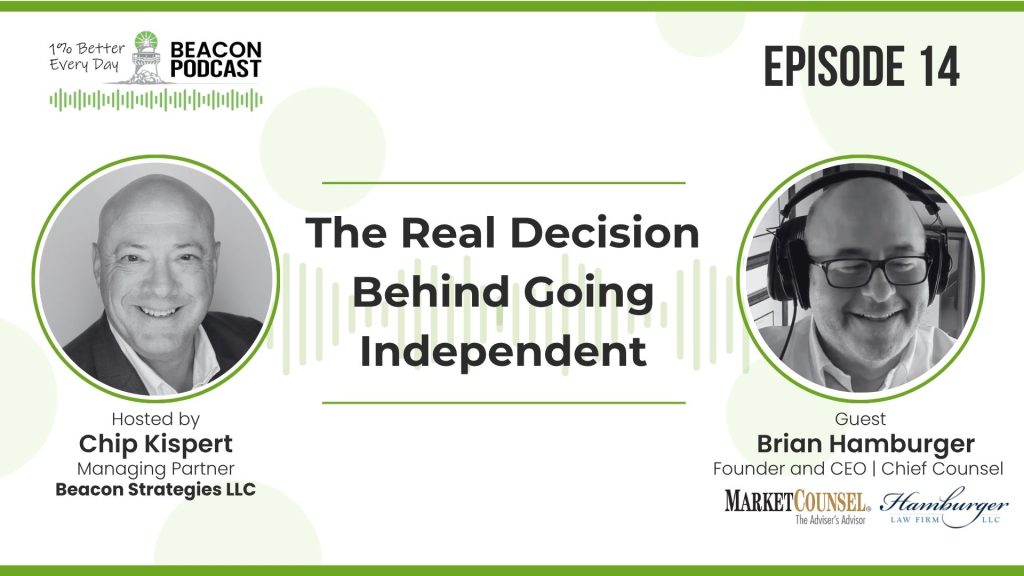
In this episode of Beacon 1% Better Every Day, Chip Kispert sits down with Brian Hamburger, founder and CEO of MarketCounsel and Chief Counsel of the Hamburger Law Firm, who discusses the complexities financial advisors face when considering transitioning from a wirehouse to an independent firm. Brian and Chip unpack one of the most defining moments in an advisor’s career, the shift from building within a firm to questioning what you truly own. What unfolds is not a playbook, but a deeper look at the mindset, patterns, and decision-making frameworks that shape successful transitions.
You’ll hear how advisors move from curiosity to action, why independence is not for everyone, and how clarity, not speed, often determines long-term success. This conversation challenges assumptions and brings a grounded perspective to what it really means and takes to build something of your own.
What to expect:
- Why most advisors don’t experience a single “aha” moment, but a slow build of discomfort
- The critical shift from “should I” to “how would I” and why it changes everything
- Common mistakes advisors make when considering independence
- How clarity and disciplined execution separate good from exceptional
Connect with Brian Hamburger:
About Our Guest:
Brian Hamburger is the founder and CEO of MarketCounsel and Chief Counsel of the Hamburger Law Firm, a leading business and regulatory consulting firm serving independent financial advisors. With more than 25 years of experience, Brian has been at the forefront of helping advisors navigate complex transitions, including breaking away from traditional wirehouses to build independent firms.
Through his work with MarketCounsel and the Hamburger Law Firm, he has guided some of the industry’s most significant and successful advisor transitions, providing strategic insight on business structure, regulatory considerations, and long-term enterprise value.
Brian is widely recognized for his deep understanding of the evolving wealth management landscape and his ability to help advisors make thoughtful, well-informed decisions about ownership, independence, and growth.
[00:00:00] RJ Malyk: Welcome to Beacon 1% Better every day with Chip Kipert, founder of Beacon Strategies. This podcast is all about challenging the norms of wealth management and empowering professionals to make continuous progress and always be curious. Chip knows firsthand how small consistent improvements can lead to big breakthroughs, and that’s what we’re focused on here, helping you get 1% better every day.
We’ll dive into conversations with industry professionals, share actionable strategies, and explore the mindset needed to overcome industry challenges and create lasting change. Let’s be curious. Push beyond what’s always been done and uncover better ways together.
Welcome to the Beacon, 1% Better Everyday podcast.
I’m RJ Malyk, your producer. Today, Chip Kipert sits down with Brian Hamburger, founder, [00:01:00] president, and CEO of Market Council. For more than 25 years, Brian has helped financial advisors navigate one of the most consequential decisions in their careers, leaving a wirehouse and building. An independent firm through Market Council and the Hamburger law firm, he has advised many of the industry’s most significant and successful breakaway transitions and independent advisory firms.
Right now, here’s our host, Chip Kispert. Hey, Chip.
[00:01:28] Chip Kispert: Thank you RJ. Appreciate that lead in. Brian, I am thrilled to have you on the show, my friend. How you doing,
[00:01:36] Brian Hamburger: brother? Man? I am. I’m doing about as good as can be, uh, for a Friday afternoon sitting down. Uh, having a one-on-one with you, what could be better?
[00:01:43] Chip Kispert: I love it.
I love it. Um, hey, we’ve known each other for a lot of years and, uh, I’ve always admired what your firm does and how your firm really helps people and helps, uh, advisors. I think it’s just, uh, a shout out to you. [00:02:00]
[00:02:00] Brian Hamburger: Thank you so much.
[00:02:01] Chip Kispert: So one of the things that, uh, as I was preparing, uh, for our show, I went in and, and read a bunch, did a bunch of research, but really came out with a basic idea.
And the idea was this and it, and it’s almost like an apex moment for advisors. That moment when many. Captured. Advisors eventually face the idea that they really don’t own their client relationships. You’ve been, you’ve been helping advisors for navigate that moment since I met you. So when they have that moment, what comes next?
[00:02:45] Brian Hamburger: You know, I’m gonna say something that’s a little surprising, I think, which is, it usually doesn’t start. At a specific moment. And it doesn’t start with a plan. It, it starts with, uh, with a, a growing [00:03:00] discomfort, something feels off, you know, it’s a client conversation. It’s the way a client refers to them.
It’s a, it’s a comp, it’s a comp change. Um, it’s a restriction that their firm imposes that suddenly matters more than it used to. Um. Or, or it’s the opportunity. Sometimes it’s the aspirational client, the one that they’re working with that seems to have it all right. Well beyond the highly compensated executive or the Trust fund client, it’s, it’s the client that’s wealthy and enjoying life.
They’ve got free time, they’ve got focus on their family. They just seem to have it all. And then you get that realization that I’m building something, but I don’t actually own it. Maybe I’m building something and it doesn’t look at all like what I would build if I was constructing it for myself. And what happens at that moment is, um, rarely decisive.
[00:04:00] Unfortunately, it’s, it’s kind of anti-climactic, but it’s typically a, a quiet period, uh, a period of observation. It’s advisors, uh, at they’re testing assumptions. They’re asking questions, uh, indirectly from some of their entrepreneurial clients, from other advisors that have done it before, and they’re trying to validate what’s real and what isn’t.
And the ones who move well, don’t react immediately. They start to get really curious before they get committed. So there’s a lot of lead up chip to that moment. That, uh, that moment of clar, uh, clairvoyance, right? That you, uh, that you reference, uh, that happens sometimes years and years before,
[00:04:45] Chip Kispert: you know?
That’s fascinating. So what you’re saying is it really builds over a, a, a, a segment of time that, as you say could be years. Um, I, I find, you know, those people that, that really make that, and, Hey, [00:05:00] you and I are entrepreneurs. We started that way, right? But. It does build. Now that I think about it. I, I love your comments.
Now if we look at, all right, it’s building, right? So you’ve seen this play out. Is there a pattern that you see kind of beyond that curiosity point that kicks in?
[00:05:24] Brian Hamburger: Yeah, the, the pattern is surprisingly consistent. Um, it’s that, um. We get to that inflection point right after that slow burn, something external forces them to reevaluate what they’ve been tolerating for a long time.
Uh, they read an article that maybe they listen to a podcast, um, they see, uh, they see someone speak about, uh, about a topic within or outside of, of the industry. Um, and, and then you get into that kind of quiet dissatisfaction, right? There’s there’s not enough. There’s not enough in that [00:06:00] inflection point to act, but there’s enough to start paying attention.
Um, and they start to pay attention. They start to compare peers, they start to compare platforms, uh, independence models, business models, and the critical moment is when they shift from should I to, how would I. That’s when the risk level really amplifies. So literally as I say that to you, I get, uh, I get chills because that’s when, that’s when we go on alert.
They move from thinking to acting often without any real structure. And the biggest mistake, I know you’re gonna ask me next, the biggest mistake that they make at that moment when they’re ready to act is they start solving for the next step before acquiring the full picture.
[00:06:50] Chip Kispert: That makes sense. Um, we’ve worked with a number of firms that have been in the breakaway capacity and they’re like, oh, oh, oh.
You know, they’re, they’re scattered, right? [00:07:00] And, and they’re like, oh, I need a tech platform. Oh, I need, and it’s, it’s, it’s amazing to watch. Um, so if what I’m hearing is you put that plan in place,
[00:07:12] Brian Hamburger: I mean, that’s what they call upon us for, right? So, um, when. When they come to us, uh, they are usually already in motion, even if they don’t realize it.
[00:07:24] Chip Kispert: Yep.
[00:07:24] Brian Hamburger: Uh, and so the, the real thing that we need to solve for is much less about the logistics. That’s what they’re focused on. That’s as close to tangible as it gets, and it’s more, uh, about the decision making, uh, structure. So the first thing that we do is slow them down, which of course, that’s what you think lawyers always do, but we slow them down.
We give them the comfort that they can sit in the client seat for once, right? They’ve spent their entire year, often decades, uh, acting as the advisor, rarely thinking about what it must feel like to sit in the, in the [00:08:00] client seat. And so we’re not starting with where are you going? We’re starting with what’s on your mind.
Uh, what’s your, what’s your vision? What are you, what are you trying to build? Because if they don’t know what they’re working towards. Every option looks viable and every decision looks reversible, and neither of those are true. And so the decisions they’re facing are, what kind of business do I wanna own?
Who do I want to be dependent upon if anyone, and what am I willing to take responsibility for that I’ve never had to before? And then the mistakes they’re about to make are also very predictable. They move too fast. They rely on anecdotes instead of structure. Uh, they ask people with incentives. Often in the sales role or business development role, what they should do, and our role is not to push them to any specific outcome or even independence.
It’s to make sure that if they move, they have a handle on the consequences and the opportunities around every decision that they’re making before they actually make that decision.
[00:08:58] Chip Kispert: You give them structure,
[00:08:59] Brian Hamburger: [00:09:00] we give them the structure, we encourage them, uh, you know, towards, uh, you know, listening to where their logic would lead them.
But if they wanna make a bad business decision, um, you know, they wouldn’t be the first. Right? I mean, you know, you and I have made plenty along the way and, and you know, and I like to think that those bad decisions helped, uh, you know, help bring us to where we are today. I don’t regret any of them. Uh, as long as they can learn from them and they understand that, you know, failure is part of the process.
[00:09:30] Chip Kispert: It’s fascinating because we see kind of the growth of, um, independent RIAs just skyrocketing right now, right? And that that kind of shiny fly or shine on the top of the hill is like, oh, I wanna do that, I wanna do that. But as we, you know, a lot of the buzz, when is it not right for an advisor to move?
What, like sometimes. Maybe they should stay where they are. [00:10:00] How do you, how, what does that look like?
[00:10:03] Brian Hamburger: I think you’re spot on, right? It’s a conversation that, uh, too many, uh, don’t want to entertain. And that goes back to, uh, the point that I raised earlier where, you know, if you’re asking people with incentives, uh, with what to do.
The decision is always buy, right? It’s, uh, you know, it’s always buy what I’m selling. And so very few advisors, uh, are going to tell them that independence is a responsibility. It’s not a reward. Um, there’s plenty of advisors. In fact, I would say the lion’s share of advisors shouldn’t even be, uh, considering a move to independence.
They’re really exceptional practitioners and they have no interest in running a business. So don’t sit in that seat. It’s okay, right? It’s not, it’s not a shameful exercise if you continue to, uh, maintain employment. Um, [00:11:00] and the other ones, I’ll tell you, the, the other ones that shouldn’t go are the ones that are reacting to a moment instead of moving towards something.
Um, because, and I know you know this well, chip, if your primary motivation is frustration, you’re probably not ready because the, that doesn’t give you enough fuel in the tank. To get you through the rigors of entrepreneurship. But if your motivation is ownership control, autonomy, long-term design, innovation, then it’s time to talk because it’s really hard to replicate that within an existing entity and feel that you’ve, uh, really built out something aligned with your vision.
[00:11:40] Chip Kispert: Yeah, it’s fascinating because. I have the ability, ’cause where we sit to see both sides of that, right? So one of our fabulous clients that’s at a good size, RIA man, he want, he’s, he’s pulling the levers all the time. Never, never status quo, right? He’s like, oh, [00:12:00] we gotta adjust our stack. We gotta, we gotta adjust our pricing.
We gotta do this. But he’s in every part of the business, right? And he’s in, he’s intellectually curious about that part. Right. And then on the other side, you know, interestingly enough, my sister-in-law is an advisor with fel and she, she’s like, this is great. They provide my technology, they provide my infrastructure.
This is awesome. I don’t need to go anywhere else. And so it is fascinating to watch.
[00:12:32] Brian Hamburger: I actually love it. Right? And uh, and I’ve started to notice this over the last many years. That I always assume that people were as curious as I was. Right? I mean, I’ll go down rabbit holes all day long, um, which I’m not very proud of.
Um, but, but it’s part of what makes me who I am. And it’s, and it’s part of what makes an entrepreneur want to continue to go deeper, further, broader, right? You’re always curious as to what else is out there, right? How do we improve [00:13:00] this process? How do we expand into a new area? How do we, uh, how do we create, uh, efficiencies and.
Most people aren’t built that way. And, and that’s okay by the way, right? You don’t have to be curious about everything. Uh, you know, how does this work? And, you know, if your sister’s sitting at Stifel, she’s probably not wondering whether there’s other portfolio accounting tools that you know, that have additional features.
She’s more satisfied with the fact that it’s being delivered to her. All she reads about cybersecurity is being handled for her. Uh, her clients are getting the reports on time and she’s not lifting a finger.
[00:13:36] Chip Kispert: Yeah, every once in a while she lifts a finger
[00:13:40] Brian Hamburger: to deliver the
[00:13:40] Chip Kispert: reports. It depends which one it’s,
[00:13:42] Brian Hamburger: yeah.
[00:13:43] Chip Kispert: Um, all right. I’m gonna switch gears a little bit here. Uh, and one of the things we’re always super curious about is who are two or three people or firms out in the industry? That [00:14:00] you admire. And that can be wealth, that can be t that what I’m just, and why, why are they worth watching? I’m curious.
[00:14:07] Brian Hamburger: You know, it, it would be way easier if you would ask me, uh, to call out some that are making bad decisions.
’cause I feel like, I feel like I can’t unsee them once I, you know, once I see them and I see ’em every day, you know, the truth is, I, I tend to look. Less at individuals and and firms and more at, uh, characteristics. Uh, the firms that I see standing out now are the ones that seem to have a clarity of purpose.
Um, I mean, I’d like to say that they’re all our clients, but they’re not. Right? I mean, they, but they have a clarity purpose. Um, they’re working to build, uh, real sustaining enterprise value, not just revenue. And they’re making decisions about governance, uh, and ownership early. Um, and aligned with their vision of enterprise value and not prioritizing [00:15:00] the revenue.
Uh, truth is, I know you said call out two or three there. There’s actually a surprisingly small number of firms that are doing these things exceptionally well, and you can usually tell who they are because their growth looks very controlled, not reactive. You see them consistently in the headlines, uh, and not with hollow, uh, you know, PR type, uh, press releases, but instead about meaningful innovations and advances, uh, within, within their business.
But. Um, as much as I’d like to take a swing at that pitch and like give you two or three names, I’m gonna, I’m gonna hold off on that one.
[00:15:37] Chip Kispert: I, I, I had this sneaky suspicion we wouldn’t be hearing names.
[00:15:42] Brian Hamburger: You know me Well,
[00:15:43] Chip Kispert: uh, I do. All right. So we’re in wrap up here. Um, when we close. Each of our episodes, um, we like to close with our beacon, 1% better everyday flash.
That’s where you have 60 to 90 seconds. No [00:16:00] scripts, no guardrails. Um, you know, what’s the one or two things that financial advisors could start doing tomorrow and what makes them 1% better?
[00:16:09] Brian Hamburger: I’ll tell you, you know, people often ask the question about like, what’s the one thing that I should do as an entrepreneur?
And here, and the truth of it is, the best answer I’ve been able to come up with is you have to figure out a, a system, a process to do everything well simultaneously, right? Entrepreneurship to me is the art of spinning plates. It’s knowing when you need to tend. To the next initiative. Um, and so here’s what I would, um, what I’d love to leave advisors with, right?
They should take inventory of the immense value that they’ve built throughout their careers. You cannot do something for 20, 30, 40 years and then just suddenly come to this inflection point and make rash decisions, right? There’s tremendous value that’s been built up over their years, and they should spend more time than they, than feels comfortable thinking, than reacting.
I think the questions they wanna sit back, uh, and ask themselves are, what am I [00:17:00] actually building? Who am I building it for? And do my decisions today align with that? I get that most advisors are incredibly busy, but they’re not always incredibly deliberate, and so they should allow themselves the luxury of objective advice.
Many who have come to us haven’t solicited opinions from anyone who’s not trying to sell them something. The only lawyers they’ve ever worked with have been done in with a divorce or a house closing or, or something of that effect. They, they’ve never gone to someone and really sought objective advice that they have to pay for.
And they should know that there’s not this huge gap between what they read about, what they see and what they can do, because the difference between good and exceptional. It’s not desire or effort, it’s clarity focused by this consistent, disciplined execution. And I would argue all within my 90 seconds that if you can improve that even by 1% consistently, everything else compounds from there.[00:18:00]
[00:18:00] Chip Kispert: Love it. I need to follow that too.
[00:18:03] Brian Hamburger: You and me both. Brother
[00:18:05] Chip Kispert: Brian, thank you for being on the show. Uh, my friend, it is always a pleasure to talk to you. I always learn something new. Um, so for those that wanna learn a little more about market Council or connect with you, where should they go?
[00:18:20] Brian Hamburger: Most advisors end up finding, uh, us through trusted partners like Beacon.
Um, they, they say, Hey, who should I talk to about this? And they, you know, they, they, they come to us, but otherwise they, you know, they go to our website, they, you know, they shoot an email over to us, um, whether it’s me individually or, or to, uh, our business development team as sales at market council com.
And, um, and we get the ball rolling.
[00:18:43] Chip Kispert: Excellent. Well. We, uh, again, thank you for being on the show and uh, at some point we need to have a conversation about succession ’cause uh, we didn’t have enough time today, but I would love to reschedule you and go through succession.
[00:18:58] Brian Hamburger: You know, you always have my number [00:19:00] and, uh, I can’t wait till what’s next.
[00:19:01] Chip Kispert: Thank you, sir. Have a good one.
[00:19:03] Brian Hamburger: You as well,
[00:19:05] Chip Kispert: rj. Terrific conversation today with Brian.
[00:19:08] RJ Malyk: Yeah, Brian had a lot to say and it was very interesting and the one thing that really stood out to me was when he was talking about entrepreneurship and he said, if the reason you wanna jump into uh, entrepreneurship is because you are frustrated with your situation, or you are, you know, just not happy with it.
That’s not a good reason. And that really stood out to me. And then he labeled, he, you know, just listed off all the things that you really have to do and get into it. So that was, that’s the one point that really stood out to me.
[00:19:39] Chip Kispert: There are a couple things that stood out to me. Um, the first one he tucked in a phrase that I pulled away, and that was, independence is a responsibility and not to disparage.
But when, when you, when somebody decides to be an entrepreneur, entrepreneur [00:20:00] and go and start a business, there are a lot of different things that they have to be looking at. Monitoring and the like. And some people love that spirit and some folks are, they’re in the right place at, they’re in the right place for them.
Um, so number two, the shift from should I go independent to how do I go? Independent is an inflection point that takes time. And that was fascinating when he came back to me because I always loved the aha moment. But really he said it just his comment, how it just builds. And then finally, um, the difference between good and exceptional isn’t desire, effort, it’s clarity, executing with a consistent discipline and even a 1% improvement in that compounds over time.
I appreciate Brian being on the show. He’s always a terrific guest. Before I leave. To quote Ted Lasso, be curious, not [00:21:00] judgmental. This is Chip Kiper. Wishing you well. Until our next episode of The Beacon, 1% Better Everyday podcast.
[00:21:08] RJ Malyk: And Chip, we need to add in a shout out as this podcast is brought to you by Beacon Strategies, LLC, the go-to resource for roundtables consulting and services that support wealth management firms and their providers.
If you need some industry perspective or help, please visit beacon strategies llc.com. And again, thank you, uh, for listening to the Beacon 1% Better podcast. We ask you to share this podcast rated and leave a review because this. Actually helps others find the podcast. And again, thank you for listening and for Chip Kiper and everyone at Beacon Strategies, I’m RJ Malick and we look forward to you joining us for the next podcast.
Thanks for joining us on Beacon’s 1% Better everyday
podcast. Be sure to hit that follow button so you never miss an episode. And stay up to date with Chip and his friend’s. Latest insights [00:22:00] and strategies. If you want to learn more about Beacon Strategies or get in touch, visit us@beaconstrategiesllc.com.
Remember, progress starts with just 1% every day. Let’s keep challenging ourselves to be curious and grow. The information covered and posted represents the views and opinions of the guest and does not necessarily represent the views or opinions of Beacon strategies. The content has been made available for informational and educational purposes only.
The content is not intended to be a substitute for professional investing advice.