
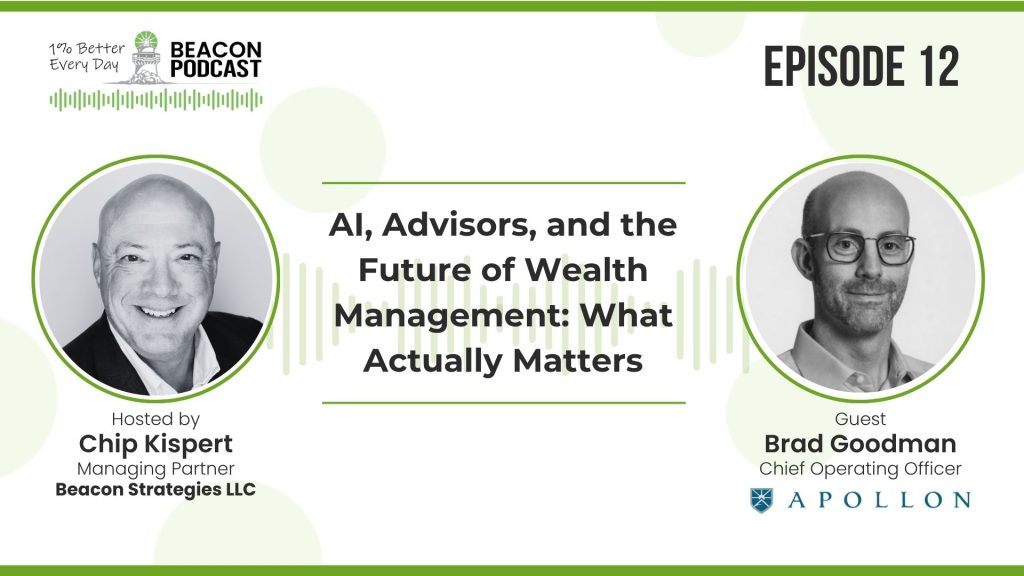
What does AI actually look like inside a modern wealth management firm, and where is it creating real impact today?
In this conversation, Chip Kispert sits down with Brad Goodman, COO of Apollon Wealth Management, to unpack how fast-growing firms are using AI to streamline operations, improve advisor efficiency, and scale without losing what matters most: the client relationship. Brad shares a behind-the-scenes look at how thoughtful infrastructure, not just new tools, is shaping the future of advisory firms. If you’re thinking about growth, technology, or how to give time back to your advisors, this episode offers a clear, practical lens into what’s working right now.
What to expect:
- How AI is reducing meeting prep time and increasing advisor capacity
- Why owning your data and workflows matters more than chasing new tools
- The shift from fragmented tech stacks to integrated ecosystems
- How culture and technology must evolve together to support growth
Resources:
About Our Guest:
Brad Goodman is the Chief Operating Officer at Apollon Wealth Management, one of the fastest-growing RIA firms in the country. With a background that spans leadership roles at William Blair and early-stage growth at Hightower Advisors, Brad brings deep experience in building infrastructure, scaling operations, and supporting advisor growth. He is particularly focused on how firms can use AI and technology to streamline workflows, improve client experience, and give advisors more time to focus on what matters most: meaningful client relationships.
Apollon Wealth Management, LLC (“Apollon”) provides advice and make recommendations based on the specific needs and circumstances of each client. The information contained herein is intended for information purposes only and should not be considered investment advice. Please contact your financial advisor with questions about your specific needs and circumstances. Please visit our website http://apollonwealthmanagement.com for other important disclosures.
[00:00:00] RJ Malyk: Welcome to Beacon 1% Better every day with Chip Kiper, founder of Beacon Strategies. This podcast is all about challenging the norms of wealth management and empowering professionals to make continuous progress and always be curious. Chip knows firsthand how small consistent improvements can lead to big breakthroughs, and that’s what we’re focused on here, helping you get 1% better every day.
We’ll dive into conversations with industry professionals, share actionable strategies. And explore the mindset needed to overcome industry challenges and create lasting change. Let’s be curious. Push beyond what’s always been done and uncover better ways together.
[00:00:51] Chip Kispert: Welcome to the 1% Better Everyday
[00:00:53] RJ Malyk: podcast.
Today Chip sits down with Brad Goodman, COO of a Pollen wealth Management, one of the fastest [00:01:00] growing RIA firms in the country. Brad is here to talk about something he’s personally passionate about how AI is actually being used inside wealth management practices. Chip, take it away from me,
[00:01:12] Chip Kispert: rj. Thank you very much, Brad.
Great to have you on the show.
[00:01:18] Brad Goodman: Glad to be here. Thank you.
[00:01:19] Chip Kispert: You came to me with, uh, the AI subject as wanting to kind of talk through. I’m, I’m really looking forward to that. Um, but before we kind of start here, a little bit, a little bit of background on yourself.
[00:01:34] Brad Goodman: Been with the pollen since January of last year.
Uh, prior to that, spent, uh, almost 10 years with William Blair outta Chicago, overseeing new platform services capabilities. And prior to that was employee 14 at Hightower Advisors in Chicago. Uh, helping build out everything from operations to capital markets and, uh, the initial infrastructure of, of the phone.
[00:01:56] Chip Kispert: That’s quite a bit, that’s a lot of experience. [00:02:00]
[00:02:00] Brad Goodman: It’s been a fun run,
[00:02:01] Chip Kispert: you know, you’re chief operating officer, uh, of Apple on, and, you know, what are the things that you’re looking at as you continue to scale, um, especially in light of, I saw. Some acquisitions done recently. Um, I’d love to hear your thoughts on that.
[00:02:22] Brad Goodman: My personal thoughts on it fold around two different topics. Most important for me is how do I get more time back in our advisor’s hands, how do we allow them to focus on their clients? How do we allow them to go out and find new clients? Um, that to me is, is priority number one. Uh, there’s also.
Significant opportunity using the same tools and, and other resources to help streamline operations behind the scenes, which ultimately then makes it easier, faster for advisors to do what they need to do for, for their clients. [00:03:00]
[00:03:00] Chip Kispert: So. You’re packing a pretty big punch there in terms of, you know, those are the things that you wanna do to support those clients.
How have you really looked at kind of the experience of transitioning both process and technology, um, over the last couple years to be able to handle that scale that you’re going through currently?
[00:03:25] Brad Goodman: Yeah. Um. It’s a really good question because I think there’s two factors that that come into play. One is change management is hard.
Advisors like to do things the way that they like to do things. Um, and that’s our opportunity to really show them why the tool works, how a tool works, why it’s gonna make their lives easier, how it’s gonna ultimately impact and support their, their end clients. Um. That that is a, that is a not, [00:04:00] not an easy conversation to have, but, um, some advisors pick up on that really quickly and some tangibly need to, need to see it.
The other aspect of it is there’s, there’s always a new shiny toy. Um, and so I like to, I like to use the cell phone analogy. Uh, I have an Apple phone. Others carry Android phones. And so, um. I think it’s really important from a leadership team standpoint down to set a, set a strategy of where you want to go in the next 12, 18, 24 months.
It’s important to understand and see what’s getting released and launched and what roadmaps are out there, but it’s also important to stick to the plan, execute, show value, show ROI, um, and then iterate from from there forward.
[00:04:52] Chip Kispert: Now I’m amazed at your growth over the last couple years. Um, you know, and it’s interesting too, as I talk to people in the [00:05:00] industry, there are a couple firms out there that they reference and you, you all are, are one of them.
So kudos to the work you guys are doing. Um, you know, one of the things we see with, with that growth right, is, is a lot of firms are, are capable of being able to grow to a certain point. Right. And then there’s that tipping point.
[00:05:25] Brad Goodman: There can be a couple of those at different sizes.
[00:05:28] Chip Kispert: Tell me more.
[00:05:30] Brad Goodman: I think there’s natural, I’ll call ’em plateaus or benchmarks.
It can be at a $5 billion mark, a $10 billion mark, a 25, a 50. Um, and they, I think from my, from my previous experience. The challenges and the, uh, opportunities that you have to solve around those challenges are, are different between the firms. And so the, the way that we think about it at a pollen is, um, we want to set the appropriate [00:06:00] guardrails and, and provide the right infrastructure and feedback and resources to our advisors, but also give them the flexibility and the, the opportunity to.
To run their businesses the way that, that they’ve been successful before joining us. Um, that was a different take in a partnership model at William Blair, and that was a different take in an early, uh, growth iteration at, at Hightower. And Hightower went through a number of different, uh, model changes in the early days.
And so we had to pivot our support and infrastructure needs based on those changes as well.
[00:06:37] Chip Kispert: Mm-hmm. Let’s talk a little tech. You’ve gone down a very interesting path, uh, you know, kind of a fast forward path. I believe you’re truly embracing ai. Where do you see AI really delivering, um, apple on’s value, right, and [00:07:00] value both to the home office?
To the field. I, I know you talked earlier about being able to give the advisors more time to work with prospects and clients, but I’m, I’m super interested to hear kind of your approach or your thinking on where you are taking it and where you see the industry taking it.
[00:07:20] Brad Goodman: I, I’ll stick to my viewpoints.
Um, I, I have some guesses of where the industry may go, but, um. Let’s start with the advisor side. I think there is a number of wonderful tools out there that support the, let’s call it advisor note taking, whether that’s digital in person. I think the real value add and, and the arms race that’s happening within the note taking world is really around what do you do with that information afterwards?
How do you get it into your, your note taking into your CRM system? How do you. Digest that information and get it into financial planning tools, um, and, and [00:08:00] really streamlining. The day to day of, of an advisor. I think if I had to guess where the industry is going next, it’s gonna be how do you make, how do you prepare for a meeting?
Now that you have that information, how do you, uh, pull information from your reporting system? Pull information from your financial planning tools. Produce the reports that you wanna produce. Take that five, you know, two to five hour prep time. An advisor may go through and cut it down to 30 minutes. That allows an advisor to go spend more time prospecting.
That allows an advisor to have more meetings. That it, it really opens the door, um, for the productive advisors to go out and, and facilitate the work that they wanna do from a home office perspective, there’s a lot of support and operational workflows that I think are. Um, starting to get evaluated and, um, tools are coming in place to, to really support that.
More so now than in the [00:09:00] last 10 years, um, we’re hyper-focused on what we’re doing around account onboarding. We’re a multi custodial firm, so normalizing that process, not only on the data collection side. How do we, how do we collect that information from advisors, our CRM system and, and clients when we don’t know that information?
And that can be across, um, the custodial account applications, our suitability information, financial planning details, um, risk and insurance capabilities, being able to collect that in a seamless way and then, and, and then send it downstream to the areas that it ultimately needs to be. Um. Step one. And then step two is how do you put the right analytics and, um, models of on top of that with the right safeguards and, and regulation to bring thoughtful intelligence to an advisor so they can, uh, again, have better conversations with their clients, [00:10:00] um, and not spend as much time digging for that information.
[00:10:04] Chip Kispert: That’s a lot of moving parts, a lot of moving parts. Um. Are you building it? Are you partnering? What’s, what’s kinda your strategy there?
[00:10:16] Brad Goodman: Yeah, so we, we have a strategic roadmap of how to execute on that plan. Um, I was very fortunate during the early days of Hightower, the, the best way to eat an elephant is one bite at a time.
Um, and so my focus is on, on the bigger operational, um. Workflows and processes as well as building the right container to store all of that information so I can plug in the tools that are evolving and changing in the new shiny tools. We’re lucky that there are great partners out there from a note taking perspective that have those integrations already in place.
Um, so from an advisor perspective, those tools [00:11:00] are in their hands and we continue to iterate and partner with, uh, folks on. Analytics where we store our data and, and the internal workflows that we’re, that we’re building.
[00:11:11] Chip Kispert: Yeah, it’s fascinating to me, um, how, you know, for years everybody’s calling for how we wanna automate, we wanna streamline account opening as well as transitions when bringing new advisors in.
Um, and really in the last 18 months it’s taken off and there’s some very interesting firms out there that’re doing some really good work in this area.
[00:11:35] Brad Goodman: I would agree, I think, I think that comes down to two different, there’s two different reasons why I think that door has opened up as much as it has in the last 18 months.
One, I think the technology is getting better, and so with large language models, with the right workflow tools, that that is easier to do. I think the custodians have also come to a realization that they need to open [00:12:00] up the connection points to actually allow that. I won’t pick on any one custodian. Um, but they have all spent decades trying to solve the account opening process, um, but never built the right infrastructure to also allow firms to have their own internal workflows and end-to-end capabilities that are ultimately needed in a fast growing organization.
They’ve all come to the table and they’re all making great strides now to really allow that to, to happen.
[00:12:35] Chip Kispert: That’s good to hear because for years I’ve, I’ve just watched the process and it’s been, you know, kind of like gears grinding on one another that have very little grease about that. Um, so that’s good to hear that from you.
That’s, uh, that’s exciting. I know that, you know, when we’re talking to a lot of these, you know, a lot of our customers are. Independent broker dealers or large RIAs [00:13:00] and they’re just desperate for new tech. And you know, that said, you gotta look at the providers and say, Hey, where do you got hooks? Right? So where’s, where are your integrations?
And some of ’em have ’em with the traditional ones and some of ’em are, have maybe one or two. And how do you play that out? Um, so. This is what I’m really, really curious about. Over the next 18 months or so, what one AI use case do you see really kind of expanding and that you are really focused on?
[00:13:42] Brad Goodman: I think for me it is.
Intelligent workflows, right? So account opening is a component of that. We talked about meeting prep. I think how I, how I need to deploy that at a pollen is different than how I, uh, needed to deploy that [00:14:00] at William Blair. And I think the AI component of that is going to allow more and more firms to be successful in implementing tools of, of that nature, where in the past.
Yes, tools got implemented and maybe they didn’t solve a hundred percent of the needs. I do think you’re gonna start seeing the firms that are leaning into technology and, and the providers that are succeeding. Those firms are gonna be able to scale and grow in a way that, um, may have been a little stickier in the past.
[00:14:36] Chip Kispert: Interesting. Um, that is fascinating to me because as I really, the industry is moving so fast right now. Um, you know, you’d see all these different moving parts right now. You know, you look at the note takers, you referenced the note takers earlier. They’re now slipping into the account opening world. Um, it’s getting pretty [00:15:00] interesting to watch.
Um, how this, this AI is bringing things forward. Um, and you, you talked about being able to have the data vessel. I think that’s the most interesting thing that we’re seeing improvements in right now with some great firms out there.
[00:15:16] Brad Goodman: Yeah. My, my personal belief is I need to be able to own the repository of where all that data is, and I wanna plug in the best in breed, um, partners.
To access that because it is evolving and, um, it, it’s a very fast, uh, moving landscape. You know, as you were talking, I’m, I’m thinking about when you fly somewhere, you know, you know the, where you’re starting from and you know your end destination, and sometimes you’ll look out the window, but you ultimately have that plan of where you’re going.
I, I kind of feel like we’re in that same spot right now. Firms that have really good strategic visions on, on their technology platforms and roadmaps. Know where they’re going, but they’re [00:16:00] looking out the window and, and enjoying the view sometimes.
[00:16:04] Chip Kispert: That’s an interesting analogy. Interesting analogy. And you just actually hit one of my, uh, questions.
Um, one other question I have before we move to different subject is, you know, when you look at kind of the different AI technologies, you, you look at, you know, the enabled versus the native. How are you thinking about that? You know, when, when you see that enabled or versus the native where kind of they’re growing from or they’re building from the bottom up?
I’m just curious what your thoughts are.
[00:16:38] Brad Goodman: I’m gonna answer that in two different ways. I think we have seen a significant shift in the tech landscape in the last 24, 24 months. I think prior to that, there was a. A belief in best in breed technology. Go find as many providers as you want. [00:17:00] It’s all gonna work.
We’ll integrate it for you. And then you end up with this spider web diagram that is almost impossible to maintain. And I had an I I, I had a conversation with an advisor that said, I thought it’s supposed to be integrated. And it is, but it’s not integrated. Seamlessly end to end. And so I think where I believe the industry is going is we’re gonna see more full ecosystem, um, environments.
And you may lose a bell or a whistle, but it’s much more deeply integrated. And I think ultimately that is, um, a better end result for, for advisors and, and their clients.
[00:17:46] Chip Kispert: It’s interesting, as we’ve talked with, uh, lots of advisors out there, what, what the feedback we’re getting is less, is more. Um, we want a, we wanna get outta the tech business, which, you know, they’ve seen their productivity go [00:18:00] down to 25%, you know, area they wanna see that go up and they just don’t want to be, they don’t wanna own the tech stack anymore.
They want somebody else to do it for.
[00:18:12] Brad Goodman: There’s one thing about the technology actually working, and it has to work to stay in the tech stack. It’s a whole nother job to manage the contracts, the relationships, the integrations, the entitlements as firms continue to grow. And we we’re fortunate at our firm that we have a wonderful team that can facilitate that.
Um, but for someone that doesn’t have the experience of the background, that becomes unwilling and, and hard to do.
[00:18:40] Chip Kispert: It absolutely does, and I’ve, I’ve watched it. There’s a, one of our customers about four and a half billion, and I’ve watched them go through the mental mindset of I want to build it to who’s gonna provide it for me.
So it is a, uh, interesting world, 180 degrees flip here. Um, who are two [00:19:00] or three people or firms in the industry that you’re paying attention to and, and why?
[00:19:08] Brad Goodman: That’s a good question. So I, I have, um, I have wonderful friends from my, from my past still at some of the, the predecessors. Um, and so, um, appropriately having conversations with them, um.
We’re also part of the, the merchant ecosystem. And so, um, they have done a wonderful job of keeping us connected with the other large growing organizations, um, that, that we’re partners and peers with. Um, and so I, I’m very fortunate to have some of those relationships as well.
[00:19:44] Chip Kispert: Got it. All right. As we work to the close right of our, of our time together.
We like to give you 60 seconds, um, for the 1% better everyday flash, which is [00:20:00] you have the floor, no scripts, no safety net share, something that, uh, you find is, is interesting within the wealth space or something that has been just kind of gnawing at you that, that you’re working to figure out.
[00:20:18] Brad Goodman: Unscripted off the cuff.
Um, I think it’s really important from a culture standpoint, this is something that, that we talk about as well. Um, I think the acquisition space in our, in our industry is pushing us more and more into what is the new wirehouse. You, you see the, the aggregators getting aggregated together, and I think it’s, it’s.
It’s important to have really good tech that works, but it’s also important to have really good culture and people, um, to differentiate yourself within the industry and, and build a wonderful firm.
[00:20:59] Chip Kispert: [00:21:00] That’s terrific. That’s terrific. Um, before we leave Brad, uh, for folks that wanna learn more about Aon or follow you, where do they go?
[00:21:11] Brad Goodman: Pollen wealth.com. You can find, find us there, uh, or, uh, Brad Goodman. I’m on LinkedIn as well. You can find me on there as well.
[00:21:19] Chip Kispert: Brad, thanks for being on the show.
[00:21:21] Brad Goodman: Thank you,
[00:21:22] Chip Kispert: rj. That was a terrific interview with Brad.
[00:21:25] RJ Malyk: Yeah, yeah. You, you, it was, it wasn’t an interview, it was just a conversation between two friends.
That’s what it was.
[00:21:32] Chip Kispert: That is true. Um, you know, it was interesting. I, I took three. Distinct items from that, that conversation. Um, one is infrastructure, infrastructure first, growth second, um, second, AI is moving the conversation to capabilities. And third, you know, when I look at it, um, weaving all the pieces of the puzzle together, um, with the use of [00:22:00] AI is becoming, um, more highly.
What’s the word I wanna use? Um, it’s becoming more efficient and there’s better management of data and there’s better management of workflows. And I think that, um, uh, Brad brought that point to, to, to, to me, without a doubt. Um, and I thought that was absolutely fascinating.
[00:22:27] RJ Malyk: And then it will allow people to focus more on the important stuff as far as the job is concerned and creativity or whatever, whatever your job entails.
It, it, it’s allowing you more time to focus on that.
[00:22:41] Chip Kispert: Well, as you said, you know, their, their goal is to give the advisor more time to work with clients and prospects, so.
[00:22:49] RJ Malyk: Excellent. All right. Thanks Chip.
[00:22:51] Chip Kispert: Long story short, that was a great conversation with Brad today. Um, obviously they’re growing f fast at Apple on, [00:23:00] um, and you know, that’s a good thing.
So before I leave, I always like to quote my favorite, uh, person, Ted Lasso. Be curious, not judgmental. This is Chip Kiper. Wishing you well until our next edition of The 1% Better Everyday Podcast.
[00:23:18] RJ Malyk: And Chip, before you go, how about your contact information?
[00:23:21] Chip Kispert: Chip Kiper at Link on LinkedIn, and let’s see, chipkispert@beaconstrategiesllc.com.
[00:23:30] RJ Malyk: Excellent. All right. And we need to add in a shout out as this podcast is brought to you by Beacon Strategies, LLC, the go-to resource for Round Tables Consulting and services that support wealth management firms and their providers. If you need some industry perspective or help, please visit. Beacon Strategies llc.com.
And again, thank you for listening to the Beacon 1% Better podcast. We ask you to share this podcast rated and leave a review because this actually helps others find the [00:24:00] podcast. Again, thank you for listening and for Chip Kiper and everyone at Beacon Strategies, I’m RJ Malyk and we look forward to you joining us for our next podcast.
[00:24:10] Chip Kispert: Thanks for joining us on
Beacon’s.
[00:24:12] RJ Malyk: 1% Better Everyday podcast. Be sure to hit that follow button so you never miss an episode. And stay up to date with Chip and his friend’s. Latest insights and strategies. If you want to learn more about Beacon Strategies or get in touch, visit us at beaconstrategiesllc.com.
Remember, progress starts with just 1% every day. Let’s keep challenging ourselves to be curious and grow the information covered and posted, represents the views and opinions of the guest, and does not necessarily represent the views or opinions of beacon strategies. The content has been made available for informational and educational purposes only.
The content is not intended to be a substitute for professional investing [00:25:00] advice.