
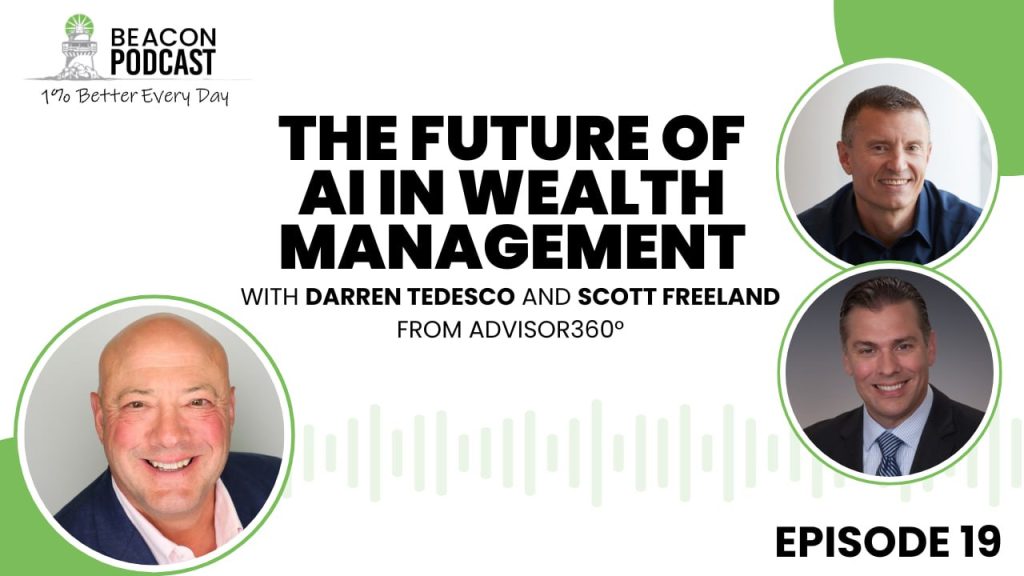
Technology is changing how financial professionals work, but not every AI solution is built on the same foundation.
What separates tools that create real efficiency from those that simply add another layer of complexity? And how can firms prepare for a future where AI handles more of the administrative workload?
In this episode, Chip Kispert speaks with Darren Tedesco, President of Advisor360°, and Scott Freeland, VP of Product Management for the Enterprise Suite at Advisor360°, about the future of AI, data strategy, and workflow automation in wealth management. They explore why unified data is becoming the foundation for agentic AI, how firms are approaching technology consolidation, and what operational challenges stand in the way of broader AI adoption. The conversation also examines workflow automation, advisor productivity, and the infrastructure needed to support long-term innovation.
Key takeaways:
- Why unified and trusted data is becoming the foundation for meaningful AI adoption in wealth firms
- How technology consolidation can reduce operational friction across advisors, clients, and home offices
- What separates note-taking AI tools from systems capable of executing workflows and actions
- Why agentic AI may shift advisors away from administration and toward client-facing activities
- How end-to-end workflow automation could reshape onboarding, reporting, and portfolio management
- And more!
Resources:
Connect with Darren Tedesco:
Connect with Scott Freeland:
About Our Guests:
Darren Tedesco is President of Advisor360°. Darren is responsible for strategic relationships at the executive level and leads business development activities for complex enterprise relationships. He represents Advisor360° externally as an industry leader, elevating the brand through conferences, councils, and thought leadership on the intersection between technology and wealth management. Internally, Darren provides market intelligence and competitive insights into the company and advises on account growth opportunities. Prior to Advisor360°, Darren spent most of his career at Commonwealth Financial Network, where he was the Managing Principal of Innovation & Strategy, overseeing all aspects of technology and designing the platform that would eventually become Advisor360°.
An accomplished senior leader with over 30 years of experience in driving value creation, growth, and profitability across global financial services and FinTech, Scott Freeland has a proven track record of launching and leading industry-leading wealth management businesses, financial products, digital solutions, and enterprise integration. A transformational leader with strong communication, organizational, and strategic skills, he has successfully led teams in high-stakes environments, delivering exceptional results in the areas of wealth management, banking, product and digital innovation, and investment research and analytics.
With a deep expertise in global financial markets, product and technology development, M&A, and strategic partnerships, Scott has played a pivotal role in the growth of organizations like London Stock Exchange Group (LSEG) / Refinitiv, Scivantage, and Bank of America / Merrill Lynch. His leadership has been instrumental in driving multi-year strategic plans, reshaping business models, and creating new digital experiences, positioning companies for long-term success in an increasingly competitive and tech-driven financial landscape.
In his most recent role as Global Head of Business Strategy for Investment & Wealth Solutions at LSEG, a global business providing investment research, market data, analytics, and digital solutions to wealth and asset management markets, Scott was responsible for leading strategy and the execution of strategic programs. Scott successfully executed a comprehensive multi-year strategy to transform the business through targeted market expansion, strategy-aligned product development, and strategic investments with corporate development, and restructured market strategy to regain competitive advantage and focused growth. With the successful transformation of the business, in 2023 Scott took on expanded responsibility serving as Global Head of Wealth Solutions.
[00:00:00] RJ Malyk: Welcome to Beacon 1% Better Every Day with Chip Kispert, founder of Beacon Strategies. This podcast is all about challenging the norms of wealth management and empowering professionals to make continuous progress and always be curious. Chip knows firsthand how small, consistent improvements can lead to big breakthroughs, and that’s what we’re focused on here: helping you get 1% better every day.
[00:00:30] RJ Malyk: We’ll dive into conversations with industry professionals, share actionable strategies, and explore the mindset needed to overcome industry challenges and create lasting change. Let’s be curious. Push beyond what’s always been done and uncover better ways together
[00:00:51] RJ Malyk:: Welcome to Beacon 1% Better Every Day
[00:00:53] RJ Malyk: I’m your producer, RJ Malyk. Today, Chip is sitting down with two of the architects behind one of the most consequential [00:01:00] platforms in enterprise wealth management. Darren Tedesco is the president of Advisor360°, and Scott Freeland is their VP of Product Management for the Enterprise Suite. Right now, here’s Chip.
[00:01:13] Chip Kispert: Darren, Scott, great to have you on the show.
[00:01:16] Scott Freeland: Great to see you again, Chip. Great to see you again, Chip.
[00:01:19] Chip Kispert: It was exciting to see you guys last week, or I, I saw Darren last week when you were here in, in Denver for Pershing. Um, it was good to catch up.
[00:01:29] Darren Tedesco: Yes, it was. It’s always good to see you and catch up in person.
[00:01:32] Darren Tedesco: Uh, nothing like that, so.
[00:01:34] Chip Kispert: Hey, w- so, uh, I’m really looking forward to our conversation today. I think, uh, w- there’s a good set of, uh, questions that, that I have for us to go through, but, uh, before we even get into kind of the Q&A and the, the conversation, how about you guys, uh, introduce yourselves, give a little backstory, and talk a little bit about [00:02:00] Advisor360° and its genesis?
[00:02:01] Darren Tedesco: Sure. So I’ll kick us off, Chip. Uh, again, thanks for having us on. Uh, I spent about 25 years at, uh, early part of my career working in a broker-dealer, eventually owned a broker-dealer, uh, one of the more successful ones that was out there, and then about seven years ago we took my technology department and spun it out as a standalone company today, um, which is called Advisor360°.
[00:02:22] Darren Tedesco: Uh, we serve broker-dealers of all types, roll-up RIAs, individual advisors. Uh, right now I think there’s about, uh, a little over 2% of the households in America sit on our platform, so it’s a pretty wide and robust platform with a lot of usage. Um, in terms of just our belief system at Advisor360°, we strongly believe that the advisor-client relationship is actually the product, uh, and that holistic technology should just amplify that relationship and product.
[00:02:51] Darren Tedesco: Uh, we also believe that AI should really be executing the work safely, compliantly, and measurably on an advisor’s behalf and believe [00:03:00] strongly in that future, um, and that ultimately that AI needs to be powered by clean, holistic, workflow-based data that I, I know we’re gonna talk about a lot in this podcast today, so.
[00:03:10] Chip Kispert: Got it. Scott, little background?
[00:03:14] Scott Freeland: Yeah. So first of all, thanks, Chip, for inviting me. Was looking forward to this. Um, yeah, so I head up product overall for our wealth management applications. So, I lead the strategy and development of all of our wealth solutions for our advisors today. So I’ve been, as of, as of today, as of this month, I’ve been at, uh, Advisor360° for a year now, so it’s been great, and it’s been great working with Darren as well too.
[00:03:34] Scott Freeland: Uh, prior to joining, I was the Global Head of Strategy of Investment and Wealth Solutions at London Stock Exchange Group, and I ran their wealth solutions business. Prior to that, I was a chief product officer at a fintech company called SiVantage. It was, um, it was a leading SaaS, uh, provider of digital wealth management and tax solutions to the, to the, to the banks and large broker-dealers.
[00:03:52] Darren Tedesco: Mm-hmm.
[00:03:52] Scott Freeland: And then I spent the majority of my career at Bank of America, Merrill Lynch, particularly in the wealth management space, um, really leading [00:04:00] and, uh, building out and leading multi-generational banking and investing relationship offerings, particularly from a digital offerings standpoint, culminating with the b- leading the build-out and running, uh, Merrill Lynch.
[00:04:11] Scott Freeland: Um, so I’ve been in the wealth management space for quite a long time, and it’s been great working at Advisor360° and working with Darren and team, um, y- you know, particularly working within the RIA space itself. It’s been great.
[00:04:22] Chip Kispert: Well, you know what, as we look at it, and firms like yours are, are taking it to the next level in terms of how they service the client and the advisor.
[00:04:32] Chip Kispert: So you guys have had some big news in the last week. Um, Milind Mehere, who built Yodlee and YieldStreet, uh, seem- ha- is now the CEO
[00:04:45] Darren Tedesco: Yes, he is. Super excited to have him on board. So, uh, yeah, I, I, I re- first off, I, I remain super thankful and grateful to the first two CEOs who were here, Rich Napolitano and Mike Fanning.
[00:04:56] Darren Tedesco: Um, the first two chapters of the company, they really set us up for [00:05:00] where we are today, so I wanted to start there.
[00:05:02] RJ Malyk: Mm-hmm.
[00:05:03] Darren Tedesco: But I’m super excited about Milind joining. I’ve actually been working with Milind for about two years, um, on, on our board at Advisor360°. So, uh, and I really think he’s the perfect fit for the next stage, um, of Advisor360°, one which frankly will be dominated by AI.
[00:05:19] Darren Tedesco: Um, so Milind’s certainly well-versed, as the two companies you mentioned serve the industry that we serve, so he understands the wealth management industry. Uh, but he’s also deeply committed to and understands the AI kind of world, and the intersection of wealth and AI is really what makes him the perfect candidate.
[00:05:38] Darren Tedesco: Um, because we know that the AI’s gonna need to be performing meaningful work on users’ behalf in the future to help them become competitive and drive that organic growth that we know so many in the industry are using. So again, I think the combination of his industry knowledge, his knowledge and passion about AI make him the perfect candidate to help lead us in the next chapter for Advisor360°.
[00:05:59] Chip Kispert: That’s great. [00:06:00] Um, I’m gonna shift from you, Darren, to Scott, all right? So Scott, Advisor360° really … And, and I go back to the early days when I was talking with Darren. Uh, it’s a data foundation first environment, right? And then really a meeting layer over that. We’ve seen some of the other firms, like Zocks and Jump, they went in a different direct- they went the other direction.
[00:06:26] Chip Kispert: But what is the Advisor360° approach- Really s- you know, how do you look at that approach as separating yourself in the industry?
[00:06:36] Scott Freeland: I think it’s a great question. I think there’s, there’s a phrase we use internally at A360, and Daren can attest to this, is AI is only as good as the data and the systems beneath it.
[00:06:45] Scott Freeland: Um, so from our perspective is that when you think about the meeting summaries that created, uh, these, uh, you know, out of the Zocks type solutions today, the AI lacks the k- kind of the, kind of the client, kind of actual financial context to verify what it’s actually hearing. So that distinguishes [00:07:00] between simple note-taking a- applications from reliable, actionable systems itself.
[00:07:04] Scott Freeland: So it’s important that you prioritize a unified data foundation that cuts across CRM, financial planning, and reporting, and ensures all the applications and AI agents utilize the same normalized permission source of truth around that area. Because having coherent data, data really eliminates time spent stitching information from- for agentic workloads themselves.
[00:07:25] Scott Freeland: So it’s actually, you know, the, you know, AI itself is actually executing follow-through tasks like record updates and onboarding flows with reliable confidence in that particular area itself. Um, don’t get me wrong, like the meeting first players are good at what they do, and they’re trying to build that data underneath it, um, as a go forward strategy in terms of broadening their, broadening their, their, their, their market share and their scope within the industry itself.
[00:07:48] Scott Freeland: But it’s really harder, you know, from a direction to build in because you’re- when you’re inferring structure from a conversation after the fact rather than starting from the data that’s already clean. So starting from a foundation of [00:08:00] strong data, we don’t have to be… Y- you don’t have to re-platform anything, and firms of any size can really plug in and scale, you know, as part of that.
[00:08:06] Scott Freeland: So starting with a, a, a strong foundation is very important. And you think about what we’re doing at Advisor360°, we have our, a lot of our own kind of AI-enabled application capabilities with our, with our comparable power note ca- uh, uh, note-taking application, our intelligent reporting capabilities, some new capabilities that we’re gonna be launching.
[00:08:26] Scott Freeland: It’s one thing to put those solutions out as standalone solutions, but they all sit on a strong unified data foundation to really drive that adjacent value and experience alongside those wealth applications as part of the overall A360 experience itself. So starting with a s- a strong data foundation and building that adjacency across those applications so you have context in terms of how you’re driving intelligence, in terms of opportunity servicing, intelligent insight delivery, it all starts from a solid data foundation itself.
[00:08:53] Chip Kispert: That’s great. Uh, and we’re firm believers in that. You know, as we– It’s amazing how when we work with [00:09:00] our wealth firm customers literally tell them, “Yeah, you gotta start with the data, otherwise everything else is just kind of… It’s not, it’s not accurate. It’s not- You know, it, it’s just not good for your overlaying systems.
[00:09:15] Chip Kispert: So I love the philosophy you guys have.
[00:09:18] Darren Tedesco: Yeah. I’ll even add, Chip, by the way, the, the, the… Just on the data side, uh, one key element is, like, not all AI is the same, and not all data is the same, right? So a lot of companies will say, “Hey, we’ve got all our data together, it’s great.” Well, can you trust it? Do they…
[00:09:32] Darren Tedesco: Are they contextually relevant, meaning they understand each other? And, you know, I think later on we can get into some examples of how that workflow breaks down in a true agentic world. So, uh, but again, uh, the analogy I draw is, like, just ’cause a dodo has, d- dodo bird has wings doesn’t mean it could fly, right?
[00:09:50] Darren Tedesco: Just ’cause you’ve got data doesn’t mean it’s actually gonna present a great agentic framework for the future. So, uh, but again, we can get into that, more of that later.
[00:09:59] Chip Kispert: I love where you [00:10:00] guys are going with the agentic, the agentic work that you’re doing, and I, I, I do look forward to chatting with that, chatting about that a little bit later.
[00:10:08] Chip Kispert: Darren, when I’m looking at the industry right now, okay, and especially as at our last roundtable that we had, which was a bunch of CIOs and CTOs, I’m s- seeing a shift in a lot of ways, right? Um, and so my question here is- As you look at the firms and you talk to the firms that you’re looking at to make clients, what has shifted inside them that makes consolidation feel possible when it wasn’t, you know, a few short years ago?
[00:10:46] Darren Tedesco: Yeah. I’d say that there’s a couple of trends that I’ve seen in a lot of the executives I’ve talked about. First off, the, just the word consolidation that you used has created a lot of the shift. When you’re consolidating, by the very [00:11:00] nature, you’re bringing things together that are not gonna be exactly apples to apples.
[00:11:04] Darren Tedesco: Could be apples to oranges, it could be apples to elephants. They could look completely different, or they can look similar, right?
[00:11:09] Chip Kispert: Yeah.
[00:11:10] Darren Tedesco: As you do that, you’re bringing together, and I’ll just focus on the technology, forget about the cultures and the people and a whole bunch of other elements of that, you’re invariably bringing together elements of different screens, of different data models.
[00:11:22] Darren Tedesco: We just talked a little about the data. And when you start bringing that together, invariably you’re going to find pain and create inefficiencies of trying to bring that together. So I think the consolidation landscape has kind of started people, or, or shifted people so that they’re starting to think about, “How do I actually unify kind of an experience that I don’t have to have,” you know, the classic swivel chair that you and I have been hearing in the industry forever.
[00:11:48] Darren Tedesco: How can I stay away from the swivel chair for my users? And by the way, that’s not just advisors. Obviously our company’s named Advisor360° for a reason, that we’re centered on the advisor as part of the, the importance to the industry. [00:12:00] But the clients, don’t make clients go and log into seven different places to see all their information.
[00:12:05] Darren Tedesco: And the last three conversations I literally had this morning were wrapped around the home office. So again, as these consolidations are happening, these operational or compliance or even wealth teams are having to go to all kinds of different systems, and it just creates inefficiency and sometimes even leads to wrong answers.
[00:12:23] Darren Tedesco: And again, we keep hounding on agents and agentic, but if you’re getting not consolidated information or information that doesn’t reconcile completely, there’s no way you’re gonna truly be able to leverage that agentic framework to kind of automate in the future.
[00:12:38] Chip Kispert: Yeah, I find it fascinating. Um, you know, there are a handful of firms that really have embraced, um, kind of the framework that we’re, we’re talking about.
[00:12:49] Chip Kispert: But the majority of wealth firms, it’s like- They, they are just starting to dip their toe in on, on a lot of [00:13:00] the, that framework, and I think we’re gonna see a lot of firms deciding, “Hey, you know, I don’t wanna be hosting 20, 30, 100 different platform- or different solution sets and I have to weave them together.”
[00:13:14] Chip Kispert: I think they’re looking for one spot, so.
[00:13:17] Darren Tedesco: Yeah. Agreed.
[00:13:18] Chip Kispert: Scott, quick question here. So I ha- I read some research recently, it was a Deloitte report, and it estimates that only 6% of firms are using agentic AI tools today. Um, so I’m really, really curious, what does the firm that gets this right from both, uh, a, a, really in, from a wealth firm, what do, what do they look like in a couple years?
[00:13:50] Scott Freeland: That’s a great question. I think that, to be honest with you, Chip, I think that number isn’t really a story about adoption, I think it’s a story about readiness, to be quite honest with you. So most firm- most [00:14:00] firms can’t run agentic AI because their da- data isn’t ready for it. So the real question is in three years isn’t who adopted it, but it’s who built the foundation to let them really leverage, leverage that itself.
[00:14:11] Scott Freeland: So I think the firms that get it right is allowing those advisors to shift from some of the things that Darren was talking about in the, in the last question you asked is shifting from administration to more pure advising, right? Focusing on growing relationships and the financial wellbeing of their clients themselves.
[00:14:27] Scott Freeland: So systems become more proactive, it’s surfacing actions for things such as held away assets or where the client is in their financial planning, whether adjustments need to be adjust- uh, made based on their personal preferences and so forth. Um, but AI handles the scale around that, but it really reduces the burden, the administrative servicing burden from the advisor and allows them really to kind of drive financial outcomes for their end client itself.
[00:14:52] Scott Freeland: So in my view, in three years, I think agentic won’t be a feature anyone brags about. I think it’s, I think it’s table stakes, to be quite honest with you, for these [00:15:00] firms to be able to be successful. So when the f- these firms, winners won’t look like firms like they have … Win- winners look like the firms with better AI, but they look like firms that finally have time to really focus on the work that they want to work on, uh, in terms of growing those relationships and really focusing on the financial wellbeing of their clients.
[00:15:18] Chip Kispert: Right. Yeah. Um, and I’m gonna stay on this thread, but I’m gonna ask Darren another question here. So I know you guys have been putting agentic AI into the work you’re doing. Um, what are some of the benefits that your, uh, customers have seen?
[00:15:38] Darren Tedesco: Yeah. So if you look back at some of the agents that we’ve already put in production, such as meeting prep, which automates the meeting prep, uh, reporting, uh, we used to have a system, well we still offer it, called One Click Review, where the advisor clicks once and bundle of all the stuff for the review comes up across all kinds of data domains.
[00:15:54] Darren Tedesco: Great. But if someone clicks that link for the same household 14, 100, [00:16:00] 1,000 straight times- … why are we making anyone click? Like, they’re just wasting their time. Okay. Right. Then it becomes zero click reviews, which is we’ve put into production now. And so people can see all of the information analyzed upfront, and then can prompt and ask the kinda large language models the question.
[00:16:16] Darren Tedesco: So those are some examples where, and I know it sounds funny to say you’ve gone from one click to zero clicks. A lot of advisors in the world would just say, “I’d love to have just one click to set up a review.” But those are the types of automations that we’re doing where there’s no point in people clicking anymore.
[00:16:31] Darren Tedesco: And when you think about the future UX, um, you know, we refer to it and I talk about it as a headless UX, there’s really not much you’re gonna need to hunt and peck anymore. You’re gonna be on your phone or your watch, and it’s gonna say, “Here’s what’s just happened for you.” For some of the higher risk activities, there’ll still be a co-pilot mode.
[00:16:48] Darren Tedesco: So for example, if you’re trading in a, in a non-qualified account and there’s tax ramifications, the agents probably aren’t gonna do that, at least short term, um, and will still wanna have an advisor in the loop. So [00:17:00] we’re building the intelligence there. Um, the other piece I’d just highlight as we’re building out these workflows and automating them from the pure agentic world, which again, is very different from just saying AI.
[00:17:11] Darren Tedesco: A lot of people say AI, and AI can mean a lot of things. When you are truly saying the agentic world, which the word comes from agency, right? Which is to actually make decisions and take actions, right? When you’re thinking through that, you know, we firmly believe that you have to have a verticalized platform to operationalize that the most effectively.
[00:17:32] Darren Tedesco: So this gets back into what we were talking about earlier, about all this proliferation of point solutions that are collapsing because of the inefficiencies, uh, that are created across the different personas. But I th- like, let me just use a real world scenario. Okay, so here’s one workflow that I think will kind of exemplify this.
[00:17:48] Darren Tedesco: So the new client fills out an intake form on the client portal, uploads it to the secured message that the advisor’s assistant gets. They get a text or email, they popu- that automatically populates into the [00:18:00] CRM. That sets up a meeting with the client. The notetaker’s then in the meeting, finishes things up.
[00:18:05] Darren Tedesco: They now need to go open a bunch of accounts that might include advisory, brokerage, variable annuities, et cetera. That account also on the advisory side gets hooked to a fee schedule. Then they fund the account, then it goes into a model portfolio that then they have to execute the trades on That’s, that’s a, like, real world workflow.
[00:18:21] Darren Tedesco: I’m not making stuff up, right?
[00:18:23] Chip Kispert: No.
[00:18:23] Darren Tedesco: There’s nine or 10-point solutions I just named. So if you’re any given point solution in the industry and you’ve got the blinders on, you might see what’s happening in your little world of that workflow, but if you can’t open up, how are you gonna see that? And I think one of the challenges a lot of firms will have, whether they have data lakes or data warehouses, whatever the term du jour is, is yes, I can still pull in data from all these disparate sources.
[00:18:47] Darren Tedesco: That doesn’t mean you can follow the path of the most efficient advisors in your universe and watch how they work and automate those. Those are two very distinct and different things, [00:19:00] and unless you start thinking about how that flow works across these capabilities, I don’t know how anyone’s gonna create the most efficient agentic operations without a verticalized platform, frankly, in every industry, but certainly in the wealth management industry we serve.
[00:19:16] Chip Kispert: Great perspective. Great perspective. All right. So we’re coming towards the end of our, our conversation here. I’m gonna kind of go to the soft side a little bit. And, um, so one of the questions I always love to ask when I get really smart people together are, you know, who are two or three who are two or three people or firms doing the work right now that you think folks should be paying attention to, and why?
[00:19:48] Scott Freeland: I think if we think about from an incumbent standpoint, Chip, I think Altruist is a really good example of that, to be honest with you. I think that’s pretty a po- pretty popular, um, um, com- You know, they’re, they’re really clearly [00:20:00] established themselves, particularly in the lower end of the RIA market, but they’re a tech first, digital first type company.
[00:20:05] Scott Freeland: And with their announcement of Hazel AI around tax planning capabilities, as you saw, it, it shocked the world from a market perspective. And the reason it did is because it just doesn’t stop at the tax planning. That type of intelligence is gonna cascade down into m- into model management, intelligent rebalancing, and so forth.
[00:20:21] Scott Freeland: So you, you’re talking about kind of the next generation of, of, of, of portfolio management and rebalancing and so forth. So that, that, that, that’s a key area to kind of watch on in terms of how they’re setting pace in that particular area. The other two that we talked about earlier is Zocks and JUMP. So they started at the meeting layer itself, but now they’re morphing into a full advisor, uh, operating systems.
[00:20:42] Scott Freeland: I, you know, I think back to our, uh, back to the operations operating ta- table that we had back in March. The common theme I heard around there is that, you know, JUMP and Zocks are actually building integrations deeper into, into advisory firms where they’re starting to facilitate onboarding for, for advisors for new clients and so forth.
[00:20:59] Scott Freeland: So [00:21:00] those particular firms are expanding even more broadly into the wealth tech space itself beyond just being a simple meeting note-taker itself.
[00:21:08] Darren Tedesco: Yeah, I’m gonna go a, a slightly different route than Scott here, which is leaving the industry. Um, I certainly, I pay deep attention to all of the firms, including the ones Scott just mentioned inside the industry.
[00:21:19] Darren Tedesco: I’m more of a I’m also a macro kind of economic type of, kind of watcher, right? I- Mm-hmm … I watch convergence of technologies come together, and then watch industries change to improve people’s lives for the better. That’s, that’s kind of what drives me a- and gets me excited. So I even step back, like if you look at the convergence of satellites, the internet, cell phone towers, et cetera, all coming together, and all of a sudden when you’re driving down the road now in your car or, you know, when Google first announced it on their phones that GPS was there, wow.
[00:21:49] Darren Tedesco: Talk about a disruptive technology that’s disrupting in a positive way. It’s great. I don’t have to stop at the gas station to ask for directions anymore, right? Us guys hate that. Uh, but as I look through kind of [00:22:00] the, the macro pieces of the internet browser wars, infrastructure of data centers, um, you know, the satellite journey I just led us on or talked about, the large language models world, right, is leading to the prompt wars, which is leading to the infrastructure wars on processors, Nvidia, AMD.
[00:22:16] Darren Tedesco: Storage now is the hot thing, whether it’s Dell, whether it’s Western Digital, Seagate, like those are the darlings that are driving this. Those are things that I th- I pay attention to. So Anthropic, as you guys both know, is obviously making a lot of headway. That’s a, a horizontal platform that can be used in every industry, but it’s starting to try to figure out, can I get into wealth and disrupt wealth?
[00:22:39] Darren Tedesco: I think the most interesting thing is still tied into the data layer that, again, Advisor360° is really known for, being really good at. Can they take that horizontal platform and really get to ground truth in that data layer? I don’t know. Um, we’ll see how that plays out. I know there’s a lot of, I’ll call them science experiments going on right now in the industry.
[00:22:58] Darren Tedesco: I don’t know how they play out [00:23:00] long term, but Anthropic is definitely winning right now, and Mythos is obviously on everyone’s mind. Um, the other kind of two pieces I’d highlight is quantum. Uh, you know, Q-day is coming at some point where, you know, the quantum computing is cracked. How that ripples in- and to the industry, not just, you know, everyone’s talking about security, of course, with it, where, you know, hackers today are even going to steal encrypted data and just stashing it, saying, “Hey, when quantum computing comes, I’ll be able to kind of decrypt that really quickly, so I’ll just grab that, grab it now and worry about it later.”
[00:23:31] Darren Tedesco: Uh, but I think quantum combined with the LLMs has some interesting combination plays that I think could really revolutionize almost every industry, so I, I’m paying attention there. And it’s hard to not pay attention to Elon Musk. You know, I, I don’t want to ever pull politics into any of my podcasts or anything I do with anyone.
[00:23:49] Darren Tedesco: But between Starlink, SpaceX, which just went public, like the power needed for AI, I, I think you pull all of those three pieces together, there’s some interesting [00:24:00] big-picture macro pieces that are converging that probably will have an impact, a substantial impact on the wealth management industry.
[00:24:08] Chip Kispert: Absolutely. Those are great, uh, great fo- great folks and firms to take a look at. All right, we are in the, uh, final, uh, part of our conversation, our podcast, one of the things we always like to do, give you 90 seconds, no script, and share something that, uh, you think the industry needs to hear right now. So I’ll turn it over to you guys to, to share your thoughts
[00:24:37] Darren Tedesco: Yeah, I’ll just close by kind of saying that a lot of what we talked about in this podcast was data centric, right?
[00:24:43] Darren Tedesco: And so understanding data, a lot of the C-suite leaders I talk to feel that they’ve got their data warehouses, lakes, again, whatever they, they wanna call them, in good order to future-proof their business that will take them into the agentic future. I would suggest [00:25:00] asking the quest- next question on how that will happen, understanding that data lineage, understanding the compliance, understanding the trust layer, understanding the workflow layer of that because I, I think there’s a lot of, gonna be a lot of executives that are surprised in a few years if they’re not asking the right questions about their data and their data strategy today.
[00:25:22] Chip Kispert: That is good insight. Fabulous insight. So, uh, I appreciate you guys being on the show. Um, one of the things I always like to also get from you guys is, you know, hey, where can people get in touch with you, you know, if they have questions or, or wanna connect with you?
[00:25:39] Darren Tedesco: Yeah, most of our contact information’s on our website.
[00:25:41] Darren Tedesco: So you can go to Advisor360°.com. You can follow our LinkedIn, Twitter. We have all kinds of the handles there. Uh, you can just call Chip right now. Um, one way or another you can get in touch with us. Uh, but I appreciate the time, uh, that you spent with us today, Chip, and it’s always a pleasure to talk with you.
[00:25:59] Chip Kispert: Gentlemen, thanks [00:26:00] for being on the show, and, uh, can’t wait to catch up the next time.
[00:26:04] Scott Freeland: Thanks, Chip, appreciate it.
[00:26:06] Chip Kispert: RJ, what a terrific discussion with Darren and Scott.
[00:26:09] RJ Malyk: That was a lot. It, it, you know, I’m … It, it took a lot for me to keep up, and, and I do have to say really what I got out of that is just, you know, how important the workflow is and how much time is gonna be saved with the workflow, and how, you know, the systems will be, you know, something that’s gonna be so beneficial to people who need time saving.
[00:26:35] Chip Kispert: You know, I’ll build on that a little bit, is that, you know, it, it’s amazing what’s coming out of many of these wealth techs right now in terms of, um, the agentic AI as well as also just being able to digest and provide insights on data as well. Um, I had three real takeaways from that conversation. Um, the first [00:27:00] one was, you know, I think that, and, and I love Darren’s kind of core argument on this, is that agentic AI only works if it sits on clean, unified data foundation.
[00:27:15] Chip Kispert: Um, if y- it’s all about the data, otherwise lots of hallucinations and, and n- and also potentially not true insights into it. The second thing I saw, um- That I th- I think’s gonna be a, a win, and, and Darren and Scott really said the wealth firms, um, that in the future will be winning the most are those with AI, um, as you discussed, being a p- part of the automation to remove a lot of the admin work so advisors can really, really focus more on client relationships and the outcomes that they have.
[00:27:57] Chip Kispert: I think that, you know, if you look at some [00:28:00] research out there right now, you know, if you look two, three years ago, um, it was starting to be 60/40, and the 60 was admin and the 40 was client relationships. So that’s a big impact, right? And then, um, the final point that I looked at, um, it was simply, you know, in the pa- we’ve been using these fragmented point solutions that really, sure, they can integrate to some extent, but I think what we’re gonna see and what they, what Darren really was talking to, um, was the automated end-to-end workflows that go from, uh, prospect to onboarding new accounts and clients all the way through the reporting, annual reporting, and that includes, um, you know, proposals, insights, and, uh, working with a client during the year.
[00:28:56] Chip Kispert: That’s gonna be a end-to-end workflow coming forward. [00:29:00] I think that’s pretty amazing things to think about when all of those used to be so one by one by one and, and so disparate experience.
[00:29:12] RJ Malyk: Yeah. So, so the, the time saving is really gonna be huge.
[00:29:18] Chip Kispert: I, I see that happening. I see that happening. And other people, and, and, you know, the folks that may be doing some of this stuff will be able to do other things that they may be interested in terms of the business.
[00:29:29] Chip Kispert: And I don’t necessarily think that it’s a, um, reduction in staff. I think it’s a change in, in how they’re gonna work within firms.
[00:29:40] RJ Malyk: And increased productivity.
[00:29:42] Chip Kispert: Hopefully that, too.
[00:29:44] RJ Malyk: Yeah. Okay.
[00:29:45] Chip Kispert: All right. I think we’re ready to wrap up. What do you think?
[00:29:48] RJ Malyk: Yes, absolutely,
[00:29:49] Chip Kispert: sir. All right. So before I leave, I wanna give you my favorite quote- Ted Lasso, be curious, not judgmental.
[00:29:58] Chip Kispert: This is Chip Kispert [00:30:00] wishing you well until our next episode of the Beacon One Percent Better Every Day podcast.
[00:30:06] RJ Malyk: Thanks, Chip, and we need to add in a shout-out as this podcast is brought to you by Beacon Strategies, LLC, the go-to resource for round tables, consulting, and services that support wealth management firms and their providers.
[00:30:18] RJ Malyk: If you need some industry perspective or help, please visit beaconstrategiesllc.com. Thank you for listening to the Beacon One Percent Better podcast. We ask you to share this podcast, rate it, and leave a review because this actually helps others find the podcast. Again, thank you for listening, and for Chip and everyone at Beacon Strategies, I’m RJ Malyk, and we look forward to you joining us for our next podcast
[00:30:43] Scott Freeland: Thanks for joining us on Beacons
[00:30:44] RJ Malyk: 1% Better Every Day.
[00:30:47] RJ Malyk: Be sure to hit that follow button so you never miss an episode, and stay up to date with Chip and his friends’ latest insights and strategies. If you want to learn more about Beacon Strategies or get in touch, [00:31:00] visit us at beaconstrategiesllc.com. Remember, progress starts with just 1% every day. Let’s keep challenging ourselves to be curious and grow.
[00:31:11] RJ Malyk: The information covered and posted represents the views and opinions of the guest and does not necessarily represent the views or opinions of Beacon Strategies. The content has been made available for informational and educational purposes only. The content is not intended to be a substitute for professional investing advice