
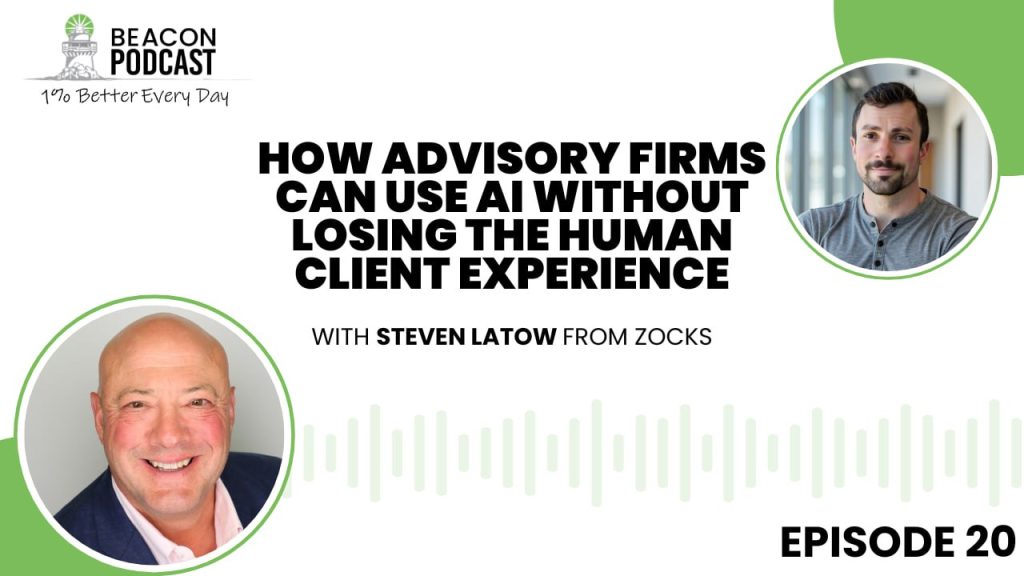
How can financial advisors use AI to improve the client experience without creating more administrative work?
As AI continues to reshape wealth management, many advisory firms are asking where technology can create meaningful value and where the human element still matters most. In this episode of Beacon 1% Better Every Day, Chip Kispert welcomes Steven Latow, Chief Strategy Officer at Zocks, to explore how clean client data, connected workflows, and AI-powered tools can help advisors spend less time on manual processes and more time building stronger client relationships. They also discuss why the firms that prepare their data today may be better positioned to adapt as AI continues to evolve.
What to expect:
- Why clean, structured client data is becoming the foundation for successful AI adoption in wealth management.
- How AI meeting assistants are evolving beyond note-taking to improve advisor workflows and client records.
- Why disconnected CRM systems and manual processes create friction for advisors and clients alike.
- And more!
Whether you’re leading an RIA, broker-dealer, or independent advisory firm, this conversation offers practical insights into how AI, better data, and stronger operational processes can help your team deliver a more efficient and connected client experience while growing your business.
Explore more conversations from Beacon 1% Better Every Day for practical ideas on advisor growth, operational excellence, technology, leadership, and the future of wealth management.
Resources:
Connect with Steven Latow
About Our Guest:
Steven Latow is the Chief Strategy Officer at Zocks, where he helps shape AI solutions designed specifically for financial advisors. In this conversation, he shares insights on client data, advisor workflows, AI adoption, and how technology can enhance, rather than replace, the human side of financial advice.
Connect with Chip Kispert
[00:00:00] RJ Malyk: Welcome to Beacon 1% Better Every Day with Chip Kispurt, founder of Beacon Strategies. This podcast is all about challenging the norms of wealth management and empowering professionals to make continuous progress and always be curious. Chip knows firsthand how small, consistent improvements can lead to big breakthroughs, and that’s what we’re focused on here:helping you get 1% better every day.
We’ll dive into conversations with industry professionals, share actionable strategies, and explore the mindset needed to overcome industry challenges and create lasting change. Let’s be curious, push beyond what’s always been done, and uncover better ways together
[00:00:51] Steven Latow: Welcome to One Percent Better
[00:00:53] RJ Malyk: Every Day.
Today Chip sits down with Steven Lehto, chief strategy officer at Zocks, winners of the Mary Blackburn Partner Challenge at the 2026 Beacon Innovators Roundtable, to talk AI, data, and what the advisory firm of the future actually looks like. Right now, here’s Chip.
[00:01:12] Chip Kispert: RJ, thanks a lot. I appreciate that. You know, uh, firms have been talking about fixing their data for 20 years.
I actually have had this conversation about seven times this week, and my guest today is actually doing it. He and his team just won our Mary Blackburn Partner Challenge at the Beacon Innovators Roundtable to prove it. Steven, chief strategy officer at Zocks, welcome to the show.
[00:01:40] Steven Latow: Chip, thanks for having me on.
It’s a beautiful day in Colorado. It’s not every day that I get someone in my same state, so I’m, uh, excited. Hopefully, we have no major hailstorms or summer thunder coming our way.
[00:01:51] Chip Kispert: That’s true. That’s true, and I see you’re in a different room today th- than the last time I spoke with you.
[00:01:57] Steven Latow: Well, to be honest, I mean, I’m in the bat cave.
I was trying to go … We have this nice view of the mountains and the aspen, and I was like, “Oh, man. I’m really gonna one-up Chip here and have it in the background,” and then the lighting was terrible, so I conceded and came downstairs.
[00:02:11] Chip Kispert: You know, uh, I get it. I’ve … You know, recently I did a podcast down in Florida with, uh, with the ocean behind, or excuse me, the Gulf of Mexico behind me, and, uh, people were a little jealous.
[00:02:22] Steven Latow: Yep. Don’t, don’t blame them.
[00:02:24] Chip Kispert: When I look at Zocks, right, Zocks made an early bet that the data layer, not the front office experience, was the real constraint holding firms back. What did you see that most people were missing?
[00:02:42] Steven Latow: Yeah. It, it’s a great question. So we started Zocks almost four and a half years ago, which generally when I say that, firms are surprised.
They’re like, “Wait, we started really thinking about business application of AI two years ago. What, what were you guys doing?” And the answer is we were building the platform. So the founding hypothesis of Zocks was that financial services middle and back office workflows were being hamstrung by the fact that they did not have accurate, up-to-date representations of end client data.
So this was our hypothesis, that AI systems were gonna get built on that end client data. It needed to be clean, it needed to be up to date, and frankly, it needed to be flexible. And flexible’s really important as the needs of these advisory firms changes. So we spent, you know, about two years building out that platform layer, and what we got to is, hey, we have this great engine.
It has public APIs, it’s ready to integrate thing… with things like MCP. We have a flexible integration engine. Okay, we, we need to start hydrating that data. And so that’s where the note-taking app came from, is we went and actually were like, “Okay, what is, you know, something we can do that’s valuable for our user base to start building these client profiles?”
And as you know, and as you know, this, this world has seen, the, the note-taking app and that surface area has just exploded like wildfire over the last two years.
[00:04:02] Chip Kispert: Yeah, it was interesting ’cause I sat on a Pershing panel this week and, um, had some amazing folks with me from Citi and from Sanctuary, and, um, I got the first question, and it was, “What has given the most ROI to wealth firms?”
And I said, “Note takers,” because they have really driven, uh, the ability for advisors to interact with their customers in a more meaningful way and faster.
[00:04:34] Steven Latow: Yep. I mean, it, it’s been fascinating to watch. As a technologist, you think about the value chain, right? So what’s your point of entry? What’s the first problem you solve?
Then how do you leverage that into something else that’s more valuable, and a tertiary value prop that, that adds onto that. So note taking, it really did change the way these businesses operate. It is eight to 10 hours a week and a full person removed from this workflow where you had multiple people having to sit in a room, one scrambling to take notes, asking questions of, “What did I miss?”
And by removing that, you get better client conversations, you get faster follow-up, and you get better data. Well, the question then becomes, what are you actually able to do with that time saved? And that’s where Zocks is really differentiated, right? Is we’re powering those secondary workflows where not only are we helping you save time up front, but then we’re helping you lower NIGO rates, we’re helping you serve more households, we’re helping you open accounts, all of that kind of secondary thing that slows down your team.
[00:05:30] Chip Kispert: So additionally, right, if we take a look at, um, you know, I look at the 40-year operational anchor, right? And, and looking at, hey, all those manual, you know, logins that you have to do from custodians, CRMs, all those different things. Looking at, at hand-generated tax forms and, you know, also having clients getting locked out of their accounts.
It, it’s nuts, right? So how, how do, how do you see you all smoothing that process?
[00:06:04] Steven Latow: Yeah. There are so many individual cases where a lack of data consistency drives client friction. I mean, you named a few examples. “Hey, my client needs to send us their tax form, but they’re actually locked out of their account because we use two different custodians, but they can’t reset the password directly, so they have to go to our broker-dealer, who then is coming back and sending them a reset link that we have to go walk them through,” and the end result is client friction.
And so we actually ran a six-month beta. Mm-hmm. And it was really cool because when I say beta, I mean we were starting with the real basics, Chip. We had advisors sending us a recording, we were processing it back, and we had like a 48-hour window to get them back their structured notes. But what it gave us insight into is we started to learn, okay, what is slowing your team down?
And so you identify things like, hey, our intake process is really slow. We actually have this great first meeting. There are problems that the client is trying to solve. We think that our services match what their needs are, but we can’t get back to them fast enough. Or we’ve gone and done a financial plan, you know, we’ve started it and we actually need more data to finish it, but it’s taking us two, four, six, 14 business days to go from that second interaction to the final meeting where we start to talk about funding.
Mm-hmm. And so during that six-month period, we essentially just prioritized what are the things slowing down the middle and back office, and you’ve seen us if you’ve been watching our product announcements, we’re literally checking those off the list. Email responses when clients ask questions, check. Uh, incorporating documents into doing tax planning for the upcoming year, check.
Going and looking across the different systems to identify growth opportunities or held away assets, check. And so you start to think about that value chain, and we’re literally just going through what we learned in that six-month period and layering on applications to pull people out of that assistant middle office role and into, you know, a client service role where they’re spending more time with their, with clients.
[00:08:05] Chip Kispert: Great answer. I love, I love that, you know, you guys, it, it’s just amazing how fast you’re expanding. So let’s talk a little bit more about Zocks, right? So if, if we look at the broader audience- They see Zocks as a note taker, right? And so I always find it super interesting to see where you’re going, right?
And, you know, how Zocks is, is converting conversation into structured data, taking unstructured data and organizing it. And especially, um, you know, as you’re syncing, you know, you’re aligned with Salesforce, Redtail, Wealthbox, Practifi, I look at that and say, “Hmm That’s, that’s interesting. So I, I wanna hear your comment on that.
[00:09:02] Steven Latow: Yeah. I mean, I get back to the round table, which is such a unique event, like I really wanna pitch it. I learned so much in just the level of engagement in that closed community of being able to talk about the real problems firms are facing. And I think it was Casey Cotton that brought up, she goes, “You know, I’ve been coming to these for a long time, and one of my takeaways today is the more things change, the more things stay the same.”
The actual clean data is the main thing hampering these firms from going and building end user workflows. And so we think about the last 40 years, and we’ve been in this hub and spokes model where you have, you know, the advisor and team inputting information into a CRM, and then that CRM feeding out, it, it out into the different point systems.
Well, that’s required manual intervention at every single step, and there’s two problems with that. The first problem is that humans are not deterministic. Like, there is data loss every single time you make one of those hops, whether it’s the handoff from the advisor to the team, whether it’s the team to the planning team, or whether it’s even between systems, you have data loss.
And the second thing is you go down to the path of least resistance where you think about what is the core workflow I have to execute? You get that done, and you don’t have an opportunity or the time to think creatively about what else could we do for this client? What, hey, they brought this thing up that is 18 months out, but is there prep we should be doing now?
And when you’re in a time-constrained system, you can’t operate with that creativity mindset. It’s all execution. So the true beauty of what SOX is doing is it’s pulling the teams out of that routine work, where they are not the ones having to go and manually translate information coming in into the correct point system, and they’re now able to think creatively with that extra time of, “Hey, I’ve noticed this trend.
We have a lot of clients that have kids that are approaching high school that we probably haven’t ever met. Let’s go and f- create a program to get in touch with them, to go and form a relationship as they’re going into, in, into college.” And this type of service expansion results in a better client experience, and it- Mm-hmm
we could literally see the data of it’s helping our firms grow, which all of this has to get back to how can we do, do more? How can we go and, and grow our businesses?
[00:11:19] Chip Kispert: Absolutely. Um, when we chatted at the round table, we, we chatted a little bit about The egenic side, right? And, you know, one of the things I see, and as I talk to you guys more and more, you know, you’re, you’re creeping into account opening.
You’re creeping into advisor transitions, both from the advisor’s information and the end investor client’s information. I, I just see this progression occurring. Um, share a little bit about that.
[00:11:58] Steven Latow: So the way we think about our roadmap and what we’re trying to accomplish is at the end of the day, we frankly wanna change the unit economics of how the middle and back office operates to let these firms focus on the end client.
And there’s two things that are happening that I think are driving this. The first is everyone talks about fee compression, fee compression, fee compression. The reality is we’re not really seeing fee compression, but what we are seeing is service expansion. Um, clients expect more services, and they expect this, their advisor to not just be a money manager.
That takes time. If you’re inundated with having to do the nuts and bolts of running your business, you cannot go and, and meet the client with where they’re at from a service expansion perspective. The other side, and this is where it’s super fun, is if you think about a value quadrant where you have urgency and creativity, uh, as the two y- x and y axes, AI operates extremely well in the bottom left quadrant, where it is routine, it needs execution.
It is not necessarily interrupt-driven or urgency. It doesn’t need a prioritization decision. And so we ask ourselves, “Okay, who, what, what is happening? How does that impact these firms?” Well, the answer is their middle and back office has been spending all of their time there. Yes. So AI is pulling those people out of that routine work that is important, it is vital, but it is able to execute that, and what that means is that these firms are able to start grabbing the opportunity from the service expansion expectation.
[00:13:26] Chip Kispert: You know, my brain when I kinda look at the note takers, which aren’t the note takers anymore, um, is just wow, this is pretty incredible and, um, you know, I, I, I think we’re probably super curious about what your roadmap looks like as you kind of go through the rest of ’20- the last six months of 2026 and into 2027.
[00:13:53] Steven Latow: Yeah. So if we look at the rest of this year, there, there’s two things we’re really focused on. The first, as you mentioned early on, that we built a lot of integrations. Well, that’s not gonna stop. Um, so one of our core value props, and frankly core beliefs, is we wanna be an open ecosystem. We understand that advisors are going to use different point solutions for different operations, again, looking at that service expansion, and we want to support all of them.
Um, and so if we can go and be the data translation layer that’s getting the point system the data it needs to execute the action for the client, that puts us in a good position, it puts our clients in a good position. So we’re gonna continue to invest there. The second thing is you’re gonna see us going from the first and second step to the third and fourth step.
And what I mean by that is you look at our email engine. When we first started, our email engine could answer about 40% of the questions that a client asked. It now can answer almost 90% of the inbound questions a client asks because we’re hooked into the financial planning system, we’re hooked into the CRM, and really importantly, we’re starting to get hooked into the internal SOPs and data architecture of either the broker dealer or the custodian that the advisor is working with.
So we actually know how the, what has to happen for the client. Um, and so we’re gonna keep chewing away at what are the things that a human has to do from a data gathering perspective. We believe that AI can do a good job of that, and the human aspect is human in the loop. They’re always checking corporate actions, but also deepening those relationships.
And so you’re creating more workflows around, again, the example I gave. How do we map better to beneficiary or next of kin? How do we go and have a consistent way to follow up on referrals that we receive? These growth opportunities that have kind of been executed inconsistently or are not capitalized on in the past purely because of bandwidth.
[00:15:48] Chip Kispert: Fascinating. You know, and, and I mentioned… And, and we talked about this the other day. We, you know, I mentioned CRMs before, right? And I’m kind of seeing this, I won’t call it scope creep, but in some ways I’ve been thinking this for six, eight months or so It seems to me that, that the CRMs are really kind of at, at risk at, to some point, um, and they need to figure some things out.
What’s your… I’m curious about your perspective on that.
[00:16:34] Steven Latow: Yeah. I mean, I think there’s a few things going on. The first is that that hub and spokes model that I described is changing. It’s now a data flow where you have inputs on the left, you need a data translation layer, and then you have outputs in systems like your planning system, like your workflow management system, which might be your CRM or your communication systems.
So that’s a, a different data model that is changing the role that the CRM plays. What I will say is books and records law is not going to change. You need books and records, and it is hugely valuable for regulators to know I know how to go into a Redtail instance, I know how to go into Wealthbox, I know how to go into Salesforce.
[00:17:12] Chip Kispert: Yeah.
[00:17:12] Steven Latow: What we’re seeing as kind of the paradigm shifts is advisors and their firms are starting to identify what is the best possible system of work for my team, where like we’ve been talking about single pane of glass forever, uh, at least forever in my mind since I’ve been in this industry. I’ve
[00:17:30] Chip Kispert: been talking about it for 20 years.
[00:17:33] Steven Latow: We are closer to that right now than we ever have been because AI is able to do the architecture level work so teams can focus on the user experience. And so I do think the CRMs are either going to figure out how to invest in user experience better to maintain their role as that system of work and workflow execution, or we’re going to see where an advisor is logging in change into something that is more workflow directed, that says, “Here’s the value of your book of business.
This is how it benchmarks you against your peers, and here are the top opportunities for you to grow that and also be able to execute it.” And, you know, in some cases that’ll be proprietary, in some cases that’ll be an AI, um, system of work, and in other cases that’ll be the CRM. Like, what’s exciting about this is that it’s real and it’s happening.
Um, I get less picky about kind of what, what the specific architecture decisions are there.
[00:18:27] Chip Kispert: Got it. I’m gonna change gears a little bit. Um, this is one, this is one of the things you and I have kind of gone back and forth with, and I am in total agreement with you ’cause that’s the kind of what I’ve been thinking for the better part of the last 10 years.
Um, but when we had our chat, we both agreed that we thought that the seat licensing is a broken model and that, you know, also advisors are super nervous, right, about who really owns that data, right? And this, the advisor’s nervous about the data. That’s been, I can go back to 2000s, right? But comment on those, those two- items.
I’m, I’m, I wanna have your perspective shared. I, I, I may be, uh, um, dropping a little bomb in here on this one.
[00:19:25] Steven Latow: Well, I think, you know, as the age-old adage goes, “If you’re not paying for the product, you are the product.” And so we’re seeing a lot of new incumbents come in and offer the world, and for good reason.
Like, you know, you look at the Kitces map, it’s tripled in the last couple of years. That is a net good thing. This industry has been underserved from a technology perspective. But advisors should be nervous. They, their relationship with their clients is the most valuable asset that they have, and privacy matters there.
And so a few things that I would be hyper-conscious of, that we were very intentional about, is, is any kind of anonymized data benchmarking default on or off? Do I understand, if I am going to participate in that, exactly what the mechanism is where I no longer own my data? With SOX, you maintain ownership of your data.
If you decide that you no longer w- want to be a SOX customer, you get an automated export of all your data, and you get confirmation when it’s been deleted. And oh, by the way, we do not do any broad benchmarking. The only things that we do are when firms approach us to say, “We’d like to do a value study within our ecosystem.
Here are the parameters. Can you work with us on that?” We will then, with their permission, go and work on that. And that’s, it frankly makes it harder because the data is valuable. It’s really tempting to try to go learn from it. And especially in the world of AI, I think the, the most important, the single most important thing is having a strong understanding of what is my data scope, where is my PII going, and do I maintain ownership of it?
[00:21:02] RJ Malyk: Mm-hmm.
[00:21:03] Steven Latow: To your second question, it’s really important is when we think about vertical SaaS, so the way that advisors have typically consumed technology, you know, it, it’s always been license-based. And the reason for that is if you’re a Redtail or you’re a Wealthbox, your 100th license actually doesn’t cost you very much.
Like, there’s some setup cost and there’s some database compute, but you get returns to scale. Now, for the AI native companies, our costs scale with usage. Like, our best users are also our most expensive users. And so as a technologist, I hope for a system where you can align those incentives, where we can say, “Hey, here are the outcomes we’re gonna help you drive using our system.
You’re gonna pay based off those outcomes, so if you grow, we grow.” And th- you know, what more could you ask for? Now, it’s gonna take longer to get there, like, than, than we think it would. It takes a while to change, and it’s scary because from a budgeting perspective, firms wanna know what their budget needs to be, how much they’re gonna spend on th- on their tech stack, and how much variance there is there.
But I do think it’s a better aligned system.
[00:22:09] Chip Kispert: Well, for two things I’ve, I’ve been- professing that the current models are broken. All right? The, you know, how many basis points are you gonna pay? The seat licenses, and that one kind of… That one really annoys me, quite frankly, because I look at the seat licenses as a way of, you know, ensuring revenue to these companies.
But I’m like, you may have a person who’s using it twice a month, and you may have another person or another advisor using it 200 times a month, and that just doesn’t seem equitable to me.
[00:22:49] Steven Latow: Right. Well, and you have one of the best points of view in the entire industry on this. When you talk to budget owners and you bring this up, what, what do they say?
Like, do they, do they agree? Do they not agree? Um, what’s the feedback you get? ‘Cause as a CTO, like, uh, you’re thinking about this all the time.
[00:23:06] Chip Kispert: Yeah. It… I think you and I could go on with this conversation for a while at this point. Um, I was fascinated when we got together, um, earlier this week, when we kind of ended up and, and you shared with me, um that firms are coming to you with hiring questions, not just technology questions.
So tell us about that, please.
[00:23:35] Steven Latow: Yeah. It’s been really fun for me. This is like I, you know me, I love connecting with these firms, and I love seeing our advisors win. One of my strongest held beliefs is that AI is going to do the routine manual labor that has kind of plagued this industry. Well, what that means is that the people you want to have on your team actually need a different skill set.
They need to be more creative. They need to think about art of the possible. Mm-hmm. And they need to kind of think of, “How can I be a force multiplier on the business?” So we’re starting to see firms think about, “Hey, what does our administrative staff look like if they are a force multiplier? Who do the people, um, that we need– Who are the people that we need?
What are their backgrounds? And then frankly, what is a leveling guide so that we can keep them around because they are immensely valuable?” And you and I connected on this, my belief is that we are going to see more liberal arts-minded people entering this industry who are curious and creative and want to connect, versus being more execution-oriented.
[00:24:37] Chip Kispert: And know how to communicate.
[00:24:38] Steven Latow: Yes. Yes.
[00:24:41] Chip Kispert: Know how to communicate. So, um, Steven, two items as we’re winding down our, our, our discussion today. Um, and the first, I’m kind of doing a little bit of a sidebar here. Um, the first question I’ll ask is, who are two or three people or firms right now that are doing really admirable work that, that you’re looking at, and why are they worth, worth watching?
[00:25:09] Steven Latow: Yeah. So a few people come to mind, and first is one of our earliest partners and biggest advocates, and that’s Dani Fava over at Carson Wealth. So Dani has been really loud about the early investments that they have made in AI and the business impact that it’s having. Dani was one of the first people to partner with us and really see kind of the forest through the trees of how powerful the structured data was going to be, and their Steve AI platform is truly state-of-the-art and incredible.
And definitely go check her out. She’s talked about how they’re tracking number of households served per advisor, how they’re tracking organic growth per advisor, and how they’re actually seeing margins improve. So that is someone that is on the right path.
[00:25:51] Chip Kispert: Dani’s super smart. I-
[00:25:52] Steven Latow: Yeah …
[00:25:53] Chip Kispert: I’ve sat in a couple meetings where I’ve just been so impressed
[00:25:56] Steven Latow: Yeah.
The, the second person I would call out is Erica Molina over, over at Cambridge. So, um, you know, in the broker-dealer space, they have lived in a world where you have advisor choice from a technology platform perspective for so long. And what that means is it’s really hard for these broker-dealers to build systems because they’re constantly having to integrate with whatever platforms the advisors happen to be using.
Well, with AI, we’re seeing that integration layer change, which means that they actually can start, as the broker-dealer, working on how do we streamline these workflows? How do we make it as easy as possible for, um, our advisors to execute their businesses, grow their businesses, lean deeper into the practice management side?
And Erica’s just, uh, been an incredible partner for us and an incredible partner to the advisors over at Cambridge. So those are two people I’d call out that we are lucky to partner with, we learn from all the time, and I think are doing amazing work.
[00:26:49] Chip Kispert: That’s fabulous. That’s fabulous. So, um, before I get too far and give you the mic for 90 seconds here, um, you won the Mary Blackburn Challenge and, um You guys chose a, um, a group to donate the money to, um, Forging Youth Resistance.
Tell me a little bi- bit about that.
[00:27:13] Steven Latow: Yeah. So, um, in my personal time, which it turns out that I have some of other than my work time, I am very passionate about fitness and wellbeing. Um, so I was a competitive wrestler in high school. I’ve competed at the highest level in CrossFit, and one of the things that I’ve seen is the power of youth getting in touch with working hard, putting a barbell in their hands.
And something I’ll, I’ll call out CrossFit as is it has really revolutionized the people that have access to a barbell, and frankly, the importance of strength training for everyone, and how it is one of the highest indicators of longevity. Mm-hmm. So this is a group in Denver that, um, works with youth centers to actually get them in the gym, to get them on a workout program, to create like a big brother, big sister program where they’re connected to them.
Um, I had helped, when I was in town, incorporate them into a few competitions that we did, and it’s just incredible to see these kids being connected to working hard, and really proud of the work that that group is doing, so wanted to support them.
[00:28:08] Chip Kispert: That’s terrific. That’s terrific. All right. As we close, um, I like to give our guests a, uh, 90 seconds to have their own 1% better everyday flash.
So with, uh, no script, no guardrails, no nothing, Steven, take 90 seconds.
[00:28:30] Steven Latow: Yeah. So, you know, right now we are being inundated with AI this and AI that, and it is easy to think of it as binary. Either I am totally against AI or I think it’s the panacea and it’s going to fix everything. And the reality is, and I tell this to advisors all the time, it’s just a tool in your tool belt.
And so they … I, I tell everyone, “You need to abstract away, you know, ‘I need to be AI-ifying things,’ and get back to what are the things that ha- are hampering my business from growing, and what does success look like, and start there.” And if you can define one thing, the most important thing, and start with that, it might be an AI solution.
There are incredible solutions out there. There has never been more solutions for this industry. Or it might be spending some time on operations. It might be going and creating, spending a little more time on those job descriptions. So I encourage everyone to get back to first principles, really think about what problem do I wanna solve, and then go and, and set off on the effort of trying to solve that.
Um, and it … You know, at the end of the day, this is a really exciting time to be in financial services. It
[00:29:38] Chip Kispert: is.
[00:29:38] Steven Latow: It is moving really fast, and what that’ll result in is more people getting help More people being financially independent, being financially educated, and if we can all push towards that goal, it’s going to result in better business outcomes, and it’s also gonna keep your tech partners honest in making sure that they are helping you grow.
So start with the basics. Don’t get scared by AI, but also don’t think that it’s a panacea that’s gonna solve all your problems, and take the first step in solving your first problem.
[00:30:08] Chip Kispert: Stephen, I wanna thank you for being on the show. Many topics we covered, uh, and, uh, I’m so appreciative of your time and of, uh, being able to learn from you.
[00:30:19] Steven Latow: Yeah. Chip, it’s an absolute pleasure. I love working with your team. I really enjoyed the round table. I’m looking forward to joining more, and, uh, I can’t wait to take you up on that golf round you promised me next time I’m in Denver.
[00:30:30] Chip Kispert: That is a promise, so thanks, Stephen.
[00:30:33] Steven Latow: All right Good afternoon.
[00:30:36] Chip Kispert: Hey, RJ, that was a terrific call.
I love Steven’s perspective, and it was fresh, and we had great dialogue.
[00:30:44] RJ Malyk: Yeah, that was an interesting conversation to eavesdrop on. Uh, I, you know, just listening to him, there was a lot of common sense he was using. And, uh, what stood out to me i- it was, it was always going back to client relationship and making the client experience probably is a better way of putting it, and that was, that seems to be his focus.
Yeah, using AI not to cut costs, but to improve the client experience, and that’s what stood out to me.
[00:31:18] Chip Kispert: Well, and I think that’s a lot of people out, um, out there, you know, think AI can just do a search. It can do, um, you know, and it, it, it doesn’t have the humanistic or it doesn’t drive human interaction.
That’s wrong. That is absolutely wrong because, um, done right, I think it enables human interaction and makes it richer.
[00:31:41] RJ Malyk: Absolutely. Absolutely.
[00:31:44] Chip Kispert: You know, I had a couple takeaways, uh, from our call. Um, and it… This is one that resonates, and I think I mentioned, have mentioned it probably in the last four or five podcasts, but, um, the data problem is no longer optional.
It’s gotta get squared away. And, uh, if firms don’t, then, um, they’re gonna, they’re gonna struggle with that. So, uh, definitely focus on data, which is gonna drive a lot of the, the, uh, opportunities on top of that, both, uh, from a AI and knowledge base perspective, as well as interaction with clients. Uh, two, I loved our conversation on seat licensing.
Um, and I’ve been professing this for a number of years, but, you know, the concept of who uses it gets charged for it. And, uh, it’s something that I think’s gonna come forward as, as we look forward and, and, um, and expand into the future. And then I loved his comment about, um, advisor teams And the human aspect about it.
And the, uh, the next advisor teams are gonna not look like anything that an advisor team has been structured as in the last 20 years. Um, it’s gonna go really to being able to have a firm control the data. It’s gonna be able to enable that interaction, and it’s gonna enable, um, a lot of the, the, the folks that are working in the field to, to be more effective, I think, and efficient with different agents and whatnot.
So I, I found that fascinating. I could probably go talk about that for, for a while. But, um, that, that’s where we are. Um, as, uh, we close at this point, Steven was a fabulous guest. Um, and I am grateful for him to be on the show. And so, uh, without, uh … We’ll close it up here. This is Chip Kispert wishing you well until our next edition of The Beacon 1% Better Every Day Podcast.
[00:34:04] RJ Malyk: You’re not gonna quote your favorite person?
[00:34:07] Chip Kispert: Here it is. To quote Ted Laszlo, and this is w- my favorite quote, “Be curious, not judgmental.” Have a great day.
[00:34:15] RJ Malyk: All right, excellent. And, uh, Chip, we need to add in a shout-out, as this podcast is brought to you by Beacon Strategies, LLC, the go-to resource for round tables, consulting, and services that support wealth management firms and their providers.
If you need some industry perspective or help, please visit beaconstrategiesllc.com. And thank you for listening to the Beacon 1% Better podcast. We ask you to share this podcast, rate it, and leave a review, because this actually helps others find the podcast. Again, thank you for listening, and for Chip and everyone at Beacon Strategies, I’m RJ Malyk, and we look forward to you joining us for the next podcast
[00:34:55] Steven Latow: Thanks for joining us on Beacon’s 1% Better
[00:34:58] RJ Malyk: Every Day podcast.
Be sure to hit that follow button so you never miss an episode, and stay up to date with Chip and his friends’ latest insights and strategies. If you want to learn more about Beacon Strategies or get in touch, visit us at beaconstrategiesllc.com. Remember, progress starts with just 1% every day. Let’s keep challenging ourselves to be curious and grow.
The information covered and posted represents the views and opinions of the guest, and does not necessarily represent the views or opinions of Beacon Strategies. The content has been made available for informational and educational purposes only. The content is not intended to be a substitute for professional investing advice