
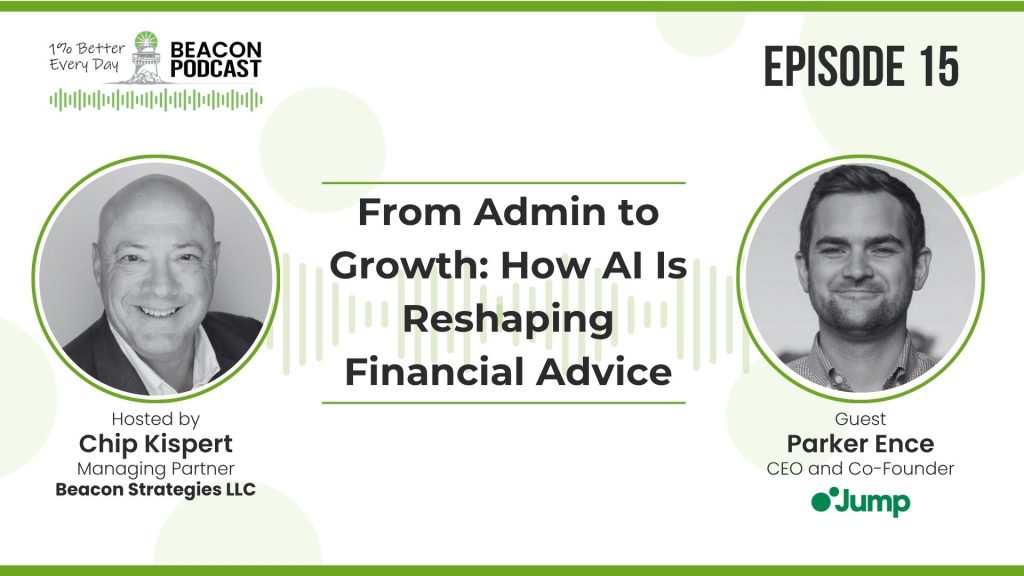
AI may be the biggest operational shift wealth management has seen in years, but its real value is not just speed. It is what that speed unlocks: better advisor capacity and time, stronger documentation, and more room for human connection where it matters most.
In this episode of Beacon: 1% Better Every Day, Chip Kispert sits down with Parker Ence, CEO and co-founder of Jump, to explore how AI is reshaping the wealth management industry in real time. What started as a simple idea to eliminate CRM data entry has quickly evolved into a broader AI-driven system helping advisors streamline meeting prep, automate follow-ups, and improve documentation.
Parker shares how advisors are reclaiming hours in their day and reinvesting that time into deeper client relationships and business growth. The conversation also highlights a shift happening across the industry, where compliance teams are beginning to support AI adoption due to stronger, more consistent documentation.
As the pace of technology accelerates, this episode challenges advisors to rethink how they operate, adapt, and stay relevant in a world where speed, personalization, and human connection all matter more than ever.
What to expect:
- AI’s role in reducing administrative workload for advisors
- How Jump evolved from a CRM tool to an AI operating system
- Why compliance teams are starting to embrace AI tools
- How advisors are using saved time to drive growth and focus on client relationships
- The rise of AI in detecting new client opportunities and referrals
- What the future of advisor-client relationships may look like
- Why firms need to act now instead of waiting for AI adoption
Connect with Parker Ence:
About Our Guest:
Parker Ence is the CEO and Co-Founder of Jump, the leading AI-powered operating system designed to support financial advisors by automating meeting workflows, improving documentation, and helping identify growth opportunities. With a background in fintech and experience working with AI at scale, Parker and Jump are focused on helping advisors combine technology with human connection to better serve clients.
[00:00:00] RJ Malyk: Welcome to Beacon, 1% Better every day with Chip Kipert, founder of Beacon Strategies. This podcast is all about challenging the norms of wealth management and empowering professionals to make continuous progress and always be curious. Chip knows firsthand how small consistent improvements can lead to big breakthroughs, and that’s what we’re focused on here.
Helping you get 1% better every day. We’ll dive into conversations with industry professionals, share actionable strategies, and explore the mindset needed to overcome industry challenges and create lasting change. Let’s be curious. Push beyond what’s always been done and uncover better ways together.
Welcome to the Beacon, 1% Better Everyday Podcast. I’m RJ Malyk, your producer, and today Chip Kiper sits down with Parker Ence, CEO [00:01:00] and co-founder of Jump, the fastest growing wealth tech application in industry history with more than 30,000 advisors on the platform and a freshly closed $80 million series B right now.
Here’s Chip.
[00:01:15] Chip Kispert: Thanks RJ, appreciate the intro. Parker, welcome.
[00:01:19] Parker Ence: Yeah, thanks for having me. Great to see you again.
[00:01:21] Chip Kispert: I am so excited to have you on the show. Your team did a fabulous job at our round, the round table that we hosted in November, and, and ever since then, I’ve been really excited to kind of get into it with you and, and have a great conversation and learn a, a bunch about what you’re doing.
So, uh, again, welcome and, uh, one of the things I always like to do is. Talk or get our, our guest talking a little bit about their background. And you have a very interesting one.
[00:01:56] Parker Ence: Yeah. Yeah. So, um, grew up in [00:02:00] Utah and, uh, and have been, uh, kinda involved in a number of different startups and, um, my, my, my first real job was actually as a guitar teacher, but then kinda got interested in technology and building companies.
Have done a lot of different things over the years. My co-founders and I have a background in building primarily FinTech and software companies. And so, um, that was kind of, you know, we, we, we didn’t, we didn’t come. We are personally not advisors, although we have a lot of advisors in our friends and family, and they are actually.
The ones that pulled us into doing jump, if you can believe it.
[00:02:38] Chip Kispert: Uh, I think it, I think it’s amazing. But you also, you in your background, um, you spent time at Google and I’m want, I’m really curious how that shaped, um, your view of ai.
[00:02:55] Parker Ence: Yeah, so, and I wasn’t there very long. It was, so I did my MBA at Sanford [00:03:00] Business School, so I was right there in Palo Alto.
Right next door to Google. And, uh, I did my MBA summer there, and it was really the first time I had been exposed to AI and data at, uh, an incredible scale. And the team that I was working with, they had created this AI model that, uh, and, and keep in mind, this was before large language model style ai. So this was deep learning or machine learning, much more arduous, right?
To, to create, um, these models. And the problem they were trying to solve is, if you’re a big company that has a lot of resumes submitted to you and you have a lot of job openings, how do you make matches? And so I think really for me, it was the first time that captured my imagination about how powerful, uh, AI could be in wrangling massive amounts of data and, and really making things easier.
Um, so I came away from that experience. Uh, I mean, loving it. Google’s an amazing place to [00:04:00] work. Um, but really, uh, just fascinated by the, the potential power of what AI could do for all of us.
[00:04:07] Chip Kispert: And boy, what, what’s come down to pipe since it’s pretty incredible.
[00:04:12] Parker Ence: Yeah,
[00:04:13] Chip Kispert: it’s interesting to me three years ago. I didn’t know who you were, and now every time I turn around it jumps in the middle of a conversation.
[00:04:27] Parker Ence: That’s very kind of you. Uh, yeah. We, um, you know, to me I feel like AI time is in dog years, so I feel like I’ve been at this for 21 years at this point, but it’s, it really has been just about three years. We started working on jump in late 2022. My co-founder, Tim and I, we were seeing the incredible advancements of GPT, uh, uh, you know, three at the time.
And we realized, wow, you know, these large language models are, are finally [00:05:00] practical and useful enough that you could use ’em for a lot of different things. And we said, well, you know, one thing that we’ve always hated doing in, in our companies and my co-founder has also started and, and run. And exited other companies.
We said, you know what we hate is typing data into places like A CRM.
[00:05:19] Chip Kispert: Mm-hmm.
[00:05:20] Parker Ence: And if we can’t get AI to save humanity from data entry into A CRM, then it can put us on Mars. And who cares? Like we have to at least do that. And so we were building, um. An AI assistant that would come to your meeting, take out all the interesting data, and then do all the data entry into the CRM and into other places for you.
Uh, the original version of Jump literally was not a note taker. It did. There was no note. It was just field level data, uh, ready to go into a CRM and so
[00:05:53] Chip Kispert: Really?
[00:05:54] Parker Ence: Yeah. So there was no note in the first version of Jump and. Um, I remember, [00:06:00] so, you know, we were telling lots of people about this capability and my brother, who’s a financial advisor, was the first one to say, oh, I really need that.
And then my brother-in-law, who’s also a financial advisor, uh, said, oh, I would love to have something like that. But it took until my neighbor, we were literally sitting at the park with our kids and they were kind of running around and it was, and it was just after dusk. And I explained to him what we’re doing and he said, you know, I love working with my clients.
I love the investment management process. Um, and his firm was a little unique. They actually started their own hedge fund kind of next to what they were doing. So really, he really, truly loves the investment management process. And he said, but you know, what I hate is note taking and all this compliance stuff I have to do after my client meetings is the bane of my existence.
And so that finally really caught my attention. And so, um, you [00:07:00] know, my, my two co-founders and I, we decided to narrow our focus to only work with wealth managers and financial advisors. And we had a pretty big learning curve. But at the time. You know, this was early Chad GPT time, and it was, it was kind of reaching a fever pitch of, wow, look how cool this is.
But, you know, most advisors that we talked to were really experimenting with, with ai really more, uh, as a novelty. It was like, Hey, look, I got it to write a song, um, in the voice of like Donald Trump or Eminem or something. It’s like an original song about me. And, uh, there, you know, there was a lot of excitement about the potential of ai, but.
Other than the chat bots, there weren’t a lot of actual use cases that were driving really good ROI. And so when we launched in January of 2024, uh, we essentially said, Hey, you know, you know, this could be something that actually moves the needle for you and, and helps in the day to day. And that’s, so that’s been really [00:08:00] fun to see that, um, uh, evolve since then.
[00:08:03] Chip Kispert: And boy, it’s just the tip of the iceberg, isn’t it?
[00:08:07] Parker Ence: Absolutely. Yeah. I still feel like we are. Depend, you know, top of the first inning or chapter one, or pick your analogy. But we’re, yeah, we’re just, we’re in the very, very beginning.
[00:08:17] Chip Kispert: It’s interesting ’cause I, you know, in, in doing a little research, you know, I, I found that kinda your goal initially was to cut admin time by 90% for adding notes and, and the like.
Um, obviously you’ve gotten there. Um. But one of the things that I’m curious about, you have a lot of years of data, you have a lot of years of learning. Um, what are some of the things you weren’t expecting?
[00:08:50] Parker Ence: Yeah, yeah. So that’s right. So, so the original concept was if you’re an advisor, you spend a third or more of your time.[00:09:00]
On meeting related administrative work. So how does that break down? We’ve gotta go dig through everything to get ready for the meeting. And then when my meeting’s done, I’ve created an hour or more of administrative follow up. I’ve gotta go update my CRM, update my financial planning tool, send an email back to the advisor, confirming what we’re gonna do next.
Delegate tasks, go execute on setting up the financial plan. Adds up a lot. So the original, uh, jump. Uh, concept was we’re gonna use AI to cut that down by 90% by putting notes and tasks and data entry and research, pre-meeting prep, all of that on ai semi autopilot. And that’s gonna get you back a lot of time.
And the, and the reason it’s going to work is because we’re gonna integrate with the rest of your tech stack. We’re gonna make it so that you can customize all the AI outputs so that you sound like yourself and not [00:10:00] like an AI generic robot, right? And then we’re gonna make sure that your compliance officer feels comfortable and, and actually is excited because you’re gonna have better compliance outcomes.
And then we’re gonna make it really easy to use, right? Because we’ve got some advisors that are new to the industry and they grew up on the iPhone and TikTok, and they’re ready to go with any tech. And then you’ve got some that are still afraid of their own email. So that’s a pretty wide ridge. And so we wanted to design it for ease, uh, of use.
And so, um, that’s going great. That’s what jump’s best known for. And you know, as uh, was mentioned in the introduction, we’ve got 30,000 advisors now using it. Um, up from, you know, our first advisor was like January 1st, 2024. So pretty wild.
[00:10:44] Chip Kispert: That is wild.
[00:10:44] Parker Ence: And, um, working with all about, about half of the top 25 RIAs, all the major IBDs.
So it’s been really fun. And the average advisor will say, I save at least an hour a day, just [00:11:00] from, just from that. Um, which is, which is amazing. And so then we said, well, that’s great. And we wondered for a little bit where that extra time would go. Like would, you know, may, maybe advisors. Just kind of go home early on Friday afternoon or go hit the golf course or something.
So I actually did a survey and we said, how are you using this time that’s been freed up? And the number one answer was, I’m actually using this to either, uh, number one, do more for my clients than I would’ve been able to do before. Or number two, I’m gonna go, uh, figure out ways to grow. And so we got really curious about how do we help you grow faster?
Organic growth is, you know, the elusive, uh, the elusive white whale or, or, or the unicorn, right? If you can nail organic growth, you’re in a great spot. And so we started looking at all the data that was collected in the [00:12:00] form of a conversation between an advisor and a client, and we said, how can we actually unlock this data?
This visibility into what’s going on has never been available before. How can we use that to grow faster? And so that’s kinda where we started. And um, it’s, yeah, so that’s, that’s kinda where we are today is we’ve actually launched a whole new product called Jump Grow. And it’s all about how do we help you detect more growth opportunities.
So one of the top RIAs ran an AB test and they found that JUMP was two and a half times better at detecting growth opportunities than a human advisor. And when I say detecting growth opportunities, what I mean is are we noticing opportunities for referrals? Are we noticing opportunities where there’s some held away account or some other held away asset?
[00:12:50] Chip Kispert: Mm-hmm.
[00:12:51] Parker Ence: Are we noticing opportunities to engage with the next generation? Um, are we taking action on, uh, anything like that [00:13:00] that helps us deepen our relationship with the client? Expand what we’re doing with them or go get more referrals. Um, we also found, uh, one of the top four broker dealers found that their jump users were growing their a UM at double the rate of their non jump users.
[00:13:18] Chip Kispert: Interesting.
[00:13:19] Parker Ence: So lots of amazing opportunities to use AI to drive organic growth, and it’s been really fun to see that play out.
[00:13:26] Chip Kispert: And I think, again, you’re, you’re at the tip, you know, it’s, you’re at the, that it’s so much bigger beyond, it’s just amazing, you know, and one of the things I’ve had a lot of discussions, um, with a lot of broker dealers, a lot of large RAs on, is.
You know, one of the things we see you drifting more and more towards is that operating system and really being able, being kind of the, you know, you’re pushing data here, there and, and the outputs that come from [00:14:00] it along with the analysis. I mean, it’s changing the game. It’s changing the narrative.
[00:14:05] Parker Ence: Yeah, I think so.
In this moment in time, we’re in this Cambrian explosion of new. Companies. I’ve got a, a different brother-in-law, not the advisor, but different brother-in-law who’s at a mutual fund.
[00:14:21] Chip Kispert: Okay.
[00:14:22] Parker Ence: And he showed me some research that they’ve completed recently that showed that there were 34,000 new software companies founded in 2025.
And if you’ve been watching the Kitsis map, you can, you can see some of those popping up left and right. There’s more software companies today than I think there ever have been. Which is great. That means there’s a lot of options, right? You can, any problem you have, there’s probably three software alternatives for you.
But the, the, the trade off there is if you look at the ingredients for what does it take to actually be really effective with ai, [00:15:00] you need to get your data in one place and cleaned up and labeled so that AI can know what it’s looking at and has access to what it needs. That usually means integrating with the rest of your tech stack, so you have the connections to read and write.
Then you need the AI logic to actually do the thing that you want it to do in a somewhat straightforward way with all the data and context and knowledge about how your firm operates. And then you need safety and compliance wrapped around all of that. So just a few weeks ago, we announced this concept of an AI operating system to try to deliver those things.
If you’re a small firm, you might come to jump and get all of that. If you’re a enterprise firm and you’ve built your own data warehouse or data lake, you might come to jump for pieces of the puzzle. Uh, so I think that’s, that’s what we’ll see [00:16:00] over the next few years. The dream is I’m an advisor. I show up, I work with my clients.
I’ve got an incredible relationship with them. AI is handling everything behind the scenes, everything that’s backstage, and that all will, I believe, eventually be on autopilot, but it’s gonna require that operating system with the data foundation, uh, as I’ve described.
[00:16:25] Chip Kispert: It’s interesting ’cause this parallels a conversation that I had two nights ago with another firm in the industry who’s in involved with compliance tech.
So it’s absolutely fascinating to me. So let’s spin down to the advisor level, right? Um, from the time they op, you know, basically open a meeting to the, to the time that their follow up ends up. In the client’s inbox, what does that process look like? [00:17:00]
[00:17:00] Parker Ence: So we’ve, we’ve come a long way since the early days and now
[00:17:05] Chip Kispert: that was two years ago, right?
[00:17:07] Parker Ence: Yeah, long, long time ago. The early days. Yeah. It’s funny, funny that I would even phrase it that way. Um, so in the beginning, yeah. So, uh, today the jump AI meeting assistant. Which we have creatively named meat, MEET, jump meat, like
[00:17:26] Chip Kispert: it.
[00:17:28] Parker Ence: You may have noticed a minute ago, our product that helps with organic growth is called Grow.
Okay?
[00:17:34] Chip Kispert: Yep.
[00:17:35] Parker Ence: We try to make these very easy to understand.
[00:17:37] Chip Kispert: Very simple, very straightforward. The AI
[00:17:39] Parker Ence: meeting assistant is, is now full cycle. So what does that mean? Uh, it starts with scheduling. So we actually now have a scheduling tool that’s AI assisted that helps to keep clients on your calendar when they’re supposed to be on the calendar, and they can, they can schedule their appointments and they can get on your calendar.
The next step is, okay, we’re [00:18:00] now a couple days out from the meeting. We wanna start doing preparation, uh, jump will connect to many, many of your other. Systems, including CRM, email calendar, past conversations that were captured in jump financial planning systems like E-money or right capital or holistic plan or tax status, wherever you keep data about that client, we’re gonna connect to that.
We’re gonna pull that in and generate comprehensive meeting prep and meeting agendas. So then you can walk into that meeting prepared to nail the meeting without having to spend, you know, three hours digging through everything that you should be fresh on with that client.
[00:18:45] Chip Kispert: Mm-hmm.
[00:18:45] Parker Ence: So then during the meeting, you’ve got that at your side and you can focus on the client because.
You don’t have to have, you don’t have to do note taking anymore, right? ’cause the AI is gonna join the meeting, whether it’s an in-person [00:19:00] meeting or a virtual meeting, or a phone call, even on your own personal smartphone. We have ways to tap into that audio, pull that in, process it. We take that unstructured data, we organize it, we pull out all the things that are important, and then when the meeting’s over, you get an email that says, uh, hey, this meeting’s now ready to review.
And so then what are, what are all the things we have to go do after the meeting? We’ve gotta update the CRM. So jump’s gonna tell you, Hey, based on your CRM and based on what was in the meeting, here’s what, how we think you should update the CRM. Here’s your note for compliance. Here’s your tasks. Let’s push those into your task management tool.
Maybe those are cases, maybe those are tickets. However you manage the work after the meeting’s done. And you might say, okay, I know that Chip wanted to. Change the beneficiary or add a beneficiary to that second account that we talked about. You can go in and ask [00:20:00] open-ended questions like, what did Chip say?
Who, who did Chip say was the beneficiary on the third account we talked about? You’ll go pull that and search. And in the early days, uh, said it again. Uh, when we first started, uh, that search was limited to one meeting at a time. A couple of weeks ago, we announced. This, uh, capability called AI Associate, which does, uh, general AI powered search across all your meetings and all of your systems of record.
So you could say, Hey, you know, tell me everything I need to know about Chip, and it’ll pull from all those data sources and bring that to you. And then you can also say, Hey. Um, chip mentioned, uh, that his favorite restaurant is, I don’t know what, what’s your favorite restaurant?
[00:20:48] Chip Kispert: It depends. There’s so many, um, you know, to, as, as an example, you know, here in Denver, um, I’ll say, uh, oh man, I eat out [00:21:00] outside of Denver more than I do internal.
Um, who do I wanna rial?
[00:21:06] Parker Ence: Okay, so I might say, Hey, you know, after the meeting was over when we were on our way out, chip mentioned, is it Rialto?
[00:21:13] Chip Kispert: Yeah.
[00:21:14] Parker Ence: Yeah. Is his favorite restaurant in Denver? Add that to his, add that to his file. And so the AI associate can go find where to add that, right. And stick it in there.
And then, you know, maybe later it’s like, Hey, Chip’s, birthday’s coming up. What should we get him? It’s like, oh, how about a gift card to his favorite restaurant? Right. The AI associate can suggest that. So, um, and then, and then, uh, we’ve got. A nice recap email after the meeting that summarizes everything goes back out.
So, and then we’re, and then the cool thing is we now have captured incredibly rich data that the next time I meet with you, I have this whole treasure trove of better data to make the next meeting even better. So those are some of the things that we do, um, on the meeting cycle.
[00:21:58] Chip Kispert: It’s fascinating. [00:22:00] And you know, it’s interesting too because in our compliance round tables, um.
Note takers and jump have been actively discussed in those and you know how that data is being held, um, where the data’s going, as well as, you know, what becomes officially books and records and, and all that. Um, I’m curious about your. Take on that because
[00:22:34] Parker Ence: Yeah,
[00:22:35] Chip Kispert: I’ve seen the swing, right? Two years ago they were like, no, nope, not at all.
Now they’re like, yes, we just have to have the guardrails in place. But I’m, I’m really curious about your perspective.
[00:22:52] Parker Ence: So I think the first shift that’s happened is that even the most conservative firms have realized that the benefit is worth. [00:23:00] The risks, right? No, no. Technologies is zero risk. So the, so the chief compliance officer, you know, they’re talking with the rest of the business and they’re realizing, okay, number one, we’re gonna be growing faster, our advisors are gonna have a better experience.
There’s actually so many upsides here. We have to take this seriously.
[00:23:20] Chip Kispert: Yeah.
[00:23:21] Parker Ence: And, and now it’s kinda like we don’t wanna be left behind. ’cause we see what’s available.
[00:23:26] Chip Kispert: Mm-hmm.
[00:23:26] Parker Ence: And so then the question is, how can we deliver, uh, these AI capabilities safely? One thing, and I’m gonna talk specifically about the questions we get most often, but before I do that, one thing that has surprised us is in many cases, the compliance office has actually become a champion for this technology.
Uh, because they’re realizing that the quality of the documentation for meeting notes, and if the, if there’s an SEC audit, you have to [00:24:00] demonstrate, you know, did we do what’s in the best interest of the client? What’s the evidence that we did? So the documentation’s just way, way more rich. Um, in fact, this is crazy, but this week we announced a partnership with Markle, um, who many, many, uh, advisors use for to ensure themselves.
And they actually are giving a 10% discount to their customers if they use Jump because they are so confident that if there’s a, a claim or a complaint or some kind of lawsuit that the advisor’s actually better protected if they have been using this documentation, um, capability. So, so I think that’s been really fun to see.
[00:24:43] Chip Kispert: Yep. Boy, it, it has been like 180, 80 degree shift.
[00:24:48] Parker Ence: Yeah. So then, so then the question is, well, how do you actually deliver this safely? The most common questions we get are, um, what about disclosure and consent? [00:25:00] So we always wanna make sure, just like you, if you’ve been to the doctor recently, your doctor used a note taking AI tool too.
Right? But you want, but you’d wanna know that, hey, I wanna know my doctor’s doing that. Just
[00:25:12] Chip Kispert: at least the one ones I should be going to.
[00:25:14] Parker Ence: Yeah. Yeah. I, I, I would predict the next time you go, I mean, it’s getting adopted just as quickly in medicine as it is in financial advisory.
[00:25:22] Chip Kispert: I was with my wife last week and everything was on a note taker.
[00:25:26] Parker Ence: Yeah. Pretty, pretty wild. Um, so let’s make sure the client is aware, and that’s actually, depending on what state you’re in, is legally required. The second thing is how do we capture the data? What we see is some of our customers, they actually want a full video or audio recording as a record of the meeting.
Then other customers very much want the opposite. They never want any kind of video or audio file of the meeting. And so JUMP is actually the only company that can do it either way. [00:26:00] And so the chief compliance officer can choose, do I want with recordings or without recordings? And then the next question is, how long do we keep that data?
You know? And we, so I think the bottom line on all this is. We’ve worked with so many firms, now you’ve got a menu of options. The chief compliance officer can come in and say, yes, no, yes, yes, no. And they’re gonna end up with a policy that they’re gonna be really comfortable with.
[00:26:26] Chip Kispert: I could talk to you all day.
I mean, this is, this is rich stuff. Um, I’m, as we’re we, we’re getting to the kind of the end here. Um. I’m gonna shift gears a little bit and I’m gonna talk about how you see the industry. All right? Who are two or three people or firms doing work right now that you admire? Um, and why are they worth watching?
[00:26:51] Parker Ence: Lots and lots of amazing people, and the, the list could be long. I’ll just pick a few. Uh, I think that Matt [00:27:00] Middleton and the future-proof folks are doing incredible work and I think the way that they have elevated the idea of what an industry conference, um, could be, has just been really fun to see. So I really like, um, really like what they’re doing.
I like, uh, Rob Nance and the team at dispatch. What I admire about them is that they are just running through walls to solve one of the most challenging technical problems of kind of the middle layer of how do we actually get all these things connected? And we’ve got, um, a, a partnership coming with them that we’re excited about.
Uh, I will, I’ll mention one more, which is, I can’t name their names unfortunately, but I think this is a really interesting trend that we’re seeing. I think, uh, before this AI era, a lot of the very large enterprise wealth firms, they would often bias towards building things themselves because they [00:28:00] weren’t satisfied with their options and.
When an organization has that as Plan A, it’s actually just from a culture cultural perspective, difficult to to think about doing it a different way. We’ve got a couple of firms that we’re working with right now that have been traditionally heavy. We build everything ourself kind of mandate, and they’ve realized that the pace of innovation now with how fast AI can be, can be used to code and build software.
It just makes no sense to have this kind of dogmatic, we build everything. And so we’ve actually seen in a couple cases where folks have shipped their own version as a V one, but then they’re coming back to partners and saying, we’re actually not gonna have pride about us building it ourselves. We just want the fastest path and the best outcome for our advisors.
And so I, I just, I’m impressed that’s, that takes real leadership to say, Hey, we’re gonna do it differently than how we’ve been doing it for the last 20 years. Like, we have to move faster. Um, so I, I [00:29:00] really admire that.
[00:29:01] Chip Kispert: And to back that up and, and that comment. We are seeing a huge shift right now from legacy kind of enabled type firms that have been there for years to very agile, flexible, fast, fast moving.
New firms that are really, their focus starts with AI and the platform. So, um, all right. We’re, we’re at the end. Um, one of the things that I always like to do is to give, uh, our guests 60 to 90 seconds, um, where basically no script, no guardrails. What’s the one thing you’d wanna share with wealth management world?
And you want ’em to hear it right now?
[00:29:49] Parker Ence: Yeah. Well, no surprise, uh, my, my billboard message would be, uh, AI is gonna change everything the same way that mobile phones and the [00:30:00] internet and, you know, pick, pick your, you know, the printing press. I don’t know, pick, pick your crazy technology.
[00:30:06] Chip Kispert: Mm-hmm.
[00:30:06] Parker Ence: It’s gonna change everything.
And that’s an amazing opportunity. It’s also a threat. And so I think specifically what we’ll see over the next few years. The pace of business is gonna go vertical. I mean, just the expectation of how fast I expect an answer back, it’s gonna be almost real time expectation.
[00:30:29] Chip Kispert: Mm-hmm.
[00:30:30] Parker Ence: The expectation of quality, because I can go get pretty good answers from Chad, GBT now, you know, I need to get really, really good answers quickly from my advisor.
So my message is you just don’t wanna wait. Right? There are gonna be companies that are gonna come out and say, Hey, you don’t even need an advisor, just use our AI thing. And then there will be companies that say, you know what? The human connection is timeless. No matter how automated we can make things.
I want that human connection. [00:31:00] And I think the, the main thing here is do not wait to get after it With ai, you gotta start building that Ironman suit for yourself. Um, and that’s, that’s how we see our role in the world is let’s go build the Iron Man suit for the advisor. Give them all the power of ai, combine that with the essence of the human connection.
We think that’s the winning combo.
[00:31:22] Chip Kispert: Love it, Parker. Thank you. Uh, for anyone that wants to learn more about jump or connect with you, where should they go?
[00:31:31] Parker Ence: So jump.ai is the website. You can learn more about us, you can do free trials, you can get in touch with our team. Um, follow us on LinkedIn as well. We post, uh, interesting insights that we pick up from when we collaborate with folks on the data, um, ideas to grow faster, organically.
[00:31:50] Chip Kispert: Love it.
[00:31:50] Parker Ence: Um, and you can certainly find, find me and connect with me on LinkedIn too. Parker Entz. And if you’re searching for, jump on LinkedIn, do Jump Advisor ai. You may [00:32:00] accidentally find Aros Ticketmaster competitor, which is called Jump. We get job applications for Aros company sometimes, and we have to say different jump.
So
[00:32:09] Chip Kispert: that’s interesting. That’s interesting. Well, Parker, thank you for being on the show. Um, I’ve, listen, you’ve just kind of peaked my interest and I, as I said earlier, I could. Talk all day about this. So thank you for, for coming and joining us, and, uh, we’ll look forward to seeing how you continue to change the industry.
[00:32:30] Parker Ence: Thank you so much for having me. We’ll see you again soon,
[00:32:33] Chip Kispert: rj. That was a fast half hour. Uh, I can’t believe how, how much we talked about.
[00:32:43] RJ Malyk: It was like a fire hose of information. I mean, it just kept coming and I’m, I’m taking notes, uh, you know, off, off camera and I just kept taking notes and I’m just like, wow, there’s, but what really stood out to me is the simplicity of, [00:33:00] in the beginning, you know, how it cutting down administrative work.
And I started thinking there, that takes up so much time on different projects and to be able to cut down the, the pre and post. Is just, uh, going to be amazing for companies and what you can now take that time and focus on. And then, um, you know, he mentioned how that’s gonna help clients grow faster and, you know, you have to embrace it.
[00:33:26] Chip Kispert: Well, there was one question I wanted to ask is you can do more, but does that add more to your plate? But that’s another, another question.
[00:33:36] RJ Malyk: Balancing act.
[00:33:37] Chip Kispert: Yeah. But what, the thing I’m amazed at, as you said, was really they’re solving the tall, the time problem. And actually, and so that’s for the advisors from a compliance standpoint, um, they have pretty good documentation.
From these calls. So that, that was super interesting. So in many ways, the administration was never [00:34:00] the point. Really. The data is, um, my second thought is, you know, for, for this type of, of service and these note takers, um, compliance is a feature and it’s, it’s not a ceiling. It was, it was fascinating how they really started with one simple.
Goal, and you mentioned it earlier, help advisors put time back in their day and now you just see this proliferation of different functionality that, that they’re adding, um, around them, the growth. Um, that was one of the things I really took away. And then the final thing I look at, and this is new, right?
Um, the operating system question. Is really now I think the, the one that truly matters. Uh, and it, it’s interesting why I’m thinking that it’s, there’s so much [00:35:00] data that they have their integrations
[00:35:04] RJ Malyk: Yeah.
[00:35:05] Chip Kispert: Everything can plug in those traditional tools that were out there as, as, as hubs.
That’s gonna be interesting to see how that plays out.
[00:35:19] RJ Malyk: Absolutely, absolutely.
[00:35:22] Chip Kispert: Really enjoyed talking to Parker. Uh, had a lot of fun and, uh, you know, the growth was, you know, in, in 24 months, 36 months, 30,000 advisors. Crazy. Um, all so wrapping up. Um, really, really enjoyed that show. Before I leave, I like to quote Ted Lasso.
Be curious, not judgmental. This is Chip Kiper. Wishing you well until our next episode of The Beacon, 1% Better Every Day podcast. And I wanna thank Parker. [00:36:00]
[00:36:01] RJ Malyk: Excellent, and we need to add in a shout out as this podcast is brought to you by Beacon Strategies, LLC, the go-to resource for Round Tables Consulting and services that support wealth management firms and their providers.
If you need some industry perspective or help, please visit. Beacon Strategies llc.com. Again, thank you for listening to the Beacon 1% Better podcast. We ask you to share this podcast rated and leave a review because this actually helps others find the podcast. Again, thank you for listening and for Chip Kiper and everyone at Beacon Strategies, I’m RJ Mallick and we look forward to you joining us for our next podcast.
[00:36:40] Chip Kispert: Thanks for joining us on Beacon’s. 1% Better Everyday
[00:36:44] RJ Malyk: podcast. Be sure to hit that follow button so you never miss an episode. And stay up to date with Chip and his friend’s. Latest insights and strategies. If you want to learn more about Beacon Strategies or get in touch, visit [00:37:00] us@beaconstrategiesllc.com.
Remember, progress starts with just 1% every day. Let’s keep challenging ourselves to be curious and grow. The information covered in posted represents the views and opinions of the guest and does not necessarily represent the views or opinions of beacon strategies. The content has been made available for informational and educational purposes only.