
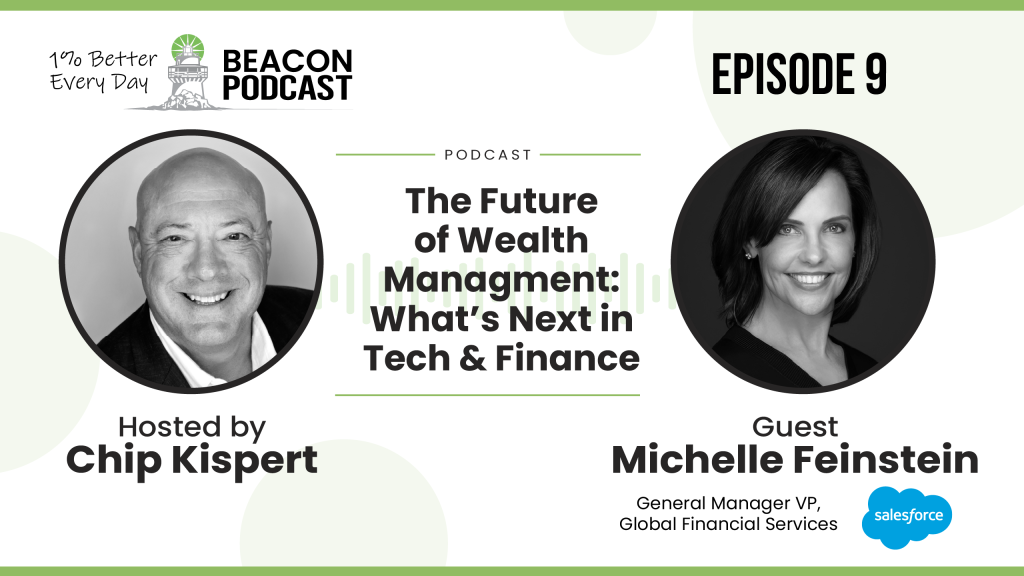
The wealth management industry is at a crossroads, and those who fail to adapt will get left behind.
In this episode, Chip Kispert welcomes back Michelle Feinstein, General Manager of Financial Services at Salesforce. With three decades of experience across Pershing, BNY Mellon, and Salesforce, Michelle offers an insider’s look at how firms can modernize, scale, and lead through disruption.
Together, they explore what it means to move from “builder” to “steward,” why AI and data strategy now define success, and how to break down silos between technology and talent.
What to expect:
- How firms can unify people, process, and technology to scale smarter
- The game-changing impact of AI, data, and MCP integration
- Why firms must choose strategic partners over endless integrations
- Practical ways to embrace innovation without losing human touch
- And so much more!
Resources:
About Our Guest:
Michelle Feinstein is general manager and vice president, Global Wealth and Asset Management Solutions and Strategy for Salesforce Industries. Her expertise is in digital transformation for wealth management. This process of digitization is complex; it requires firms to accelerate plans to harness data, digitize advisor-client experiences, and modernize service to scale and support growth.
RJ Malyk:
Welcome to Beacon 1% Better Every Day with Chip Kispert, founder of Beacon Strategies. This podcast is all about challenging the norms of wealth management and empowering professionals to make continuous progress and always be curious. Chip knows firsthand how small consistent improvements can lead to big breakthroughs, and that’s what we’re focused on here.
Helping you get 1% better every day. We’ll dive into conversations with industry professionals, share actionable strategies, and explore the mindset needed to overcome industry challenges and create lasting change. Let’s be curious. Push beyond what’s always been done and uncover better ways together.
Okay, let’s get ready for another Beacon, 1% better podcast where we discuss how to get 1% better every day with your host Chip Kispert. I’m RJ Mallick, producer of this podcast, and Chip, as always, great to see you and I see you have a guest for today’s podcast. So why don’t you introduce her and tell us what you two will be discussing on this edition of the Beacon
1% Better Every Day podcast.
Chip Kispert:
RJ, great to see you as well. I am so excited today to have Michelle Feinstein on the show. Michelle is the general manager of financial services in the FSC product group at Salesforce. She’s returning to the show after about 18 months, and I’m thrilled to have her back. Michelle, welcome.
Michelle Feinstein:
Thank you, Chip. It’s uh, been such a lovely experience all these years working so closely with you. Chip and I go way back. He’s known me since the beginning of my Pershing days, Salesforce days, all bridge. I’ve attended many beacon round tables, which if you haven’t attended one, you absolutely should.
Chip. Thank you for having me back on the show. Really so excited to jump into this conversation with you.
Chip Kispert:
I always love chatting with you. I always learn something. Um, when, when, you know, we were preparing for the show, I, I really loved the notes that you forwarded to me. Uh, three things that you really were kind of dialed in on, uh, in terms of recent accomplishments and one is the best.
I think it’s successfully raising a wealth management family, five kids and three bulldogs.
Michelle Feinstein:
Mm-hmm.
Chip Kispert:
Um, add to that. Your Pershing days, BNY, and Salesforce. Um, you have been an agent for change in this business. Um, before we get going, how about you just, you share a little of your background with the audience so that.
Um, they can better understand your thinking as it relates to kind of our upcoming conversations. Sure, sure.
Michelle Feinstein:
And I’m just gonna give a little context to what is a wealth management family. So, you know, it was just by accident and a little encouragement that as my children started to, you know, graduate college and look for jobs.
Um, I started having them look at financial services. It’s just such an amazing place to grow up and learn about the industry and technology. And so far, four out of five have landed, and some of them are at firms like Prudential, others at BlackRock, some of them are at RAA. So it’s a really nice mix. So.
And my daughter is the outlier. See, she’s international business. So we’ll see what happens. Uh, as far as the bulldogs are concerned, uh, they just benefit from being part of a wealth management family. And in terms of, in terms of my background, some of you may know I’ve been in financial services for 30 plus years.
Um, and really I think it’s probably a cross between financial services and tech. So started in discount brokerage many years ago that evolved into moving over to a. Clearing firm, which at the time was called Correspondent Clearing Services through Pain Weber. And I did conversion account management.
And that really exposed me to understanding, um, all the different changes that firms go through when they switched from one major clearing firm to another, whether it was Schwab to Pershing or Pershing to Fidelity. So that was a really great training ground. And it also put me right on the front lines with traders, with operations, with advisors.
After that, I went into product management for many, many years. Uh, some of you may know the suite of NetX solutions, NetX 360, NetX Investor. So I did product development for that platform for at least 15, and then went over to Albridge, did business development for all of the great solutions that they provide.
That also exposed me to things like, um, data reconciliation, which is. So, um, applicable for what firms are challenged with today. And then my time at Salesforce has just been incredible. It lifted me out of financial services into big tech at a global level, and what Salesforce is doing with AI and data and just the expansion.
Going from a CRM to a full platform for so many industries has just been an amazing journey.
Chip Kispert:
That’s great. I mean, you know, you and I have worked with customers, we’ve worked, uh, outside of that realm. I, I just, you’re one of my go-to people in this space and, uh, I always love chatting with you. Um, so let’s get into it.
Okay. What are your thoughts on the state of wealth management today?
Michelle Feinstein:
So, you know, I, I’m in a unique seat, right from a global level. I’m meeting continuously with firms all around the world. And what’s great is they’re all sharing their challenges, their north stars, their growth levers. And I think right now, I mean, our industry has always been in this state of constant change, but not like we are right now.
Right now, firms are at an inflection point where they cannot wait another minute. To change, they have to change how they’re doing things. So, you know, the impacts are what’s happening in the markets, the volatility, the political climate, uh, AI for certain, right? AI has been such a game changer, and it’s really forced firms to look at their tech stacks from the architecture level, the data level, it’s redefining what it means to build a user experience.
And this is a lot of change all at once for these firms. At the same time, you’re seeing a lot of market consolidation. You’ve, you’re seeing RIAs accelerate their speed in terms of making acquisitions of other RIAs, and that’s also causing a lot of complexity and friction for these firms because now they’re trying to blend the architectures and the legacy tech stacks of all these acquisitions, and it becomes a distraction.
I know we’re gonna dig into the AI side of it, but I’d also say we should probably also talk about data. So we know in financial services of all the different sectors, we have probably the most data of anyone and some of it’s structured, some of it’s unstructured. I think the biggest challenge is it’s really hard to access and you cannot launch AI use cases that are valuable unless you unlock that data.
Chip Kispert:
I would add to that, unless you have quality data. A hundred percent
Michelle Feinstein:
quality data, data that’s going to easily map into and connect to other platforms and systems. So today it’s all about playing nice in the sandbox and these platforms have to communicate. And now you’re talking also agents communicating across many different service providers.
Chip Kispert:
Well, you know, it’s interesting ’cause I think that if, if we look at that traditional model and, and people are adding in tech, right? They’d add in whether it’s a platform utilizing clearing custody. Mm-hmm. Whether they’re utilizing a platform like a Salesforce or others, whether they’re using what I’ll call more point solutions.
It was kind of bringing all these pieces of the puzzle like together and it. Basically created a lot of chaos for a lot of these RIAs.
Michelle Feinstein:
Yeah,
Chip Kispert:
last week I was at the, uh, Pershing, um, RIA growth summit, and it was interesting to listen to what all the, a lot of the, the very successful consolidators, aggregators, whatever you wanna call them.
Um, that are buying practices and what they defined as success and what they, what they were looking at, and they want to be able to create environments of growth, and that’s centralized scale. That’s
Michelle Feinstein:
right. Yeah. I think for those aggregators, uh, number one, they’re looking at just the talent that they have in-house, number one.
So they’re inheriting a lot of advisors, but they’re also seeing advisors aging out of the industry, some of which they may inherit. And so they’re challenged with how do they also at the same time, infuse. Next gen advisors into their practices. And, and the reason that’s important is one of the growth levers for many RIAs and broker dealers is how do we go beyond the typical client that we’ve always serviced, right?
So maybe that’s high net worth. Ultra high net worth, but now the younger generation, we term them as Henry’s, right? High earning, not rich yet. They really are a decade ahead of us in terms of the income that is coming their way and their ability to invest. So it’s really important that these res, if they’re gonna look modern and attractive to that next generation, they have to have advisors that can face off to them that understand their point of view, their situation.
Their risk appetites, et cetera. And that’s been a real struggle. But the other to your point, is scaling. So most of the firms I talk to, like doing advisors in transition, moving them from one firm to another, still extremely manual paper-based on more onboarding. Right? Right. The number one problem to solve, and no one has solved it yet.
And so especially with RIAs that are multi custodial, right? They have five different ways to open an account, to fund an account, to move assets.
Chip Kispert:
It’s crazy, you know, I have a bunch of marketing and recruiting people coming into DC where I am today. We’re hosting a round table, um, and I, recruitings and Transitions is, is top of that list for our discussion.
That’s right. Um, we go out and we look and, you know, we’re kind of, as you said, it’s a manual paper-based Excel spreadsheet driven process.
Michelle Feinstein:
Yep.
Chip Kispert:
The good news is I think there’s a little bit of light out there in that we’re seeing some new firms start to kind of step in and, and automate that process, and also, as you said, unstructured and structured data.
Being able to take unstructured data and make it structured to help with these transitions. I think it’s, it’s kind of a fascinating space right now, especially when you look at some of the folks that are focusing. On that transition, whether it be a forms logic, whether it be a dispatch, a mile marker, they’re all really kind of stepping in and it’s a new, it’s kind of a new day of technology.
Michelle Feinstein:
Yeah. Well, what I, I would also say is two things When you look at the growth levers, right? Remember there was a Beacon Roundtable about a year ago where we also talked about the painfully slow organic growth that a lot of these firms are seeing, and they’re like, why is that? Well, that’s because they’ve kind of left it up to the advisors in terms of the pace and cadence of engagement with their existing customer base.
So some firms in the room were saying, you know what? We’re gonna take control of that. We’re gonna put AI in there to start to assess. When was the last time Michelle was engaged? Was it 30 days, 60 days, 90 days, 120 days? What was the quality of that engagement? And they’re measuring these things and then they’re, they’re using AI to prompt these advisors with, Hey, I’ve noticed this has happened in Michelle’s portfolio, or with her financial plan, go engage her right now.
So it’s, it’s more of a real time, proactive model that we’re starting to see firms kind of force a little bit onto the advisors.
Chip Kispert:
It’s interesting ’cause I know Salesforce has been instrumental in, in really trying to drive those insights and that’s really a neat thing. So let me ask a, a different kind of question, right?
You have those firms that are really their status quo, I’ll, I’ll, I’ll call ’em. They, they don’t necessarily wanna embrace change. And then you have the firms that are embracing the change are building better scale. What happens?
Michelle Feinstein:
Yeah, so I think the ones that are in accelerated growth mode that are really getting it right.
The first thing is they’re, they’re bringing together business technology leaders. And if they’re global leaders in seats around the world, and they’re saying, we can’t operate in silos anymore, we need to have a unified front in terms of how we set our strategy, how we set our priorities. So the firms that are getting it right are saying, okay.
Instead of spreading the peanut butter really broadly and having too many priorities, they’re picking a couple big ones. Data for sure. Modernization of the data and the tech stack is first and foremost, uh, what firms are prioritizing. So they’re looking at a Salesforce and saying, you know what? We used to have our own proprietary data lakes, or we’d use the custodian, or it’s just a mishmash of solutions.
We wanna harmonize that. And they’re looking at solutions like Data Cloud as an example, to be that kind of open architecture. Foundational layer of the future of their new tech stack that they’re gonna rely upon. The second is they’re kind of coming together and saying, okay, what are the most important high volume kind of experiences that are really manual and complicated, and how can we have an approach where we’re really deploying intelligent and smart automation and engagement?
And so that’s the combination now of changing their workflow, changing the way that they’re doing their work. The third is talent. So they’re really starting to, I hate to say it, move people on that have been part of the organization that are resisting change and that they’ve been there for 30 years and they’re really starting to diversify the types of talent that they’re bringing into their organization.
People from fintechs, people from other industries that can help them transform faster with a fresh take. The last one I’ll make is strategic partnerships. So I’m starting to see across asset management and wealth. Instead of being builders and creating their own technology, they’re looking for acceleration, and so they’re being very strategic about reducing the number of partners and integrations they have in their tech stacks.
And getting that down to about five key players that can be really flexible and broad and add differentiated value to these clients and not make the, put them in a position of having to build something when that partner is really good at it. No, we’re gonna consume it into our ecosystem and that’s gonna accelerate us.
Chip Kispert:
Yeah, it was interesting. I was down with a broker dealer the end of last week and I asked their, their CEOA very simple question. I said, do you wanna be a builder of technology or do you wanna be a steward? And he looked at me and he didn’t quite know how to answer the question. He goes, well, that’s obvious.
I want to be a steward. Mm-hmm. I go, we get, we need to get you then to stop building technology. Right. So, and I think that’s an unbelievable point you make right there.
Michelle Feinstein:
Yeah. It’s hard. It’s hard for financial services firms to do that. You’re talking. Number one, they probably have upwards of 50, 60 different applications in their tech stacks.
Deciding which ones to get rid of is difficult. I mean, many don’t even have an assessment of the levels of adoption of those systems, right? And so that’s like the first place they have to begin is, alright, which of these are being used? What are we using them for? Do we still need them? And then the second is moving away from that customization.
The reason they do it is they’re trying to please the advisors or the wholesalers or whoever it is that they’re serving. You always hear about the good, better, best model, right? Where, and so many firms still deploy this, which is we’re gonna say yes to many different solutions across financial planning, portfolio management, CRM, give choice and we’ll integrate at different levels.
And honestly, that model is just, it doesn’t work anymore. It makes it overly complex for those organizations to manage over time.
Chip Kispert:
I can echo what you just said. With real life experience of a lot, a lot of these firms have a ton of tech and they don’t even know how many people are using it, and that’s, that’s a tough,
Michelle Feinstein:
yeah,
Chip Kispert:
that’s tough.
Michelle Feinstein:
Yeah,
Chip Kispert:
right. I’m a big best practice person. Right. So you hit some big, you hit some big kind of windows with your proceeding comments. Can you share some of, you know, maybe. Three four of best practices use cases that you’ve had the opportunity to see where wealth firms have adopted something and really were benefiting from it.
Michelle Feinstein:
So I’m gonna go back to the AI topic and a couple of the use cases that are real being put into, uh, production this year. The majority of them is around a meeting command center. So we know that meeting prep, anything having to do with it, whether it’s pre-meeting, during meeting, post-meeting follow up, is the number one use case that we’re seeing across asset management and wealth management firms.
Where they’re using generative AI and autonomous agents to take on those tasks. Now, from a best practice standpoint, there is a lot to think about when you’re trying to map a business process and all the different aspects of it. So what we try to do at Salesforce is we give out a template that helps these firms think through by business process, what is every single job to be done associated to that business process using meeting management as an example.
Are you comfortable with AI taking on that job to be done? A hundred percent, 50%, 30%. And so they start to map red, yellow, green. How much of this can be, um, agentic or handled by an agent, and all of a sudden the lights go on. They’re like, wow, we could gain, you know, 50% savings operationally and scale, whoever the persona is that’s doing that process really fast.
And that starts to open doors with their data governance teams, with their regulatory teams, with their executive management teams. So the big, the big ones are sales service, the advisor experience, all employee facing, haven’t seen too much from a end client standpoint in terms of AI playing a part there yet.
And I think a lot of that has to do with just the uncertainty around regulations and, you know, firms being concerned about getting fined if they’re the first ones to go down that road.
Chip Kispert:
It’s interesting though. I, I loved what you just shared. I think it, that really dovetails to what we’re seeing with the more mature firms.
The, the larger firms. Mm-hmm. For the small mid-size advisor, broker dealer, it can, AI can be overwhelming. It can be intimidating. Like how, how are you seeing those firms A, getting educated, but b. Starting to embrace some of the things that, some of the benefits that you just laid out.
Michelle Feinstein:
Yeah. So the, the smaller firms are, instead of locking themselves into a very large enterprise solution, they’re looking at niche providers.
So I’ll name a few, right? I hear a lot in the REA space around tools like Jump Sure. Or, uh, vanilla, right. For estate planning or, um. A couple others, but they do something that’s very specific and unique, uh, using ai. And so they’ll start to launch pilot programs with a branch office and use vanilla. In fact, my own advisor just used that with me and it was pretty cool because it was self-serving and he gave me the independence to go through that process.
But with AI suggesting along the way things that I was missing. So from an RA standpoint, I see them using multiple solutions like this. They are still looking at Salesforce too. They’re saying, I don’t wanna put all my eggs in one basket. And in fact, we had a product advisory council, uh, not too long ago, and they basically told us, don’t try to be all things for us, just be open architecture and plug and play and exchange data and connect agents to any niche capability that we want.
Because if we choose a, an AI capability, that’s really excellent in managing document management and analyzing those docs and synthesizing and summarizing, and let’s say it’s in, you know, insurance policies. We don’t want you to try to go build that. We’re just gonna go use that provider that’s an expert in that space.
Chip Kispert:
That’s great. That’s, that’s good advice. I, I think that’s terrific.
Michelle Feinstein:
I just wanna add, ’cause I didn’t answer this question, but in terms of learning on the RA side, um, they have shopped around and looked at different providers across custodians firms like Salesforce, Microsoft, um, but they’re also attending industry events, right?
So things like advise ai as an example, last year I was there, there were many RIAs in the audience and some of them even on the stage talking. And so they’re trying to find these events where they can. Learn from each other and see where are they achieving and where are they failing.
Chip Kispert:
And I think that’s gonna be a big, over the next couple years, that’s gonna be a big driver.
Um, you know, because some of the, some of the shops that we talk to, they are taken aback. They don’t know where to start, and they’re looking for the kind of that start point just to get a foundation.
Michelle Feinstein:
That’s right. Well, and that’s why you’re seeing. It took us until the middle of this year for firms and their compliance teams to even start approving, to move them past a proof of concept to actually put these things in production because there is that fear factor.
Like, is this really gonna work? Is this gonna cause us more issues than it will benefits? Sure. What’s the return on investment? What’s it gonna take to support it? And then how do we monitor the data flow?
Chip Kispert:
Got it. Um, one of the things I always like to kind of dive in, zero in on. Um, what are you seeing, and I know you, you articulated some of, you talked about agents, you talked about some data elements, but what are three or four areas that wealth firms are specifically trying to solve for?
Michelle Feinstein:
Yeah.
Chip Kispert:
And that you think are foundational, quite frankly.
Michelle Feinstein:
So number one, the advisor experience. We talked about this before. Uh, most of the wealth firms are focused on weaving AI into the flow of work for the advisor. Uh, generative ai, autonomous agents, right? So things like automatically. Ma managing their meetings and schedules, right?
Letting an AI, uh, tool take that on. The second is the meeting command center experience that I just talked about. The third is predictive insights and, uh, enhanced reporting, which is gonna tell them a lot more about their customers, their preferences, their needs, what they’re looking at outside of their organization.
So starting to crawl across social and, you know, different internet sites so that the advisor can be more armed. What’s interesting though is they’re also using AI to monitor the productivity and value that the advisor is providing. So using AI to see, you know, is Michelle using the tools that we’ve, you know, enabled her with, how often is she engaging with her customer?
What is the segmentation of her book look like? And is she starting to go into new segments that we’ve asked her to start to try to approach, uh, you know, what is the benefit and growth that that advisor is providing, and do we see the lifetime value of that customer starting to increase? Mm-hmm. And then there’s time management, right?
Even just monitoring the time management and the effectiveness with financial planning. That’s a big one. So, you know, I’ve seen some firms, I’ll use RBC as an example, RBC Wealth, where initially the two use cases were being able to use AI to quickly give the advisor in a couple of seconds a complete overview of what’s occurred with a household in the past year and it’s looking at 20 plus different data sources.
But the second one is planning. It’s using AI to go gather the data, organize the data, pre-populate a financial plan, suggest topics to talk about, and then monitor the progress of that plan.
Chip Kispert:
That’s the area that we’ve seen, you know, meeting prep and you mentioned jump zox, you know?
Michelle Feinstein:
Yeah.
Chip Kispert:
What they’re doing is taking that unstructured data and, and it really is pretty impressive.
Um, and then being able to populate platforms like yours, um. I think that’s fabulous. I think, you know, it’s interesting as well last week in some of our conversations, that productivity piece, right? People, you know, there are firms out there that are tracking every keystroke of what people are doing, and it’s not necessarily for a punishment element, it’s to learn.
Michelle Feinstein:
That’s right, and it’s to improve how they’re managing their practice. So, you know, modernizing the way they prospect and modernizing the way they manage their practice are two big areas that I’ve heard different firms bring up as a top priority. You know, I think the other is learning and training. Yeah.
So that’s another big category is. AI can be the advisor’s coach. Um, the AI can assess how they’re, you know, interacting with a customer on a phone call and kind of measure their, you know, how they came across in the customer’s sentiment, as an example, as a result, because these firms are trying to improve how their brand is perceived in the marketplace, right?
The third is adoption. So. You know, we’ve always struggled with adoption and training, but now AI can play a part where agents can come in and say, Hey, there’s gonna be a new product rollout and we’re gonna move you to this new process for onboarding. And they can teach the advisor in a whole new way that’s digestible and easy and kind of sit on the side as an assistant every step of the way, showing them what to do.
I think it’s gonna be a huge accelerator for adoption.
Chip Kispert:
Well, and I also think that that type of education dovetails with how people learned over the last. 10 years.
Michelle Feinstein:
Yeah. Well, listen, there’s a really cool, uh, tool that I assessed along, uh, a couple months ago called Storyline ai. And so, so so they’re changing, yeah.
They’re taking AI and saying, you know what? I’m gonna review all these big documents, or I’m gonna review what’s happening in account, but I’m gonna create short form videos that an advisor either can use for a learning perspective or. I’m gonna enable the advisor to have this short form video that the AI has created about what’s happening in Michelle’s portfolio and with her plan.
And it lets them send it to the client ahead of time as kind of a pre-experience before they get into an actual planning conversation, which I think is pretty neat. And they’re integrating with lots of different players, many of the ones that we named. It’s gonna be very interesting to see what, what happens with them.
Chip Kispert:
Yeah, I think what the work David’s doing there is pretty incredible because I sat and, and walked through the platform probably about a month ago, and it literally is taking 50 page PowerPoints, which nobody really wants to read, do they?
Michelle Feinstein:
Exactly. No. Um,
Chip Kispert:
and condensing it down into a 92nd, two minute little presentation video experience that’s much more personalized.
Michelle Feinstein:
And he’s also, he’s looking at, you know, research, he’s looking at, uh, you know, market updates and kind of make, making them like, uh, you’re watching the news, you know, for a few minutes, but it’s personalized to what’s happening in your account.
Chip Kispert:
Right. So, and it’s terrific. Great call out there, by the way. Um, so quick question on, in terms of, I always like to find out, and, you know, studying wealth in the advisor business these days, we.
We probably talked to 20 different firms a week at a minimum. Fintechs, wealth firms. Um, who do you pay close attention to within our space, um, you know, for research and for insights?
Michelle Feinstein:
Yeah, so again, I’m, I’m lucky because of the seat that I’m in, I have a lot of access to different consultants and analysts in the industry right at my fingertips.
So I’m constantly looking at. Ernest and young McKinsey, Deloitte, Capgemini, Gartner, um, all of those, we have many seats with many of them, and we often interact with them on a quarterly basis. So I get access to all those research reports. Uh. The second is, you know, because I’m meeting with so many customers live like you do, I’m in these strategy sessions.
Sometimes they even invite me into their own executive steer codes, and I’m a fly on the wall. So real time I’m listening to how they’re setting their strategies and their north stars and their top objectives, what their growth levers are. And so that’s, it’s a huge validating, um, kind of exercise for me.
I can kind of quickly see what’s changing, what’s different and what’s consistent. I mean, the third are some of the, the standard ones, right? I’m always looking at Michael Kitsis and kinda his perspectives on the advisor experience. Uh, Joel Brustein, some of the industry events. I try to make it a priority to make sure I’m there.
And the last is Salesforce. I mean, Salesforce does very large studies on what’s happening with ai, how’s it getting adopted, uh, what’s happening in the realms of sales and service. You know, where are firms investing? So all these different touchpoint feed into the perspective that I can give, um, on a podcast or to an executive committee at one of our wealth firms.
Chip Kispert:
Absolutely. Great insight. I I, I loved hearing that. Um, I’m gonna kind of jump to my final question, and we like to be curious here at Beacon, we’re always trying to push the envelope a little bit. Um, what do you see as the biggest game changer? Narrative redirect for the wealth management industry.
Michelle Feinstein:
So I think one of the biggest game changers is gonna be, we’re gonna see a whole new way to solve for this fragmentation and integration problem.
So historically it’s been through one way or bidirectional APIs, right? But now with AI and the need to connect agent to agent and the need to connect different data clouds to each other. We’re starting to see a very different integration protocol getting built. So it’s termed MCP, but it’s this orchestration layer that sits on top of any data lake, and it’s gonna, it’s out there right now.
In fact, we’re launching, Salesforce is launching it at Dreamforce next week, but it’s this ability for. To create realtime data streams using this fabric, and it’s gonna be much easier, and I think it’s gonna start to retire the standard way of APIs, which frankly, a lot of firms have been very slow or antiquated in terms of how they even build out their APIs.
So I think we’re gonna move way past that and that’s gonna get these streams of integration, um, points speaking to each other a lot faster. And the agent to agent orchestration is gonna be the biggest game changer I think we’ve seen in many, many years.
Chip Kispert:
I 100% agree with you. Um, I was hoping you’d kind of go down that path because we do see MCP as as changing the narrative Yeah.
And getting away from kind of these point to point APIs to being able to have real security as well as the ability to move data effectively, efficiently.
Michelle Feinstein:
Yeah. And it’s really important, right? Because no single wealth firm is gonna have only one AI solution. They’re gonna be using these agents as employees sitting in all these different places and with all these different partners, and someone has to orchestrate that new staff.
Right. And that staff doesn’t work for only one firm?
Chip Kispert:
Correct. All right. All. We’ve come to the end of the show, but I always like to give our guests the 1% better every day flash comment. So this is your time to share an insight that you have on the wealth management space.
Michelle Feinstein:
Wow. 1% better. Um, I guess I’d say get out there, network.
You know, get to know your peers in the industry. Learn from them. Attend events. Um, stay current. And if anything, if you’re not using AI today, you need to be using it in your everyday life. Tools like Gemini Notebook, LLM, um, perplexity, Claude. Subscribe to multiple solutions because they’re all changing so quickly.
And if you use it in your everyday life, then your ability to apply that to your business models, um, is gonna make a lot more sense and encourage your employees to do the same.
Chip Kispert:
Michelle, I’m grateful to have had you on the show until next time.
Michelle Feinstein:
All right, see you then.
Chip Kispert:
Rj, how about that conversation
RJ Malyk:
with Michelle?
That was pretty good. That was really good. There was just so much information and a lot of times with your podcast Chip, I have to admit, it’s, it’s a lot for me to, to, to absorb, but it’s just a great insight about AI because it’s, it’s coming at us so fast and we have to be prepared and, and she just had some wonderful points to make.
Chip Kispert:
She did. And one of the things that I’m, you know, that we’re seeing out there right now is kind of those firms that, um, aren’t embracing AI and those firms that are, and, and that is something it’s interesting to watch because, um, it kinda leads me into kinda my, my three takeaway thoughts. Um, and number one, uh, for.
Firms that really want to have organic growth scale comes from really these centralized platforms. They’re gonna allow advisors to focus on what they do best, and that’s helping investor customers. Uh, number two. As you said, artificial intelligence is gonna be a differentiating factor as firms look to drive organic growth.
And then number three, and I, I loved how she came with this at the end, but MCP is really gonna be the, uh, the integration platform of the future. Um, just how. Everything I’m reading about it as we’re exploring it, um, it takes a lot of the point to point. It, it makes it easier, makes it more secure. Um, I’m gonna be really excited to see how the wealth management industry kind of embraces MCP and, and the value that it can bring.
Awesome.
RJ Malyk:
That’s, uh, a lot there.
Chip Kispert:
There’s a lot to cover there. So, uh, you know, as I close out, um, I do wanna say, Hey, check out our archive of past shows with industry leaders like Robert. So from Snappy Kraken, Jeff Moore from ValMark, and I couplers Derek Nauman to name just a few. Um, we, again, I have, was super excited to have Michelle on the platform.
Or on the, uh, podcast and, uh, RJ it was a good day.
RJ Malyk:
Yes, it was a very good day. Very interesting. Just, just a, a boatload of information.
Chip Kispert:
All right, rj, as I close out for the show, um, if anybody wants to find some information out about our podcast, they can go to our website, www.beaconstrategiesllc.com/podcast.
We here at Beacon encourage you to get 1% better every day, and to quote Walt Whitman and most recently Ted Lasso, be curious, not judgmental, until our next episode. This is Chip Kispert. Be well.
RJ Malyk:
Thanks, Chip, and we need to add in a shout out as this podcast is brought to you by Beacon Strategies, LLC, the go-to resource for Round Tables Consulting and services that support wealth management firms and their providers.
If you need some industry perspective or help, please visit. Beacon Strategies llc.com. Again, thank you for listening to the Beacon 1% Better podcast. We ask you to share this podcast rated and leave a review because this actually helps others find the show. Again, thank you for listening and for Chip Kispert and everyone at Beacon Strategies, I’m RJ Mallick and we look forward to you joining us for our next podcast.
Thanks for joining us on Beacon’s 1% Better Every Day podcast. Be sure to hit that follow button so you never miss an episode. And stay up to date with Chip and his friend’s. Latest insights and strategies. If you want to learn more about Beacon Strategies or get in touch, visit us@beaconstrategiesllc.com.
Remember, progress starts with just 1% every day. Let’s keep challenging ourselves to be curious and grow. The information covered in posted represents the views and opinions of the guest and does not necessarily represent the views or opinions of beacon strategies. The content has been made available for informational and educational purposes only.
The content is not intended to be a substitute for professional investing advice.