
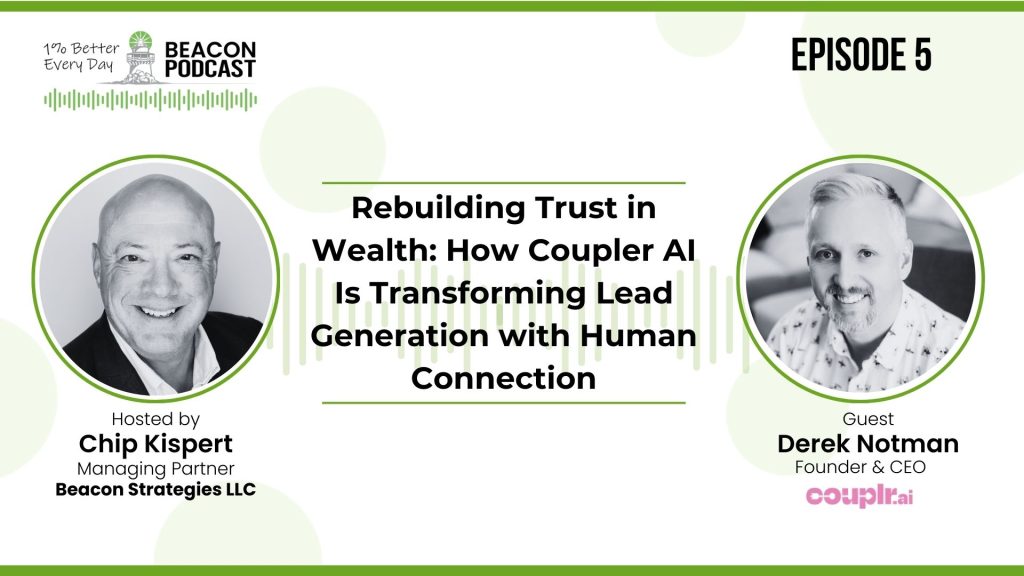
When Derek Notman, CFP®, launched Couplr AI, it wasn’t just about building a better lead gen platform; it was about bringing human connection back to the center of financial advice.
In this episode, Chip Kispert talks with Derek, a former top-producing advisor turned fintech founder, about what’s broken in traditional lead generation and how his team is reimagining it through the lens of empathy, personalization, and behavioral science.
Drawing on experience from both the advisor seat and startup trenches, Derek explains how cold outreach erodes trust and why flipping the script to empower consumers, not chase them, could transform advisor growth. The conversation also explores orphan accounts, ethical leadership, and Derek’s unexpected path to masterminding with Richard Branson.
What to expect:
- Why legacy lead gen misses the mark on human connection
- How Couplr uses behavioral data to match clients and advisors
- The orphan account crisis no one wants to talk about
- What Richard Branson taught Derek about fatherhood and business
About Our Guest:
Derek Notman, CFP®, is the founder of Couplr AI and a former financial advisor with over 20 years of experience. After building a successful advisor practice and RIA, Derek turned his focus to solving one of the industry’s biggest friction points: helping clients find the right advisor at the right time. Couplr blends behavioral psychology, AI, and a dating app-like experience to deliver more meaningful advisor-client human connections. Derek is also the creator of the Dadpreneur experience, a leadership mastermind hosted on Richard Branson’s Necker Island.
[00:00:00] RJ Malyk:
Welcome to the Beacon 1% Better podcast, where we discuss how to get 1% better every day with your host Chip Kispert. I’m RJ Malick, producer of this podcast, chip. As always, good to see you. So let’s get right to it. Introduce your guest and what you’ll be talking about on this podcast.
[00:00:17] Chip Kispert:
Terrific, RJ, thanks for that introduction.
Uh, today I am really pleased to have Derek Notman on the show. Derek is founder of Coupler AI and at Couplr AI, they’re leveraging AI and data science to connect clients and financial advisors for the right reasons at the right time and place. Uh, Derek has a number of accomplishments. But a few include winner the Wealthiest in 2002 finalist for the Wealthiest and Luminaries.
In 2023 and 24, he won the Nitrogen Advisor Appreciation Award and he also won in Business Magazine 40 under 40. Derrick, welcome to the Beacon Flash Podcast.
[00:01:02] Derek Notman:
Thank you, Chip. Great to be here, my friend. Looking forward to a fun conversation today. I always love getting together with
[00:01:09] Chip Kispert:
you. Um, let’s really kind of kick off and, and get to it.
So tell us a little bit about your background and why, why’d you
[00:01:17] Derek Notman:
start Coupler ai? So I, I’m a recovering financial advisor, so I’ve been in the space 20 years. Uh, cut my teeth at New York Life. Was a top producer there nationally for a number of years. Uh, then went fully independent, started my own RIA, which I still own today, uh, but also at, uh, about three, four years ago, started Coupler.
And Coupler was literally something that came to mind as an advisor. I found the whole lead, lead generation, the client advisor connection process to be terrible for all parties involved. And I was like, man, there’s gotta be a better way to do this. And, um. We’ll talk about more about this, but really it just came back to human connection.
People are wired to connect with other people like them. And I saw all the great relationships I had with my clients. The ones that were the best were the ones where we really connected. I’m like, well, why doesn’t lead gen do this? Why don’t we connect people like this? And, uh, next thing I know, I’m a FinTech founder, um, up to my eyeballs in startup land,
[00:02:24] Chip Kispert:
and it is an interesting land, isn’t it?
[00:02:27] Derek Notman:
Um, oh boy. Is it ever
[00:02:28] Chip Kispert:
so. You know, as you’ve kind of been going down this journey and, you know, one of the, the, the things we’re fascinating we’re, we’re studying this pretty deeply at the moment, is, is lead gen, right? And so can you share a little perspective on how you view lead gen and how you see the need for transformation from where we are today?
[00:02:56] Derek Notman:
Yeah. Lead gen is the lifeblood of every advisor business. Whether you are the solo advisor all the way up to a national broker dealer, dealer, wirehouse, it doesn’t matter. You need client flow. So where we are at today is that we have evolved from the cold list, door knocking methods, snail mail seminars.
Now that stuff still happens, but doesn’t happen as much as it used to. And really when I look at the landscape of lead gen technology today. Most of it is simply a digital adaptation of the manual cold processes we are have used in this industry for many, many, many decades. And there’s good and bad with that technology, obviously speed things up.
Um, I think there. There’s some really good players out there that have done some really, really good work and have obviously been successful. They’ve raised a lot of money and and so forth. But now we’re starting to see the cracks in, if you kind of wanna call this like first generation lead generation experience, and I think this is where the, the real transformation, why we really need to evolve to the next gen now is that at the end of the day, as I already mentioned, we are wired to connect with other human beings.
So. What does, what do I mean by that chip? Well, people didn’t like getting a cold call at seven 30 at night. People don’t like you knocking on their door to try to sell them something. People don’t like you stopping in on their business unannounced to try to sell them something. And so it worked. But you know, even a blind squirrel finds a nut once in a while.
Okay? And so what, what what has happened is a lot of this lead gen tech that has, has come out is essentially digitize these things that kind of worked. And now they’ve may, they’ve scaled them a bit, but they forgot the human element aspect. And I think this is where, where there’s massive opportunity for the next generation now.
[00:05:04] Chip Kispert:
Got it. So, you know, and, and hey, you, you have your own wealth firm, right? Um, yeah. You know, but as you look at this and you look at lead gen, you know, where are a couple areas where you can see wealth firms making meaningful improvements? To that lead gen experience,
[00:05:26] Derek Notman:
how does the technology facilitate better human connection?
And I think firms that lean into that are the ones, and again, solo shop all the way up to, you’ve got 10,000 advisors in your field force. Doesn’t matter that that is the true north star that I think we are missing. And we can, we can get into what I mean by that in a little bit. But the firms that are gonna succeed, I think are actually gonna start to rebound and lean back into that and look for tech that helps them do that.
In, in fact, like I, I just published a blog today and referenced the study from the World Economic Forum that came out last year called The Future of Financial Advice. You’re probably familiar with it. What was the number? It was either 74 or 76% of consumers want a personalized experience. And a human advisor to boot, right?
And so I think that’s where firms today and moving forward, that’s where the puck’s headed. So if I’m, if I’m looking at technology, is it helping me do that thing that the customer’s asking for,
[00:06:31] Chip Kispert:
but how within lead gen do you do that?
[00:06:36] Derek Notman:
Flip the script as we talked about, people don’t like getting cold calls, right?
People don’t like you knocking on their door. How many, uh, snail mail campaigns get out and the, and the letters ripped up before even being read or opened? Right. Terrible conversion rates. Okay, fine. But let’s also remember people need and want help with their money, and they probably want it more now than they ever have now that we’ve access to tech and, and transparency and education and all this.
Mm-hmm. So all we have to do is change the experience. So instead of using technology and now you’re doing digital cold calls or, or you know, digital door knocking or all these things and competing for leads, why don’t we flip it around and empower the consumer, the one that is thinking about their money already and has questions and wants help.
Why don’t we empower them to find the right advisor for them when they’re ready? And so that, that’s a quarter of what we do at Coupler, right? Because if, if we can now speed up the process of building rapport and trust with an advisor and giving the consumer control, you can see my pups joining me in the background here.
We give the consumer the control of the process. So now as a consumer, ’cause the second I fill out a form online. Now I’ve lost control and that process feels creepy. Or the second you cold call me and say, Hey Chip, I just learned that you moved and you bought a new house, or you rolled over, or you’re a huge donate.
You know, you donate a million dollars a year to your alma mater. All this publicly available data. Like you call me up and you say, you know these things. That’s super creepy to me. So let’s flip it. Let’s let the consumer who’s ready to make a decision and want help, let’s just empower them and let them get matched with an advisor when they’re ready on their terms.
When we do that, we have an amazing consumer experience. But what have we done for the advisor now? Advisors hate cold calling advisors. Don’t wanna be a marketing expert. If they want to help people with their money, so they need to spend time doing that and not cold calling or competing for leads and all that stuff.
So when we flip it, when we flip that lead generation experience around, everybody wins.
[00:08:57] Chip Kispert:
That’s a deeper, that’s a conversation I think you and I could probably go into for the next two hours and, and tease that one up. Yes. I think that would be a blast to talk about. Uh, but, um, I’m gonna keep this moving because you mentioned something a little earlier about the industry losing its North Star and losing, you know, and forgetting that this is a people business.
What do you mean by that?
[00:09:24] Derek Notman:
We have technology fatigue. I need a, a telescope now I need Hubble to look at the Kitsis FinTech map to zoom in. Right? Or like, like I need like, or maybe that’s the wrong one. Like, like a micron microscope, right? To really get it. ’cause there’s so many, I’m feeling overwhelmed. So whether I’m an advisor or I’m a CTO or I’m in charge of something, you know, at a technology level for a large institution, I’m overwhelmed.
I’m drinking from a fire hose. Yes, technology is a great tool. It’s something we should add to our technology bucket, our tool bucket for the businesses that we run. But we can’t forget at the end of the day that our North Star is that we serve human beings. We help them realize their hope, dreams, and goals through our expertise and advice and products and services that all revolve around money.
Right? And I think what’s kind of started to happen, my impression is now there’s a lot of good advisors out there that really are focused on the human aspect, but we’re starting to almost feel like the technology’s the easy button and it isn’t. It isn’t. And it shouldn’t be the best. The best thing about being an advisor is being able to sit with your client and cry with them, and laugh with them and understand, like I was just meeting with a client yesterday.
He’s going through chemo. And he loves the tech that we use, but we didn’t talk about the tech. We talked about the trips that he’s trying to do and the things he’s trying to do around his treatments and what he wants his money to do for his kids. That’s the human stuff. The technology just helps us have the human connection a little bit easier, and I think, man, if I’m, if I’m a CEO of a large Fortune 100 wealth company, insurance company, or I’m a solo advisor.
I’m looking at the technology landscape, I think the first filter I should use is the Human North Star. First, is this technology gonna help me actually have better human connection? You know, after COVID and with all of the stuff going on in the world and the way that technology tends to actually like.
Separate people. There’s a massive opportunity for us to come back to what’s wired in our DNA, to just be with humans, to be next to people, to be with them, and like we’re doing this today, like Chip you and I’ve never met in person, but we’re able to do this. And we have a little insight to each other’s lives.
Like, I can see your guitars, you can see my dogs running around, right? Like there’s, this is helping facilitate human connection that someday we’ll be able to sit in person together and it’ll be even more meaningful. Right. Correct. So I, I can go on and on and on, but hopefully that, that makes sense about like a human North star.
[00:12:09] Chip Kispert:
Absolutely. Makes a ton of sense. It actually dovetails with a lot of things we’ve been thinking about here of technology should be an enablement tool, not a, not a a, um, basis for the relationship.
[00:12:25] Derek Notman:
Ugh. Amen. You got it.
[00:12:27] Chip Kispert:
So, all right. That was, that was really interesting. And that was pretty cool and thought provoking for me.
Um, also when we were chatting earlier last year, uh, as we were getting together and trying to do this, um, we talked about orphan accounts and orphan accounts have, are, have a place near and dear my to my heart. So I, I’m interested on your perspective on orphan accounts.
[00:12:56] Derek Notman:
Yeah. This is a global problem, um, and one that bothers me.
Uh, and I think that it, it’s gonna ruffle feathers at some institutions. So, but, but people need to hear this ’cause if, if the human being is the true north star and doing what’s right for them is really what’s all important, then they’ll then. Addressing this orphan client problem is necessary. There are a lot of orphan customers sitting out there in the US and I mean, I, I, I have, I have customers for coupler in, in South Africa, for example.
Same problem. They have it, these are people that bought some type of financial product, their advisor quit, left, got fired, whatever. And now they’re sitting out there and they have no advisor. The company has a responsibility to get that consumer hooked up with another advisor for a variety of reasons.
But what I’ve been told, um, from I, I won’t name names, but from folks at Fortune 100 Insurance and wealth management companies, the orphan block of business is the most profitable block of business. And that they are almost kinda like just trying to ignore it. Right. In a sense, and I, I’d have nothing to back this next statement up, but I feel like they would rather be scrutinized by finra, SEC, whatever, and pay a fine versus actually reassigning accounts.
That just seems like a massive conflict of interest and a huge problem, and I, I would take the opposite approach and say, why don’t we reengage these orphan customers? We made them a promise. Life happens, advisors move on. Like, I get it, that’s fine. Why don’t we reengage ’em with the new advisor that’s best suited to help them and let’s keep that business on the books and maybe we can cross sell this, this person and get more of their wallet share at our company.
Keep the loyalty, uh, you know, and so forth and great, great experience for the customer. I really think that’s what needs to happen. But at the end of the day, we are in a for-profit industry and if that’s a really profitable block of business, and I don’t have to do a lot with it, I can understand the logic there from a financial perspective, but is that like a good human being perspective?
I don’t know.
[00:15:17] Chip Kispert:
I think your comment on good human being, I also look at it from a fiduciary perspective.
[00:15:22] Derek Notman:
Oh, all day long. Fiduciary. Yeah, all day long.
[00:15:24] Chip Kispert:
Right. So, you know, they are gonna have, and, and we do, we’ve seen it. You know, the regulators come in and say, Hey, you know, who are these accounts attached to?
They’re attached to the house. You know, things can get a little bit dicey. Um, so I think this is a huge problem in the industry. Um, for the last couple years we’ve been looking for solution providers that can help with it. Um, it is a very, very hard, um, road to till to be able to, to get in and make meaningful change.
Um, but I think that, uh, something on the, it’s something on the horizon.
[00:16:04] Derek Notman:
To your point, if I’m, if I’m a executive at a large company and I’ve got 3 million orphan customers, do I wanna spin up a call center with 500 people, pay all of them a salary and try to connect with these people? I really don’t want to do that, and I probably don’t have the budget for it either.
Like that’s a monster task that I, I would dread if I was in their shoes. But this is where technology when used correctly could be deployed. To reengage these customers very quickly and get them back with the right advisor for them. Potentially find the right advisor for them, right? All day long. So it is possible.
So if anyone’s listening, like there, there are coupler can do this, by the way, you know, that’s, it’s been a real, we, we’ve had our, our, like the customer in South Africa in particular approached us like, Hey dear, we’ve got a ton of orphan customers. How do we, how do we solve this problem?
[00:16:54] Chip Kispert:
Listen, I could probably go to 30 firms right now and put you in front of ’em and you know, I think you’d have good conversations.
So anyhow.
[00:17:05] Derek Notman:
Oh, for sure. I’m sure of it.
[00:17:06] Chip Kispert:
Yeah. So I’m gonna kind of change gears a little bit. Um, I’m fascinated, you know, one of the things I saw, uh, last year was you spent some time, time down at Necker Island with Richard Branson. Who was that experience like?
[00:17:23] Derek Notman:
Uh, it’s surreal, man. I still have to pinch myself.
Uh, and we’re going back again this next January. It, it has been, um. Life changing. It has been so overwhelmingly positive in so many aspects of my life as a father and as a business owner. You know, quick context. Um. I wanted to create a community where there was support for fathers who were also business leaders, entrepreneurs, and really blend and integrate those two roles together.
And I wanted Richard to be involved just ’cause of what he’s done himself. And almost for a short, we were able to, and he wants us to come to his island and, and do this and, and have our mastermind sessions. And like I, I actually asked him a question on LinkedIn that he actually picked up and wrote an article that was viewed millions of times.
About what advice does he have for dad entrepreneurs, as we called it.
[00:18:15] Chip Kispert:
I love that. I love it.
[00:18:17] Derek Notman:
Which is really, really cool. But yeah, it’s all about supporting fathers and business leaders to be the best they can be at home and at work.
[00:18:25] Chip Kispert:
Well, it sounds like amazing content. Sounds like you had an amazing crew with you as well, and uh, looked like you had a little bit of fun too.
[00:18:32] Derek Notman:
Ton of fun. That was it. Like we, we didn’t want this to be a stuffy, like 10 hour day in an over air conditioned conference room. We have, we have some fun in, or some work in the morning, not even work. It’s like, they’re just great conversations and then we have a ton of fun.
[00:18:46] Chip Kispert:
That’s great. Well, I look forward to, you know, hearing more about it and, and seeing what, what comes back in January.
Um, moving back to the wealth space, right. Um, when you study the wealth and advisor business these days, who do you follow, pay particularly close attention to? Um, and you know, kind of which companies out there in the wealth space are inspiring you?
[00:19:12] Derek Notman:
I’ve got a lot of friends in this space. Um, and so I’m keen on any company that is focusing on, I know this is a recurring theme now, but the human element and how are we better engaging people?
And so like Adam Holt over at Asset Map. Love what they’re doing. Um, I’m really interested in what Rob Kirk is doing at Intergen data on like mm-hmm. Predicting these life events and how we can help people earlier on. I think that’s super cool. Um, and then there’s a long, long list. Like I’ve got a lot of friends on the, um, on the FinTech map.
Right. You know, I, I love what Bento engine and Phil Hecker and his team are doing. With helping, you know, identify these life events and how do we plan for them and so forth.
[00:19:56] Chip Kispert:
Gotcha, gotcha. And I think that’s terrific. And you know, the people that you just laid out there, I know them personally. Um, and they do focus on, on that personal side and they use data to enable better relationships and that’s it.
They enable the advisor. Uh, to help people get where they want to go and, and achieve their dreams and goals financially. So I think it’s, that’s, those are who you laid out was terrific. Um, my last question, we like to be curious here. So, um, as you look at the wealth space and looking forward, what are you curious about?
[00:20:39] Derek Notman:
I’m really curious about human behavior. And so one of the things that we’re learning at Coupler is we’re getting a massive amount of data on human behavior psychology, why people look for an advisor when they connect with an advisor. Things that have never been known before, where we can start to see at.
Not only just national, but global levels, people interacting with their money and, and the professionals that support them. And what does that look like? And like preferences as far as like age, gender, um, qualifications, like South Africa, we, they have 11 official languages down there, so we’re learning about what language preference that consumers and advisors have.
Ethnicity, like the list goes on and on and on. And so that’s what’s really exciting that I’m. We’re starting to learn ’cause it’s never been done before in our industry. And we’re doing it through the lens of like, almost like tongue in cheek, but like a dating app experience. You know, we’re using the eHarmony Bumble models and we’re applying it to insurance and wealth management.
And it’s a, not only is it a ton of fun, like my, my team internally has now referred to me as the chief qubit officer at Coupler. But it’s, so, it’s a ton of fun, but we’re learning great things about people and, and this really powerful tool we call money in the process.
[00:22:02] Chip Kispert:
That’s really, really neat. So one of the things we always like to do is we wrap up our, our time together is to give you the 1% blast time.
So you, Derek, you have 45 seconds to share, you know, a topic that you think is insightful about our wealth management with our audience.
[00:22:21] Derek Notman:
Oh my gosh. This was always a tough one for me. Something that’s insightful for your audience. Does your tech have a creepy factor to it?
[00:22:33] Chip Kispert:
That’s an interest. I, that’s an interesting idea.
[00:22:37] Derek Notman:
I find it creepy when someone calls me up and like, I had this happen the other day. I have no idea who this person is or how they got my number, but they, they call me up, they keep calling. They don’t stop calling. So I answer it and they’re like, Hey, is this Derek?
Um, it sounds like you wanna some more life insurance to protect your family in the event of your death. I’m like, like, dude, who are you? How did you get my information? And like, this is super creepy. Mm-hmm. And so I like, I would just encourage all of us, because money is super personal and super private.
Like, if, if you’re gonna be engaging with a, a customer or using a technology to do that, please just have like a creepy filter first. Like, is how creepy is this gonna feel? I love it.
[00:23:21] Chip Kispert:
I love it. And you’re right, like you’re right. You know, it’s amazing. I get these phone calls, well, we need, you know, are you open to more life insurance?
And I’m like, who are you? How do you, what database Yeah. Did I pop up on? Right?
[00:23:37] Derek Notman:
It’s just like big data can be helpful, but please don’t use it in a creepy way. Please, please, please. Like people are buyers all day long, but not when it’s creepy.
[00:23:45] Chip Kispert:
I love it. I love it. Derek, I wanna thank you for joining me on the Beacon 1% Better podcast.
I always enjoy your perspective when we talk. You’re a trailblazer and I look forward to seeing you and coupler AI continue to grow while you also have a lot of fun. Before you go, how about giving us your contact information?
[00:24:06] Derek Notman:
Awesome. Well thanks for having me, chip. Really, really love this conversation.
Uh, best way to get ahold of me is go to LinkedIn, super active there, follow me, send me a note. Happy to connect with folks.
[00:24:16] Chip Kispert:
Sounds great. Derek. Thank you so much for spending time with us. I love our conversation.
[00:24:22] Derek Notman:
Me too. Thanks brother. All the best to you.
[00:24:25] Chip Kispert:
RJ. Wow. I really enjoyed that conversation. I thought it was terrific.
Uh, in reflection, I have three thoughts in my conversation with Derek. Three takeaways. Yeah. Uh, number one, um, you know, based on his comments, he feels that the North star, uh, for wealth, which is that human element is being lost, um, that was one of my takeaways. Two technology should really. Um, enable the human experience for wealth managers, uh, and advisors.
That, that, that’s a piece that keeps coming back to me, um, from our comments and my conversations with him. And then lastly, and, and we have been seeing an uptrend in this, is that the human behavior psychology is really becoming more and more important to wealth management. And the satisfaction that clients have with their advisors and wealth management firms.
[00:25:29] RJ Malyk:
I agree. Those, those are are great takeaways and, and like I said, it, it was a fascinating conversation to listen to both of you talk about this.
[00:25:37] Chip Kispert:
Well, it was a lot of fun. Um, so the other piece of this is, uh, lastly, check out our archive of past shows with industry leaders like Cambridge’s, Colleen Bell, S Ventures, Sid Yara, and Michelle Feinstein from Salesforce to name a few.
Those can be found at beaconstrategiesllc.com/podcast. We here at Beacon encourage you to get 1% better every day, and to quote Walt Whitman. And most recently, Ted Lasso. Be curious, not judgmental, until our next episode. This is Chip Kiper. Be well.
[00:26:13] RJ Malyk:
Thanks, chip. We need to add in a shout out as this podcast is brought to you by Beacon Strategies, LLC, the go-to resource for Round Tables Consulting and services that support wealth management firms and their providers.
If you need some industry perspective or help, please visit. BeaconStrategiesllc.com. And again, thank you for listening to the Beacon 1% Better podcast. We ask you to share this podcast rated and leave a review because this actually helps others find the show. Again, thank you for listening and for Chip Kiper and everyone at Beacon Strategies, I’m RJ Mallek and we look forward to you joining us for our next podcast.