
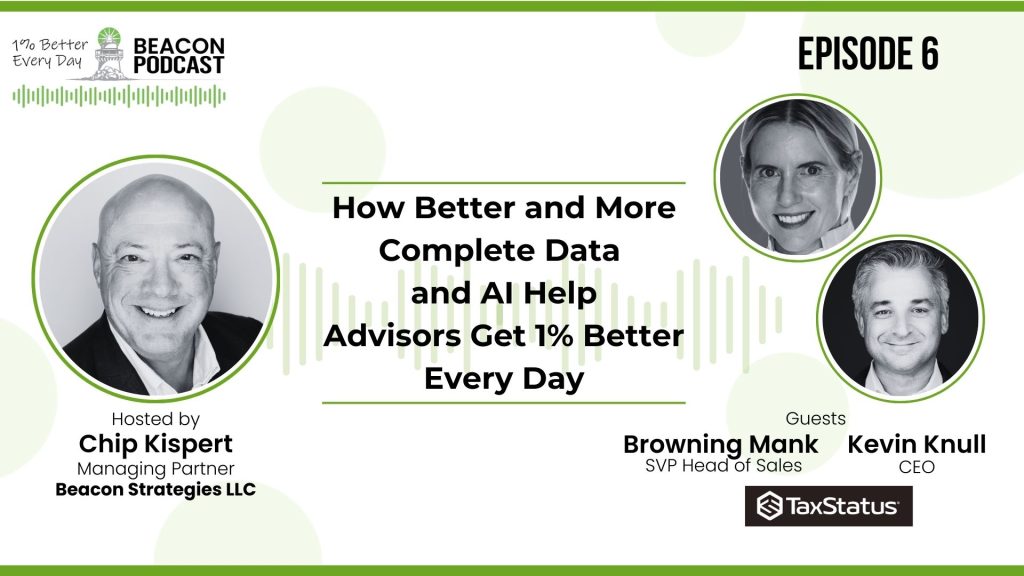
What happens when IRS tax data meets AI in the middle of an advisor shortage?
In this episode of Beacon: 1% Better Every Day, host Chip Kispert sits down with Kevin Knull, CFP®, and Browning Mank of TaxStatus to explore how their platform is reshaping advisor growth strategies and client service models.
Kevin shares his journey from the U.S. Coast Guard to fintech leadership, highlighting how solving big problems with technology and helping people has always been part of his DNA. Browning offers an unexpected but relatable story about dating that ties directly into why having better data leads to better outcomes.
What to expect:
- Why incomplete data puts advisors at risk of giving partial advice
- How firms can discover hidden assets and unlock organic growth
- The staggering advisor and CPA shortage ahead, and the opportunity it creates
- Real-world use cases of how tax data transforms client reviews and prospecting
About Our Guests:
Kevin Knull, is the Chief Executive Officer at Tax Status, where he is focused on building strong teams and creating innovative strategies that drive growth and performance in the fintech and financial services industries. Over the course of his career, Kevin has led teams and driven transformation at leading firms including MoneyGuide Pro, PIEtech (MoneyGuide’s Truth platform), YCharts, and Symetra Investment Management. With a background that began at the U.S. Coast Guard Academy and included three tours of duty, Kevin brings a service-first mindset to every role. His passion lies in solving big problems, leveraging technology, and helping advisors deliver better outcomes for their clients.
Browning Mank is the Senior Vice President and Enterprise Account Executive at Tax Status. She brings decades of experience across wealth management, insurance, and asset management, with a career that spans corporate, entrepreneurial, RIA, CPA, and fintech sectors. Browning spent 18 years in leadership roles at Fidelity Investments, where she oversaw sales strategy and execution across retail branches, regional centers, and institutional RIA/Broker-Dealer channels. Following her time at Fidelity, she founded a successful executive recruiting and consulting firm, and later held strategic roles with Ackerman Capital Management, ForwardLane Inc., and other prominent RIAs and fintechs. She joined Tax Status in 2024, where she focuses on helping wealth firms harness IRS data to improve client outcomes and drive organic growth. Known for her collaborative approach and creative problem-solving, Browning is dedicated to elevating client and employee experiences and unlocking new opportunities for the professionals she serves.
[00:00:00] RJ Malyk: Welcome to Beacon. 1% better every day with Chip Kipert, founder of Beacon Strategies. This podcast is all about challenging the norms of wealth management and empowering professionals to make continuous progress and always be curious. Chip knows firsthand how small consistent improvements can lead to big breakthroughs, and that’s what we’re focused on here, helping you get 1% better every day.
We’ll dive into conversations with industry professionals, share actionable strategies. And explore the mindset needed to overcome industry challenges and create lasting change. Let’s be curious. Push beyond what’s always been done and uncover better ways together. Welcome to the Beacon 1% Better podcast, where we discuss how to get 1% better every day with your host Chip Kiper.
I’m RJ Malyk, [00:01:00] producer of the podcast Chip. Good to see you.
[00:01:03] Chip Kispert: Good to see you, RJ. Looking forward to getting this great podcast going.
[00:01:08] RJ Malyk: Yes. And I see you have a couple of guests, so let’s not, uh, uh, waste any more time. Why don’t you take it away and introduce your guest and tell us what you’re gonna be talking about on this podcast.
[00:01:17] Chip Kispert: Great. Uh, today I’m joined by Kevin Null and Browning Mank from Tax Status, where they use IRS Tax Data, AI, and Data Science to support advisors growth and investors servicing strategies. Uh, welcome to the show, uh, Kevin and, and Browning.
[00:01:36] Browning Mank: Thanks, chip. Thank you
[00:01:37] Chip Kispert: so much for having us Chip.
[00:01:38] Browning Mank: Nice to be here. Well,
[00:01:39] Chip Kispert: we’re, we’re, we’re super excited.
Um, you know, Kevin, your accomplishments are many, but you know, you’ve led strong and built strong teams at MoneyGuide Pro. Truth, offi. Paradigm shift in Y charts as well as Symetra Investment Management. Browning Your body of work, uh, includes working with bds, RIAs, family offices and fintechs [00:02:00] like Ackerman Capital Management, forward Lane Inc.
And Fidelity Investments, uh, to help their grow their specific business lines. Um, we are so excited to have you guys on the Beacon 1% Better Everyday podcast, um, because you’re doing some really neat things and, uh, so let’s get right to it. First off, Kevin, uh, when I was looking at your background, I see that you attended the US Coast Guard Academy, the journey from Coast, the Coast Guard to FinTech and wealth management’s.
Fascinating. How’d that occur? I mean, it’s gotta be a great story there.
[00:02:34] Kevin Knull: Uh, it’s an interesting one. Uh, you know, I served three tours after, after the academy, you know, chasing bad guys in the Caribbean and just saving some lives. And, uh, you know, after nine 11, about nine months after nine 11, it was, it was time to get out and, and move on and, and I was just really interested in, in the space.
Over the years, you know, the, uh, there, there were a few things that that really served me well in [00:03:00] the military. And that was, you know, identifying really big problems, trying to find new ways to solve them. And early on I identified, uh, while in the military that technology was the path to doing that.
Although much like the trepidation around AI today, you know, they were scared of, of using GPS and navigation to drive the ship because the, the navigation didn’t care if you ran a ground. Um, today, you know, we’re, we, we’re still arguing the same problem of is AI gonna, you know, be, uh, detrimental? But, you know, uh, inevitably you have to have to take these changes.
So for me it was, you know, solving big problems and helping people. Services still in my DNA and, you know, I, I, I really am, were, uh, was then, and I’m still very motivated by. Delivering better outcomes and, and uh, you know, kind of tongue in cheek way saving people. So, uh, that’s what I’m trying to continue doing.
[00:03:52] Chip Kispert: That’s great. Well, you know, growing up, I grew up in Massachusetts on the coast and the Coast Guard was always the utmost, highly respective body, [00:04:00] uh, organization in the area. And, uh, the work they did was fabulous. Um, Browning. Now you won the Mary Blackburn Partner Challenge in May with your. Engaging story about tax status, which really kind of stood out to me from literally hundreds of sessions that we’ve done.
How did you come up with that storyline? It was absolutely brilliant.
[00:04:24] Browning Mank: Just from life Chip. Thank you. I, um, just high level, I told a story about dating ’cause I haven’t dated for 30 years and recently started dating and really compared it. To needing to have a service like tax status to really help you get the right data before you go on a date so that you can have better outcomes with your dating, um, if you only had more information.
So, um, I’m hoping this podcast will also help me get 1% better dates if we, I love it. Talk about all the right stuff.
[00:04:59] Chip Kispert: Every [00:05:00] day though, 1% better every day. That means you’re 7% better every week. Right. That’s great. Yeah. Alright, so, you know, we’ve, we’ve kind of talked on, on some of the background, but, you know, let’s get to the big subject ’cause we only have so much time.
So Kevin and, and Brownie, you all have a very innovative approach to helping firms with organic growth and advancing their service models, uh, with the tax status platform. Tell us about that.
[00:05:27] Kevin Knull: Well, you know, if, if, if we kind of take it from the high level, you know, we’re trying to help firms solve a, a massive problem, and that is how do you get the data you need to render, you know, fiduciary and complete robust advice when the clients often share the wrong information, don’t disclose all the information and.
We really need to help those, those folks get that data to do their job. We have a massive problem coming soon, and that is 110,000 advisor shortage here in the next nine years as, uh, advisors, uh, move out of [00:06:00] the, the space and, and a lack of new folks coming in, and about half of the CPAs are gonna exit the business too over the next decade.
Mm-hmm. So we’re gonna have a shortage of advice providers. And we don’t have all the data we need and we don’t have new people coming in. The only answer is to help the firms get more data and then scale advice. That’s what we’re trying to solve for, and, and tax status makes it very, uh, efficient and easy to obtain the, the data on behalf of the client with their consent from the IRS to in turn share that data back with the firm or their advisor to get the full picture.
Uh, unfortunately most advisors still only have a third of the assets or half of the assets and, and probably less than half of the information, which means they’re rendering advice on an incomplete picture. And my concern has always been, if you don’t know all the information, you can’t render a, a complete and robust recommendation.
That’s what we’re trying to solve for
[00:06:58] Chip Kispert: that. That’s pretty, pretty heady. [00:07:00] That’s pretty big stuff and pr, pretty transformative. The numbers you threw out there are, to me, are staggering. I mean those, those people going out of the business. Where all those people are, the, the customers and prospects. I mean, who’s, who’s gonna pick those up?
Uh, it’s very, very compelling.
[00:07:18] Kevin Knull: The great, the great part about that though, chip, is that this creates such a massive opportunity, right? The, all of the firms are trying to figure out how to grow organically, not inorganically. And the simple and easiest way to grow organically is to get more assets from your existing clients.
That’s what we do, is we help ’em find, find the, the assets.
[00:07:39] Chip Kispert: And that’s a big, that’s a huge deal as we’ve seen with our customers. So, uh, you also have had some recent huge news, right? You’ve added some impressive board members to the tax status team.
[00:07:51] Kevin Knull: We did, uh, we recently added Eric Clark. Um, most everyone knows him from, from his, his.
Uh, s amazing success [00:08:00] at Orion, and we added Rick Edelman, who arguably is probably one of the most well-known, uh, advisors in the industry, uh, with, you know, who is the founder of, uh, Edelman Financial Engines. Uh, they both just joined us on the board and we also added Randy Bullard, um, from State Street as well on our advisory board, who’s, you know, these three guys are just amazing individuals.
They just bring so much brain power and, and are gonna help us continue to innovate here going forward.
[00:08:27] Chip Kispert: You are absolutely correct. They are, they are three thoughtful powerhouses. Um, and to have that type of advice, that’s great stuff. Absolutely great stuff. Um, so I’m shifting a little bit here. Uh, during our discussion yesterday, you identified kinda several challenges that the tax status platform is equipped to address.
Can we explore some of those in greater detail? We always like to try to, you know, and, and even get into the sub question of, of saying, Hey, can we, can we hear some use cases? There’s [00:09:00] so many times we look at tech and they’re, they come up with these big, sweeping kind of generalities. You guys act have valuable use cases.
[00:09:11] Kevin Knull: We do. So I, I would say the, the. Probably the most prominent one, both for clients and prospects alike, is identifying the held away assets, right? Getting the full financial picture. Uh, the IRS knows everything about every individual trust and, you know, and business. And again, with that consent, we’re able to go get that information.
So consider the. Onboarding or discovery process of a new client or prospect. The alternative that’s currently being used is fill out this 70 page data gathering form. Gimme the last three years of tax returns. Go find all that stuff and upload it into a vault, or scan it or bring it in in the shoebox to me.
And you know, that’s, that’s a terrible client experience. Or Mr. And Mrs. Client, you can take one minute, [00:10:00] provide, uh, consent, and we’ll go get this data from the IRS. And in that process, by the way, we’ll also share with you what the IRS knows and which is substantial, and so we can share that back and add that, deliver that value.
Uh, in essence, now that firm, uh, the advisor now knows every dollar of income and where it came from, where all of the accounts are, they can identify. Missing accounts or accounts that the client forgot about and, you know, get all of the information around all those other holdings like businesses and trusts and partnerships and LLCs and properties and mortgages and so forth.
So, I, I’d argue this is the most complete financial picture that is available, and it takes only a minute to get permission to share it.
[00:10:40] Browning Mank: Yeah, I’d add to that too. Chip that, to Kevin’s point, you’re gonna get all that information. Just think about how you can enrich the data for existing clients. So as you get ready to do your next quarterly business review, or the next annual review for them, really looking over that financial plan, ensuring that you’ve included all that, all of that extra information, [00:11:00] all that data.
To really render fiduciary advice and be up to date with that client. It also helps with prospects. So imagine if you know all of this going into a prospect meeting, you can really position your services in a whole new way and ask great questions of that prospect and spend your time really building rapport and a relationship versus trying to gather data and, and, and find the right angle to kind of go in and, and connect with them.
[00:11:23] Chip Kispert: Got it. Got it. One of the other things, Kevin, or oh, kind of. Both of your comments, Kevin, you initially talked about pulling those documents, having the shoebox, so to speak, uh, or files, whatever, not the most secure. Right. And not the easy, you know, not, you gotta drift through that information. It’s paper based, but ever gets lost.
That’s a huge issue.
[00:11:47] Kevin Knull: That’s
[00:11:47] Chip Kispert: right. So super interesting to me. Now the other thing, I test drove this probably three years ago, right? And. Really cool to pull down that information. It actually is fairly [00:12:00] shocking at times. What is there, from my perspective, the process for, for getting onto the, that platform at the time wasn’t the easiest.
You’ve done some real work on integrating that into the advisor workflow and simplifying that process, I think right.
[00:12:18] Kevin Knull: We have, and we’ve got a number of different methods of obtaining the consent. That’s kind of the, the hard part at the beginning is getting the, the client or the prospect to share consent so that we can have the permission to go pull the data on their behalf.
Uh, as soon as we get the consent, we can return the data via API back to the firm. But, you know, we’ve now got the process down to about 51 seconds. So you can send a link to the client, to the prospect, have ’em click the link. They can authenticate a number of ways, whether with their driver’s license or id, me and so forth, uh, all completely secure.
And so as they do that, you know it, again, it takes about a minute and then that gives us the ability to go pull that data. [00:13:00] So it really does eliminate just a massive amount of friction.
[00:13:03] Chip Kispert: Yep. And you know, the other, and building on Browning your, your comment, how that weaves into workflows, whether that’s a prospect or a client.
The data that’s there is incredible. Again, I was kind of shocked by what they had when they, when I pulled mine down. Let me shift gears a little bit. So normally, like when you go through the process, Hey, we’re, this is how we’re running our business. These are the, the expected use cases. What are some of the outliers that kind of delivered unexpected results?
You’ve seen emerge from the opportunity tax status platform of Forge to its advisors or CPAs or any of those folks?
[00:13:45] Kevin Knull: Well, I’ll share a big one and, and you know, Browning and I have been working with a lot of the big tax firms, uh, believe it or not, most CPAs today. Are still waiting for the data to, to come from the client.
Right? And, and a [00:14:00] lot of folks probably on this call are still on extension, right? For last year’s tax return. Um, but the IRS already has just about all the data that you’re ever gonna give the CPA right? Other than the, the stuff they don’t know about. Um, and so. We were kind of really surprised. We started digging deep with the, the large tax firms that they’re still sitting on the phone and have thousands of CPAs on the phone every day on hold with the IRS, you know, requesting tax transcripts and, and getting information one at a time.
And, uh, what we’ve made possible, particularly for the CPAs, which is so interesting, is CPAs have what’s called a centralized authorization file or calf number. It’s like our CRD in our world. And they can plug that calf number into our system and we can pull down all the data for every single client that they already have under consent.
And so for CPA firms who operate that way, right, they put a 28, 48 on file, it’s, it allows us to go and get all that data in bulk and update it daily if they want it that frequently, to be able to [00:15:00] populate their systems, build their plans, and, you know, their, their, uh, you know, uh, returns and so forth.
Mm-hmm. And so as I look at the, the bigger picture here. The, the opportunity and really the, the, the game changer, I think for firms and CPAs, uh, you know, RA firms, CPAs alike, is that everybody’s been operating on what the client reports, but that’s only a fraction of the information and it’s not the source of truth.
The source of truth is the re. All the other reporting sources that are sending the data to the IRS, it’s the custodians and the banks and the casinos and the employers. It’s all of these other folks that are reporting information about chip that is now on file. The IRS is just waiting to see what Chip submits.
To see if you shared all the numbers and then they just compare ’em and say, wait a minute, you didn’t share all the information here. It doesn’t add up. You owe this additional amount. And if you, you have too many of those mistakes, you might just get tagged for an audit. So, uh, you know, we don’t wanna see that happen.
[00:15:59] Chip Kispert: I’m
[00:15:59] Browning Mank: glad, but if it [00:16:00] does happen, we’ll be able to, oh, sorry about that Chip. Go ahead. If it does happen, you give flagged. If it does happen and you get flagged for an audit, we’ll be able to tell you that ahead of you getting a letter in the mail so you can get prepared. So our CPAs, who prepared that. Tax return.
They wanna be ahead of any kind of audit. They wanna know ahead of that client, they wanna be proactive. Our RAs, um, want to also do that, to build affinity with the CPAs and the clients of, of just giving them the early warning
[00:16:29] Chip Kispert: that that’s a big deal. That’s a big deal. I’m also happy that the IRS doesn’t know me as chip.
So anyway, moving on. Um, all right. Browning question for you, ’cause it kind of builds off what you were just talking about. So you’re regularly engaged with wealth firms. What insights have they shared regarding tax status and its impact on their business?
[00:16:51] Browning Mank: Oh, great question. So, uh, high level we’ve talked to.
Large broker dealers to boutique family offices. [00:17:00] I give a couple examples for some of the, uh, the, the family office size, maybe a few hundred million dollars of assets that they’ve run their clients through. Just to get a sense of what other size, uh, outside accounts and assets that they might have. And we’ve had one that’s, you know, 300 million or so and, and assets found an additional 3 billion in assets.
And particularly as they look at, um. Businesses and corporate ownership and privately held, you know, uh, private equity and hedge funds and trust accounts. That’s where a lot of the hidden wealth comes from. And it’s not always something that your client’s gonna tell you a lot about because they don’t feel like you can always manage that or need to know that, or, um, it’s frankly, there’s.
It’s too complicated for them to bring up. So they’re just really showing you their investible assets at at times. Where here you get a full picture of it and um, can really see ahead of a liquidity event where you can [00:18:00] help your client really look at risk in their overall financial picture. Uh, large firms see that.
And spades for them to be able to increase their, their share of wallet is huge. So they may only have 30, 40, 50% at, on a high side of, of assets of the client. And to be able to kind of double that opportunity and, and be able to really go after specific. Types of opportunities with their clients or, or certain, um, and earn a larger share of wallet is just, is huge for them.
So they can see a hundred percent more assets, a hundred plus of opportunities that they can go after,
[00:18:39] Chip Kispert: you know? That’s fascinating. Go ahead, Kevin.
[00:18:41] Kevin Knull: Chip. Let me, let me just a add to that because Browning just hit a really important point. You know, we’ve all heard the, the conversation about the massive wealth transfer, right?
We keep seeing articles about it. The real bulk of the wealth transfer is not going to happen [00:19:00] because somebody passed down their little brokerage account to their kids. It’s going to happen in the businesses, in the properties and the trusts. That’s where wealthy people keep their assets, and the truth is most firms aren’t paying attention to that.
They wait until after the liquidity event occurs, and now they’re all fighting with everybody else. Trying to, to get their hands on those assets. It’s too late. And, you know, we’ve all seen the stats about what happens when the kids, you know, kids, you know, go to inherit that money. What, what Browning just mentioned is we can share where the businesses are and the percentage ownership in those businesses and properties and trusts before the liquidity event happens.
So if you wanna know where that transfer is going to occur, we’ll show you exactly by percentage, by business, by trust. Tied to each client, and you can be ahead of that conversation. And you know, I, I’d argue that is the single biggest opportunity over the next 10 or 15 years is [00:20:00] for those firms that focus on that.
Not on just trying to get another little, you know, IRA Yeah. It’s, it’s, and not find the businesses.
[00:20:08] Browning Mank: Yeah, not to be scared of it. As an advisor, be, be knowledgeable and that puts you in the quarterback seat. They’re always gonna have other accounts or other advisors or other kind of trusted professionals in there.
Ecosystem. You can be the quarterback for all of that. By having this line of sight and, and being ahead of all of that and orchestrating it in a way that’s gonna really benefit that client and their family.
[00:20:31] Chip Kispert: That’s great. That’s great. I’m gonna shift again ’cause I love to shift about every 45 seconds it seems.
Kevin, this is probably a question for you. You know, what innovative functional add-ons do you anticipate for the roadmap for the next six to 12 months?
[00:20:49] Kevin Knull: Well, you’re asking, asking for me to share all the cool secrets. Um, well, uh, maybe I’ll, I’ll be a a a little bit ambiguous here, but I’ll, I’ll, I’ll tell you the direction.
[00:21:00] So I have, since I started this career and became a student of the industry, have been always very concerned about. Uh, we’ll call it a perfunctory or lightweight analysis. And then, you know, the rendering of advice. And so we all know most of the industry started, you know, selling products and so forth and morphed into a real advice-based, uh, service.
But it’s kind of like going to the doctor if you, you know, if, if you’re complaining about a, a, you know, chest pain. And you’ll go into the doctor, and the doctor only does a, you know, a surface look at you and looks and spends the rest of his time, uh, waist down. You know, he’s probably gonna prescribe the wrong medicine.
You may have broken ribs, you may have a, you know, a heart problem. But that, that amount of, of kind of diagnostic, uh, evaluation isn’t happening right now. You don’t have all of the information. And, you know, if I had to, to say, my biggest concern is that the. The, the, the clients are expecting us to render fiduciary [00:22:00] advice when we don’t have all of the information and that it’s impossible.
It is an impossible ask. If you don’t know everything, you cannot render complete and best interest advice because you don’t know what else is out there. I don’t care if the client has three advisors. That advisor that’s building the financial plan needs to know where everything is. It’s okay that he doesn’t manage, or he doesn’t manage it all.
And so I, I think this is where, where we’re going is we don’t wanna have one or two or three tax scenario, uh, you know, evaluated. We wanna evaluate all of them. We don’t wanna have one or two estate planning scenarios evaluated. We wanna put in everything we can and with AI and, and complete data. We’re gonna be able to change the industry, I think.
And that’s exciting because of the, the massive problem of the shortage of advisors. We don’t have a choice. We have to find ways to do this. And, uh, we’re excited to try and be part of that picture.
[00:22:58] Chip Kispert: I love that thoughtfulness and [00:23:00] that innovative thinking. I think it’s fabulous. All right, so for our last question, right, right.
It’s kind of two. We’re actually gonna step away from talking specifically about act status, right. But. We are, we like curiosity here. So in the context of wealth management, what do you all, what are the developments or trends. You’re most interested in moving forward? First,
[00:23:26] Browning Mank: I think it’s ai, uh, and really improving the overall ability for you to be an advisor.
Taking some of the busy work out of your day, making your life easier, making your ability to give advice in any profession, more scalable, getting you. Good ideas to kind of jumpstart your own thinking as you’re presenting either to a client or a solution that you’ve really taken the time to [00:24:00] engage with that data and see that you’re really rendering the right advice for, for that client.
And whether it is. As a financial advisor or as a doctor, a teacher, uh, profession, I think is going to be, and every profession’s gonna be impacted by that. And, and it’s how you use it that’s gonna make you, um, better if you can embrace it and, and really, and, and trust, but verify. So you, you wanna make sure that you’re not getting hallucinations and getting made up data, but, um, but you’re starting from a much higher place than where you were before.
It.
[00:24:39] Kevin Knull: Got it, Kevin. So I have this vision that advisors in the future are spending 90% of their time talking to the client, paying attention to them, and managing behavior, and doing the things that they need to do that. You know, the computer isn’t going to be able to do in the same way, and only 10% of that time is [00:25:00] being spent, you know, evaluating scenarios, making decisions on which one is best and so forth.
Mm-hmm. That the, it’s going to be the combination of better data, better ai, and, and leveraging that information, that data to. To leverage both AI and programmatic arithmetic, you know, reasoning around it because AI right now is not, cannot do math and then couple that with the human advisor and that ability to layer on the, the human element on top of the data, on top of the, the AI on top of the programmatic analysis.
To create a really, uh, just a better client experience, and I’m seeing it right now with physicians. Next time you go to the physician, you will notice the physician is spending almost all of their time looking in, you, you in the eye talking to you, understanding your situation, and not writing notes, and, you know, typing things into the computer.
They’re just in their infancy of it. I think we are too. And that, that makes this really exciting to me.
[00:25:57] Chip Kispert: That’s really cool. Last question [00:26:00] that I have is, you know, we’re, we’re students of the business, of the industry, you know, on a daily basis we’re talking to five to 10, either wealth firms or providers out in the industry.
Which, uh, which provider firms in, in the wealth management business have you observed? Demonstrating really notable. Innovation recently in your mind?
[00:26:22] Browning Mank: I was gonna say you, Kevin, I’m something and
[00:26:27] Chip Kispert: you can’t be self-serving. Sorry.
[00:26:30] Kevin Knull: Alright, I’ll, I’ll, I’ll go first. Um, so, you know, we all go to the, the same conferences, whether that be, you know, you know, the, the industry conferences and the firm conferences and so forth.
I see a lot of very interesting things. Uh, you know, I’m, I think there’s a little bit of a glut right now though, because so much is being focused on. Efficiency, like AI for, you know, workflows and, and it’s great for that. And I think there’s a lot around using AI to, to do research and [00:27:00] serve up information.
Um, but I would just caution everybody in that, you know, go and test to ask, uh, copilot how many Rs in raspberry and see, you know, and then do the same with the others and see what the answer is. Like it’s, AI is just in its infancy right now, right? So what I’m, I’m seeing a lot of interesting conversations.
I’m seeing a lot of folks just scratching the surface, but I think everybody’s trying to figure this out. Now, anybody who says they’re an AI expert, I say you haven’t been doing it long enough to be an expert. I mean, I’ve been doing it since 2017. I don’t consider myself an expert, but you know, I’ve learned a lot and we continue to learn a lot.
So, you know, ultimately I, I think you know, the. The firms that are gonna get ahead of this and get outside of just thinking about AI for workflow and efficiency and start using it to really leverage the enhancement of the data and the enhancement of the, the research. And then help you start thinking about like, I think there’s gonna be a point at the AI is gonna be telling you, here [00:28:00] are new tax strategies, here are new ways to write a trust.
Here are new, here’s a law that makes sense. Right. Like I think that kind of stuff is coming, but we’re just not there yet.
[00:28:11] Browning Mank: Yeah. And I chime in to just say, I think it’s the firms that are, um, doubling down on the human component. And how do I make connections with my clients in a stronger way? How do I make connections with that second and third generation?
How do I bring the family together? Um. You know, and things that look at the wholeness of a person. So it’s not just your financial picture, but it’s your, your health. Um, as you think of health and wealth together and, and doing some things that really acknowledge that your, your bigger than just your, the dollars and your bank account, that there’s a lot more, that it’s priorities and importance to you.
Um. So just being able to make those connections. You know, there’s technologies like an, we [00:29:00] just brought on like, so an advisor pro or something that comes in and, and tells you all of the interest of a client, their LinkedIn profiles, their like, what did recruiting do before re LinkedIn came in? I think that they, there’s no way to connect, but now we have so many ways and so much information and data that we can truly connect with our clients and that’s gonna make for a much better.
Um, relationship and, and a much better outcome for them long term.
[00:29:26] Chip Kispert: I think we all, uh, we all believe that it’s important to be able to, uh, serve the client better. So, hey, as we’re wrapping this up, one of the things we always like to do on the 1% better every day. Podcast is a have a blast. So, uh, you have 45 seconds to share a thought leadership topic that you believe is insightful to our wealth management centric audience.
[00:29:51] Kevin Knull: Uh, I can do it less than 45 seconds. How are you ever going to be able to render a fiduciary recommendation without having all of the [00:30:00] information? I, I don’t know how you’re going to be able to do it, and I think you should. Everybody should take pause and consider what is the risk. Of not knowing that information, uh, of delivering a bad client outcome, um, it’s very, very high.
And so I challenge everybody to go back and just give some thought to that. And you know, it, it may challenge you to, to rethink some of your processes and, you know, and, and standardize some things in a way that maybe, you know, puts you in a better oppor, you know, a better position to to, to deliver those better outcomes to your client.
That’s great. That’s so we shoulda
[00:30:34] Browning Mank: coordinated.
[00:30:37] Kevin Knull: Alright, Browning,
[00:30:37] Browning Mank: because I, because I was gonna come up with the same, but I will, um, echo that then. And I would just say don’t be scared of being the quarterback. You know, be the fiduciary that your client expects you to be. Ask the right questions, ask them to, um, do something as simple as take three minutes to, you know, go through this link that’s gonna give you access to information.
Don’t be scared to ask [00:31:00] your clients for access of that information because they’re gonna readily give you tax returns in a less secure way. All that tax data gives you is a bunch of information. We’re gonna have it in a much more digestible way for you. And, um, just as a callback, I would say. You know, your clients aren’t gonna give you all that information upfront.
They don’t remember it. They’re, they, they don’t know if you’re gonna use it or how you’re gonna use it. So to, to really have, it’s gonna make you 1% better for sure. And, and start. Dating your clients with more information than less information. Got it. I love it that you’ll build about a relationship. It, I love it.
I love
[00:31:39] Chip Kispert: it. K and Browning, thank you for joining me on the Beacon 1% Better podcast and sharing your valuable insights. Wow. Some of the things I took away from our conversation were just so impactful. Before you go, uh, how about you guys giving us your contact information? Oh my gosh.
[00:31:58] Browning Mank: I’m, I’m [00:32:00] browning@tagstatus.com.
And is that what you need or
[00:32:07] Kevin Knull: her mobile number is? 9 7 2? No, I’m gonna, I’m gonna give that
[00:32:13] Browning Mank: my profile app will say a different name.
[00:32:18] Chip Kispert: I love it rj. I tried to jump the shark there. Yeah,
[00:32:24] RJ Malyk: I heard that.
[00:32:26] Kevin Knull: It’s real easy. Our emails are just our first name@taxstatus.com, so you can get us that way.
[00:32:31] Chip Kispert: That’s great.
That’s great. Thank you very much for joining us. Till next time, I look forward to talking to Thank you so much. Thanks for having us. Wow. I really enjoyed that conversation. Kevin and Browning shared some terrific thoughts on organic growth and how to better serve the investor by using tax data so powerful.
Uh, as I wrap up our podcast, I encourage you to check out our recent talks with Dave Gogh from Advise On, and Mike Overdo from from Sycamore. [00:33:00] Lastly, we here at Beacon encourage you to get 1% better every day, and to quote Walt Whitman and most recently Ted Lasso, be curious, not judgmental, until our next episode.
This is Chip Kiper. Be well.
[00:33:14] RJ Malyk: All right, chip, and we need to add in a shout out as this podcast is brought to you by Beacon Strategies, LLC, the go-to resource for Round Tables Consulting and services that support wealth management firms and their providers. If you need some industry perspective or help, please visit.
Beacon Strategies llc.com. Thank you for listening to the Beacon 1% Better podcast. We ask you to share this podcast, rate it and leave a review because this actually helps others find the show. Again, thank you for listening and for Chip Kiper and everyone at Beacon Strategies, I’m RJ Malick, and we look forward to you joining us for our next podcast.
Thanks for joining us on Beacon’s, 1% better everyday podcast. Be [00:34:00] sure to hit that follow button so you never miss an episode. And stay up to date with Chip and his friend’s. Latest insights and strategies. If you want to learn more about Beacon Strategies or get in touch, visit us@beaconstrategiesllc.com.
Remember, progress starts with just 1% every day. Let’s keep challenging ourselves to be curious and grow. The information covered in posted represents the views and opinions of the guest and does not necessarily represent the views or opinions of beacon strategies. The content has been made available for informational and educational purposes only.
The content is not intended to be a substitute for professional investing advice.