
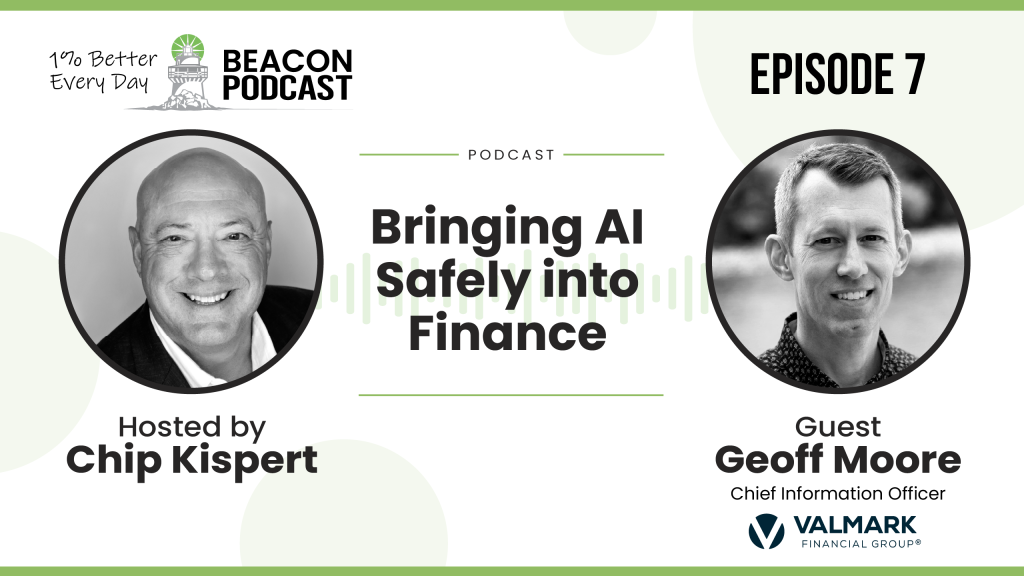
Artificial intelligence is shaking up wealth management, but how do you separate hype from what’s actually useful?
In this episode, Chip Kispert sits down with Geoff Moore, Chief Information Officer at ValMark Securities, to talk about how his firm is weaving AI into real processes without losing sight of what matters most: people.
From early wins with AI-powered document extraction to advisors reclaiming hours of family time and personal time thanks to AI note-taking tools, Geoff shares both the breakthroughs and the challenges of moving from proof of concept to production.
What to expect:
- Early wins and cautionary lessons with AI adoption
- How Compliance leaders can embrace, not fear, new tech
- Why context management is the next big frontier
- Real stories of efficiency translating into quality of life
- And more!
Resources:
- Beacon Strategies, LLC Podcast
- AI for Advisors with Mark Heymen and James Cantwell
- Boxworks.box.com
- Blueshirt.ai
- Slant.app
- BarnDoor.ai
- Camelai.com
About Our Guests:
Geoff Moore is the Chief Information Officer at Valmark Financial Group, where he leads technology strategy and innovation across the firm’s RIA, insurance, and broker-dealer businesses. With a focus on practical, people-first AI adoption, Geoff has guided Valmark through early wins in automation and data management, earning recognition as Box.com’s Small Business AI Disruptor Award winner. He serves on the CIO Inspire Chapter Board in Northeast Ohio and shares his insights as a panelist at industry events like the Advise AI Conference. Geoff is passionate about using technology to enhance both efficiency and advisor quality of life, helping professionals spend less time on manual work and more time with clients and family.
RJ Malyk:
Welcome to Beacon 1% Better Everyday with Chip Kispert, Founder of Beacon Strategies. This podcast is all about challenging the norms of wealth management and empowering professionals to make continuous progress and always be curious. Chip knows firsthand how small consistent improvements can lead to big breakthroughs, and that’s what we’re focused on here, helping you get 1% better every day.
We’ll dive into conversations with industry professionals, share actionable strategies. And explore the mindset needed to overcome industry challenges and create lasting change. Let’s be curious. Push beyond what’s always been done and uncover better ways together. Welcome to the Beacon, 1% Better podcast, where we discuss how to get 1% better.
Every day with your host, Chip Kispert. I’m RJ Malyk, producer of this podcast Chip. Good to see you. And why don’t you tell us what is on today’s agenda for Beacon’s? 1% better podcast.
Chip Kispert:
Thanks, RJ, I appreciate that. Uh, today I am so pleased to have Geoff Moore on the show. Geoffis the Chief Information Officer for ValMark Securities.
Currently, ValMark is taking a really aggressive stance with AI and working to weave AI into Val Mark’s fabric. Jeff’s accomplishments are many, but a few include, uh, most recently on nine 11 of 2 20 25. Be becoming box dot com’s, small business or small medium business AI disruptor award winner, uh, number two, Northeast Ohio’s CIO Inspire chapter Board member.
Number three, a panel participant for the upcoming Advise AI Conference in October. Jeff, welcome back to the Beacon slash podcast.
Geoff Moore:
Thanks, Chip. Always look forward to discussing industry topics with you, whether on a podcast or at one of your round tables or just when you get a chance to get together. So really excited to talk today.
Chip Kispert:
Well, Jeff, you know, you and I had some great conversations when you, you joined us down in Savannah for our innovators round table. I wanna pick, pick that right up. And, uh, so because we only have a, a certain amount of minutes here to, to chat, let’s get to question number one. Uh, so, you know, we’ve known each other for years.
I remember being in your offices probably 15, 18 years. 15.
Geoff Moore:
15 years ago. 15 years ago.
Chip Kispert:
And, um, and, and having you guys look at commission systems and, uh, but do me a favor and share a little bit about a background on yourself and Val Mark for our listeners.
Geoff Moore:
Yeah. So, uh, Geoff Moore, chief Information Officer for the Belmar Financial Group.
Belmont’s been around since 1962, really long time, so been around forever. We’re a, we’re an RIA. Insurance General agency and an independent broker dealer. So we, we work with advisors that are interested in kind of building solutions that work across kind of all three regulatory frameworks.
Chip Kispert:
Well, and I think that’s, you know, what you guys are doing is super important because we look at, you know, it used to be the, there’s the insurance side.
There was the wealth and retirement side. Um, and boy, we see those coming together. We see, you know, these financial professionals now being tasked with managing, uh, a client’s risk. We see them being in, in charge of their retirement and wealth, and we also are seeing them in charge of cash flow. And I think we’re gonna see them getting into healthcare more and more.
So, uh, interesting. It’s an interesting foundation we see. Um, so you’re, you know, you have a great firm. What you guys are doing is so special and what, what you’re kind of as a business doing from a, from a technology is, is. Is pretty special as well. So you are one of my ai go-to guys. Let’s just be honest.
Right. Okay. I, I saw your recent post on your work with box.com. So my question, I’ll start really broad. How are you and ValMark weaving in artificial intelligence into your days and work streams?
Geoff Moore:
Yeah, so box.com, they’ve really come out with a lot of good. AI features. That’s one of the first places we started because all of our enterprise unstructured data already lives in Box.
So it’s already living there and it made a lot of sense to utilize some of their AI capabilities. I’ll tell you a funny story. Uh, one of the first use cases we use, so I was in the kitchen at the office, I was talking about this new extraction capability, basically pulling data out of documents and then, you know.
Putting it in fields or tables or something. And this young woman in our office, a newer employee, uh, was looking at me, kind of funny, and, and then she says, wait, what did you just say? And it, it turns out, uh, one of the, she worked in our commissions area or works there now, and one of the vendors stopped sending us a data feed.
So imagine getting a data feed for years and years and years. You’re processing commissions. No problem. All of a sudden they stopped doing the data feed and they sent us a PDF statement. Like, so, like all of a sudden we’ve gone backwards, right? Like, and we’re like, what is happening? And, you know, this is what they’re doing.
So this, this, this woman was faced with this probably, you know, 10 to 15 hours of additional work in her month that she was not expecting. Wow. Multiple pages. Multiple lines. I’m like, well, let’s. Let’s, let’s throw the AI at it and see what we can do. Mm-hmm. And it was able to extract it. I would say, I mean, according to her, maybe 95 ish percent, like sometimes the scanned image, it might not, it might confuse maybe a zero and an eight or something if they use a little slash through it.
So, not perfect, but I would say, I, I tell people reviewing is much faster than Hand King. Um, so we were able to use box AI for her, and it, it was, it was a nice early win. It was a nice early win because it was easy to communicate and understand. Um, so we’re looking at some other extraction use cases with them.
And then the other thing that they do really, really well is you may have heard these terms rag or retrieval augmented generation. Yep, absolutely. But when, but when you’re, when you’re needing to search over a larger document set, you know, it, it, it’s bigger than the context window of the chat. So you have to use these more advanced tools.
Well, box makes it really, really easy. Essentially, all you have to do is put your documents in the repository and then you can just simply ask the AI a question. So we’ve, we’ve overhauled our old search in our advisor portal. So now advisors cannot just find the document. They can ask AI a question about AI documents at Belmar and get an answer as well as a, a list of the sources or citations that were used.
Chip Kispert:
That’s fascinating. Absolutely fascinating. So are, um, are you structuring the, the answer to those questions right. To help really drive efficiency and automation in anything ranging from account opening to maintenance.
Geoff Moore:
So, yeah, you opened it broad. Here’s what I wanna talk about and here’s where I want to be real.
And ’cause you see people out in social media, I feel like it’s all or nothing. It’s either AI’s amazing, I’ve transformed my organization, be like me, or it’s, this is the dumbest thing ever. Nobody’s stupid. It’s stupid. And I think we’re in this place right now, a little bit in between. So I just shared this story about our.
Portal that we enabled this search. And if I stop the story there, one might believe that we’ve created this amazing transcendent experience for our advisors. And if I’m being clear, all of our documentation was written without AI in mind and we’ve provided it too much documentation in some instances.
So I’ll give you a simple example. So inside of our portal, we list out maybe, uh, presentations that have happened over again, Belmar, really old company, right? Over a long period of time and what was a correct answer a decade ago may not be the correct answer today. So making sure that we’re going back and figuring out what is the right documents to leave in the system and thinking about making it a little bit easier and clearer for the AI should they ask and, and that’s an ongoing process.
I think that’s an ongoing process that firms are gonna have to go through now and indefinitely, and we’re all learning how to do that. A little bit better. So I, I think that that was something I’d like to share with people. So if you’re doing this and you don’t quite get the results that maybe you’re seeing, it’s social media, it could be because you’re not getting a realistic expectation of, of what firms are needing to do to, to fully enable that.
Chip Kispert:
Gotcha, gotcha. Uh, side question for you. Right? Yeah. So all this talk about ai, we got, you know, all these different tools that are out there. Yeah. It can be pretty intimidating.
Geoff Moore:
Um, I, I don’t even, how much time do we have for this thing? How do I even get started? Yeah. I, I, it, it is really hard. I, I would say, because if you’re a curious person like me, you may see something, you’re like, oh, well, maybe that could help me and maybe this, and you could, you could find yourself being in a situation where you’re, you’re doing a lot of chasing and then you’re not making a lot of progress because you’re spending so much time researching, finding, trying to find the next diamond, uh, in the rough, and then you miss some opportunity.
I’d say generally speaking, for now at least my strategy is I’m, I’m sticking with sort of the larger enterprise frameworks and I’m trying to apply as many use cases as I can against those larger enterprise frameworks versus Got it, a lot of individual niche because if I do a good job with the enterprise tool, I can leverage that both in terms of like the IT group’s time and how to interface with it and shared use cases with our advisor or.
Advisors and back office staff, right? Like if this department learns it, they can share with this other department their shared learning and they, they can make progress. But if everybody’s using their own individual AI tools, um, it gets a little bit harder to have some just momentum because of the, the, the shared knowledge sharing.
Chip Kispert:
Yeah, that makes absolute sense. Absolute sense. Yeah. So you’re putting some, you’re putting these processes in place, your people are using it. Right. What’s been the impact of your AI work? You know, ha ha. Where have you seen improvements? Is it, you know, is it in productivity oversight, data management? What do you, what are you thinking?
What Please share.
Geoff Moore:
Yeah. I, again, I, I want to, I wanna bring like a real, uh, yeah. Perspective too. And I, I would say even getting an award like that, I, I, I would say we have not broken into as many production, like you’ll see a lot of things. People do a really good proof of concept and then getting it to production and getting it automated, that’s a different story and it’s a little bit harder, I would say we’ve done a pretty good job with some of our proof of concepts, and I just, just, we’re just now starting to get where we’re putting some of these things into production.
So I, I would say I don’t have. As many like huge wins or massive time savings stories is, is maybe I’d like, I, I think we’ll get there. Um, I, I will say though, that the biggest win so far has been with the AI note takers. Like that’s a, that’s a slam dunk. If your firm’s not doing that, I’d probably encourage you to look at it.
Um, you know, we’ve got probably about a quarter of our advisors signed up to use an AI notetaker now. And, and the stories I hear from the ones that do use it are, are pretty good. In fact, I, I, I, I interviewed the, uh, I, I found the advisor that did the most number of meetings. Now he started doing meetings in March and he’s already done like 236 meetings with the note taker.
Mm-hmm. I interviewed him. We did like a little podcast style interview, and at the very end I shut the recording off and he goes, you know, Jeff, you know what’s really helped me? He’s like, I’m a young dad. I’ve got three kids under five. Every night I was going home and I was writing up my notes after work, and now I don’t do that and I spend time with my kids.
And I was like, you know, like that’s, that’s the kind of stuff that’s like, okay, you can read all the metrics, but at the end of the day, that was a really a. Heartwarming story about how that really impacted his quality of life, both for him, his family as well. So I, I, I like to share that because sometimes we get so lost in all of the, the time savings and metrics and that we kind of lose fact that it’s, it’s also just improving the quality of life where that woman I cited earlier, you know, just doing a bunch of hand keying off a spreadsheet, it’s just not fun.
So we’re, we’re.
Chip Kispert:
That’s the ultimate win, what you just laid out. Yeah. So are you using, um, a handful of the note takers or have you guys gone down the path of one in particular?
Geoff Moore:
We went, we went down the path of one and for us it was just, we, we just felt it was easier to. Legal and compliance wanna put guardrails in place, of course for safety.
And so it was a little bit easier to do with one. So I, I know some firms are using a couple, uh, but I even firm, or at least you probably know better than I do, but even firms that have used a couple, it’s usually one or two’s and they’re not opening up. They’re not opening up a lot. So I, and you know, speaking of note takers, I mean, wow, that’s a tough business to be in right now.
But it’s exciting and, and, and I, and I feel for them with the competition, but I also feel like as a. A person in this community, we’re all benefiting from all of this activity and interest and their, and I almost feel like it’s unfair to call them note takers. I almost wanna call them AI workstations because they’re starting to enable some of these other features.
Like updating CRMs, updating financial planning systems and tying some of this stuff together that is, uh, is really exciting.
Chip Kispert:
Yeah, I think I, I would add to that comment and call them unstructured data workstations. Yes. ’cause they’re taking that unstructured data and being able to move it into a structured framework, which also will provide benefits down street.
Yeah. Yeah. Most definitely. So, um, you and I. Chatted a little bit about Camel ai. Can you chat about that a little bit?
Geoff Moore:
Yeah, so, uh, I, I, we use several different tools, but I put three main tools, like three buckets of tools. First is unstructured data. What are you doing about your unstructured data, your documents for us, that’s box.
Then structured data. What are you doing for all of your, your rows, your tables, you know, columns and rows. And I know tools like Salesforce have some AI capabilities. ’cause you know, they’re a structured data system. Correct. And earlier we used a system called Camel, which allows us to connect to our structured data and ask questions about it.
So it, it’s, it’s interesting. So what it allows us to do is. Previously, if somebody wanted a specialized report or something that maybe touched a couple different databases, they’d have to come to the IT group and then they would request a report, it would get written and published. And that’s kind of a, a time consuming back and forth.
What Camel allows us to do is more of a democratization of data, and now a user can just ask Camel and it will write the report for them. Um, so it, it’s interesting. I, I feel like it’s probably not as used as much as I would hope yet. But I did have one success story where a young person on our, it’s all the young people, they’re doing all the experiments.
Oh. So they’re so adventurous. Um, they had a, a data cleanup project that they had tried the pre previous year, and they ended up not succeeding with it. But then they used Camel and they used, so it was connected to our CRM system. He uploaded some of his own files and it was able to kind of stitch the data together for him and help him clean it up, whereas previously he wasn’t able.
So that was, that was kind of a fun, uh, early case study. And, and I kind of do it myself even though maybe, you know, I’ve got some of the skills to do the. You know, the, the, the queries myself, it, it can just be faster to get a head start to ask AI to help you do a head start.
Chip Kispert:
It. It is. And you know, it’s interesting ’cause one of the things I think many wealth firms struggle with is their data quality.
Right? Um, traditionally they’ve had data quality issues and this is really a means to be able to help them highlight, Hey, I got data gaps, and potentially how can we improve that data? So it, it’s just amazing to me. It, it’s, uh, I love where this is going. Me too. So, so this is kind of the obvious question, right?
So one of, you know, we do compliance round tables, and for the last two years it was ai, ai. Um, two years ago it was no, no, no. Can’t let it in that this year it’ll do everything for us, right? But. We got it. How does ValMark put in place some AI guardrails for, for both your internal users as well as your third party partners?
Geoff Moore:
Yeah, so I’m, I, I say this every time I get a chance to speak Our chief compliance officer. Happens to be our number two user of AI in the company. Like when I look in our T enterprise, yes. If you look at number of messages processed, there’s me and then there’s him and which is awesome, right? That is awesome to have somebody in that role as a partner.
That is both, I mean, first and foremost concerned about protecting advisors and our organization, but also wanting to figure out how we can do this in a safe way. So, mm-hmm. At first, I’m just grateful for that. So. Policy, right? The first thing is policy. And so our policy really breaks down kind of what, what are you trying to do?
Are, are you doing something like, are you just generating images? So that’s like tier one, right? That’s that’s not, and then tier two, like, are you using. Sensitive data and then kind of what are you doing with that sensitive data? So kinda have like three different tiers and it’s like, is it a, it’s a, if it’s a fi finance, it’s a free tool.
If you’re just like making an image or a CAT video or something, like, that’s one tier, right? Mm-hmm. Second tier is, okay, you’re, you’re maybe using some sensitive data. We want to know a little bit about it. It’s maybe not to the level of where we would do an enterprise agreement, but it’s small, but we wanna understand it and then make sure compliance and legal.
Cyber are comfortable with your use case. And then third is just a full on enterprise agreement where we feel like we have great control and then we can be much more, um, free to use those systems liberally. But, but they have a lot of contractual as, as well as technical controls around it to keep the data safe.
Chip Kispert:
Makes completely s complete sense. I think this is an area that we’re gonna see a lot of. Work in, as with this proliferate with the proliferation of ai, of, of firms going in and saying, uh, oh, I gotta figure this out, and yeah. Get our arms around it.
Geoff Moore:
I, I, I will say one of the, the hardest things right now, Chip, is that let’s say we approve a tool two or three years ago, right?
The advisor is now using that tool. It, it has been approved. All of a sudden, the vendor puts in ai. And we’re like, well, wait a minute. Yes, yes, your tool is approved, but we don’t understand how they’re using AI yet. We time out, you turn off the AI feature, let’s talk and make sure we can figure out what kind of data is going in it, how they’re using it, what’s involved.
That’s probably the biggest challenge right now is just is these are. You know, proliferating everywhere inside of our existing approved tools, making sure that we’re, we’re, we’re, we’re being diligent about, uh, before those get turned on that, that we’ve had a chance to review them.
Chip Kispert:
Yeah. And it’s in interesting ’cause the, the vendor management work that we’re doing, we’re weaving in now.
Um, you know, AI policy review is part of that for third party providers. So we find that that to be pretty interesting. Um. Hmm. All right, so we got through that compliance piece, that regulatory piece. Um, quick question for you. Um, and this one’s more going back to the broad industry, right? So, you know, as you are looking at the well space.
You know, and when you study the wealth and advisor business these days, who do you follow? Who are you paying particularly close attention to?
Geoff Moore:
I’m curious. Yeah, yeah. I saw, I, I still feel like Michael Kites is the og, right? Like, I mean, he just came out with his tech, uh, research. He had this, his speech at, uh, future Proof.
And everybody’s been talking about his, his statement now where he is basically saying, make you hire staff to help you. It’s not just tech.
His, his latest FinTech report. I thought it was really well done. Uh, just even in terms of structured study. So I think he’s always worth a follow, uh, and, and up on kind of all the latest and greatest. So him, Ben Olson, BMO Automation, he’s been getting a lot of press lately, talks a lot about automation and how to use AI with that.
So I, I think he always tries to share some interesting use cases. A, a newer podcast you might not be aware of, Chip is called AI for Advisors. It’s put on by Mark Hanan and James Cantwell, and I think they’re doing a good job of trying to. Uh, kinda build community around those interested in AI in the wealth space.
So I’ve, uh, I, I, I’m, I’m not sure how many episodes they have yet, but I’ve listened to a couple of them and I thought they were pretty good. In fact, I even learned about a new CRM that’s getting built. It was kind of an AI first type CRM, and then I, I had a demo with them and I was like, okay, well, so those are, so I picked up something new.
Yeah. So those are three. And then,
Chip Kispert:
uh, yeah. Gotcha. You know, it’s funny you bring up that CRM when I was out at Futureproof last week, I may have bumped into that CRM. Might it have been Slant?
Geoff Moore:
Yeah, yeah, those are, yeah. Yeah. So slant. Yeah. Yep. I was,
Chip Kispert:
I was pretty impressed with what they were doing. I mean, it was, I mean, really, really cool.
Geoff Moore:
Yeah. So they’ve, they’ve. I mean, they haven’t been building that tool very long, so I, I feel like they’ve made a lot of progress. I mean, it’s still, you know, there’s, you know, more mature serums, obviously they’re gonna have more features, but what they’ve been able to build so far and at least their thesis around it.
I mean, and then I would say for, for some smaller firms, it’s, it’s, it would be ready to go and more than capable, uh, to accommodate their needs, for sure.
Chip Kispert:
Well, and, and it’s fascinating too, from my perspective, they weaved together. They, they started as a marketing firm. I don’t know if you knew that.
Geoff Moore:
Yes.
Yeah, yeah. Right. Which is yes,
Chip Kispert:
which is another big problem in the industry, right? It
Geoff Moore:
it is. So it’s, it’s almost like that’s, and that’s the way HubSpot started too, right? Is a marketing tool first. So it’s kind of, it is an interesting point that started, started as a marketing group and then come into C rm.
Chip Kispert:
Yep. So, um, which, uh, which companies out there in the wealth space are inspiring you with their work on ai?
Geoff Moore:
So obviously I, if it hasn’t come clear yet, probably I’m biased because I won that award from them. But like the folks at Box, right? Like they’ve, they’ve kind of won my heart somewhat, but, but their CEO Aaron Levy on LinkedIn, he does a really good job of, of posting, uh, his thoughts on ai and I, I, I’ve definitely taken some of his.
Concepts and tried to apply them, but, and just as a product, I, I think they’re doing a really good job of baking it into unstructured, I was gonna mention slant here. Uh, we already talked about them a little bit. I just think, again, interesting kind of AI first approach and we, we already talked a little bit about the, the note takers, but I, I do find their work inspiring.
I really do. And I know it’s a hard fight for them right now ’cause they’re being so competitive with each other. But man, they are, they are really. It’s a hard thing to think through, like how, what are the use cases we can build? What are different ways we can use this technology to, to create a better experience for advisors and their clients?
And I, I think they’re doing a good job of adding new capabilities. All the time. Like I, I, I don’t follow all of them closely, but even some of the features where they’re, you know, now updating the CRM automatically from a conversation, I think is just right. I think is just really cool. And well, and I, I, I
Chip Kispert:
think, you know, it’s interesting ’cause if we look at the traditional CRMs out there
Geoff Moore:
Yeah.
Chip Kispert:
I, I think that to some extent it’s a wake up call for them. And we may be at a tipping point where, you know. There’s a balance there and being able to take unstructured data and make it structured is really, really valuable.
Geoff Moore:
Valuable.
Chip Kispert:
So, you know, it’ll be interesting to see how kind of this, this unstructured versus structured plays out, especially as it relates to the CRM space.
Um, so yeah. Um, so I find that interesting. But I do too. Um, alright, so I gotta ask this question ’cause I. I talk about Notetakers probably more than any subject. Right. So, and you had, Hey, I like all the Notetakers. Did you, you said you chose one in particular, right? Yeah. Are you comfortable sharing which one?
Geoff Moore:
Yeah. JUMP is approved, uh, for LL market, ADV member offices to use. Yep.
Chip Kispert:
Got it. Got it. Okay. Um, yeah, I was curious ’cause I was, I was going, all right, which way are you going? You going, you know, ’cause there, there are a handful that are leading the charge out there and certainly jumps one of them.
Geoff Moore:
Yeah. And you know, I, I think it would be naive to think that whichever one you pick is gonna be the ultimate winner.
It’s too hard to tell right now, you know, and they’re all fighting to, to for that space. And, um, I, I think they’re all doing a really good job, uh, uh, of building out new capabilities, so.
Chip Kispert:
Got it. All right. So I’m leading into the last question here. ’cause we try to keep this less than a half an hour and we like to be curious at Beacon, much like you, um, in the well space looking forward, where do you see AI going?
Geoff Moore:
Okay, so three things. Uh, first is rag, uh, retrieval, augmentation. Lots of documents going in. The best example of this that I think is just hilarious if you haven’t seen it, blue shirt ai. So Jason Wa from Altruist. Mm-hmm. He took all of Michael Kite’s research, he threw it in to a giant chat bot, and now you can just ask a question.
So if you’re wondering what rag looks like, that’s a great example that it’s like publicly available to see in our industry of how, and then maybe you could do something like this for your firm, but you see the power of this and I, I just think there’s gonna be more use cases this. As, as like, at least internal for us.
We’ve had small teams starting to do that with like their internal training or their documentation or
Chip Kispert:
mm-hmm.
Geoff Moore:
Product information from vendors and, and we’re getting small, simple win is like something that used to take somebody maybe 15 minutes to find the document. Right now they get it almost instantly.
And if you multiply that times, you know. One or two times even a week. It’s, it starts to add up over a large number of people. So that’s, that’s the first
Chip Kispert:
good.
Geoff Moore:
The second thing I would say is jobs. Everybody’s always concerned about AI taking their jobs. I think the next wave of jobs, it’s important to ai.
Is context management, which you’ll hear some people are starting to say 2026 is the year of context management. What do I mean by that? Yep. It’s basically just doing a better job of managing your documents and data and making sure that the AI has the right. Information to give you its answer. And that is, I think, harder than people might think.
And that’s more, and it is gonna be more and more important. So we’re gonna spend more time trying to like get AI all the right information so that if, whether we’re using it as a strategy, thought partner or getting an answer or having it do a task, it needs the right context. Correct. And it, it’s not gonna guess.
So I think, I think that’s an area. Of growth for people. And then the last thing I would talk about if you haven’t heard is MCP, which stands for Model Context Protocol. It’s a way for an AI system to communicate to a fintech’s API. Right? And not enough of us are talking about that yet. Still, I think this is absolutely amazing.
Let me give you just a really quick example of how this could work. So let’s say I’m a wealth advisor and I go to a, uh, a client appreciation event, right? And I meet somebody. Potential client, X, Y, Z. I’m not at that meeting, gonna sit there and pull out my laptop and type into my CM system, right? But I might pull up my phone, I might say, Hey, I just met so and so and they wanna talk about 4 0 1 Ks next week.
Can you add them as a prospect to my CRM system? And then put this note in and then follow up in a week and boom, it’s connected to your CRM system, your structured data. It understood what I said, and it knew how to fill out the data. Instantly. Like that to me is really interesting. I, I, I mean, I’m not an advisor, so I don’t know if they’re gonna start to do this kind of workflow.
It seems to me that would be a good use case, um, where I’m interacting with this system more as a human and having to do less, um, you know, nuts and bolts work. Mm-hmm. So nuts and bolts work. So, you know, APIs connecting to AI and CPS make that way easier to do.
Chip Kispert:
I think the MCP is gonna be a game changer.
I think it’s gonna change how we look at integrations. I think it’s gonna change. I think it’s gonna make, you know, be able to, as long as we can get security around it and make sure we’re comfortable. Right.
Geoff Moore:
Hey Chip. Oh, I’m gonna drop another thing. I was at BoxWorks, right? I just met a new vendor, barn door.ai.
Their entire business model is creating a control layer around MCP for organizations.
Chip Kispert:
There you go. So, so you are starting,
Geoff Moore:
they’re starting to think about it.
Chip Kispert:
Excellent. Excellent. Wow. What a, what a great group of thoughts you just shared. Um, so one of the things we always like to do is to give you about 45 seconds to a minute to, uh, share your 1% better every day.
Final thoughts So you have the floor.
Geoff Moore:
Okay. 45 seconds. It’s gonna be tough. Here we go. I would say if you’re not using ai, just try it and be okay with failing and having it not work. And that’s okay. I think it takes a little bit of grit. Yes. The part B to this is if you do it today and it doesn’t work, it’s not a bad idea.
Park it for three months, come back in three months and try it again. I can’t tell you how many things I tried three, six months ago that didn’t work all of a sudden because the models are like so much better in such a short period of time that now they work. That’s my, that’s my 2 cents, so wow. Try and try again.
Chip Kispert:
Try and try again. I love it. Jeff, I wanna thank you for joining me on the Beacon. 1% better every day podcast. I always enjoy talking with you. I enjoy having you on the show. You’re super thoughtful and you care so much about what we’re doing and having constant improvement in the insurance and wealth marketplace.
I’m grateful for you in my eyes, as well as I know in the eyes of your peers. You truly are a trailblazer, and I look forward to seeing what comes next. As you can continue to climb this AI Beanstalk. ’cause that’s kinda what it is, right? Absolutely. So, um, before we go, you know, do you wanna share, uh, your contact information and maybe how to get in touch with you?
Geoff Moore:
Yeah, yeah. Best way to reach out to me is through LinkedIn. So just search Geoff Moore ValMark. That’s with A-V-V-A-L-M-A-R-K, uh, hit me up for a connection request. Send me a direct message. I’d be more than happy to chat with you,
Chip Kispert:
Jeff. I’m grateful. Till next time.
Geoff Moore:
You too. Take care, Chip. Bye
Chip Kispert:
rj. I really enjoyed having Geoffon the show.
He was fantastic.
RJ Malyk:
Absolutely. Absolutely.
Chip Kispert:
All right, before we close out, um, I wanna encourage our listeners to check out our archive of past shows with industry leaders like Couplers, Derek Notman, sycamores, Mike Overdo, and Dave goes from advise on to name a few. Uh, these can be found at beacon strategies.com/podcasts.
And, uh, at the end of the day, we here at Beacon encourage you all to be, get 1% better every day. And to quote Walt Whitman and most recently Ted Lasso, be curious, not judgmental, until our next episode. This is Chip Kiper. Be well.
RJ Malyk:
Excellent Chip and, uh, we need to add in a shout out as this podcast is brought to you by Beacon Strategies, LLC, the go-to resource for Round Tables Consulting and services that support wealth management firms and their providers.
If you need some industry perspective or help, please visit. Beacon Strategies llc.com. And again, thank you for listening to Beacon 1% Better podcast. We ask you to share this podcast rated and leave a review because this actually helps others find the show. Again, thank you for listening and for Chip and everyone at Beacon Strategies, I’m Marj Mallek, and we look forward to you joining us for our next podcast.
Thanks for joining us on Beacon’s. 1% Better Everyday podcast. Be sure to hit that follow button so you never miss an episode. And stay up to date with Chip and his friend’s. Latest insights and strategies. If you want to learn more about Beacon Strategies or get in touch, visit us@beaconstrategiesllc.com.
Remember, progress starts with just 1% every day. Let’s keep challenging ourselves to be curious and grow the information covered and posted, represents the views and opinions of the guest, and does not necessarily represent the views or opinions of Beacon Strategies. The content has been made available for informational and educational purposes only.
The content is not intended to be a substitute for professional investing advice.