


TRANSFORM AI RISK INTO COMPETITIVE ADVANTAGE
The Critical Inflection Point: Why Wealth Firms Must Act Now
The wealth management industry stands at an unprecedented crossroads. AI adoption has shifted from competitive advantage absolute to existential necessity, yet 73% of firms lack the governance frameworks to deploy AI responsibly.
The Problem with Today’s AI in Wealth Management
All your competitors are rushing to deploy AI and potentially without understanding the risks. They’re integrating ChatGPT into client communications, using Claude for investment research, and embedding vendor AI into every platform. This creates a ticking time bomb of regulatory, reputational, and operational risks that will inevitably explode during the next SEC examination or client complaint.

Consider what’s happening inside these AI systems:
- Opaque Models — Black-box LLMs generate outputs without audit trails, making it impossible to explain decisions to regulators or clients during examinations.
- Prompt Injection & Jailbreaks — Attackers or even curious users can manipulate prompts to override safeguards, extract sensitive client data, or produce prohibited investment advice.
- Agent Drift & Autonomy Risks — Autonomous AI agents can mis-prioritize tasks, act outside intended scope, or trigger cascading failures in portfolio management systems.
- Data Leakage — Poor governance of training and prompt data can expose PII, account information, or confidential trading strategies.
- Hallucinations & Fabrications — LLMs may confidently generate false market information, incorrect tax advice, or fabricated regulatory guidance, leading to fiduciary breaches.
- Vendor Dependencies — Third-party AI embedded in platforms operates as black boxes with unknown risks, training data, and decision logic.
- Bias & Discrimination — Models trained on historical data may amplify systemic bias in lending decisions, investment suitability, or client segmentation.
WHY THESE RISKS ARE REACHING A CRITICAL MASS NOW
These AI risks aren’t theoretical future concerns – they’re today. The window for establishing proper governance is rapidly closing as three powerful forces converge to create an inflection point that will separate industry leaders from those scrambling to survive.
Firms that act now will harness AI’s power safely and strategically. Those that wait will find themselves trapped between aggressive competitors leveraging AI advantages, regulators demanding answers they can’t provide, and clients abandoning them for AI-enabled advisors who deliver the personalized, proactive service they now expect.
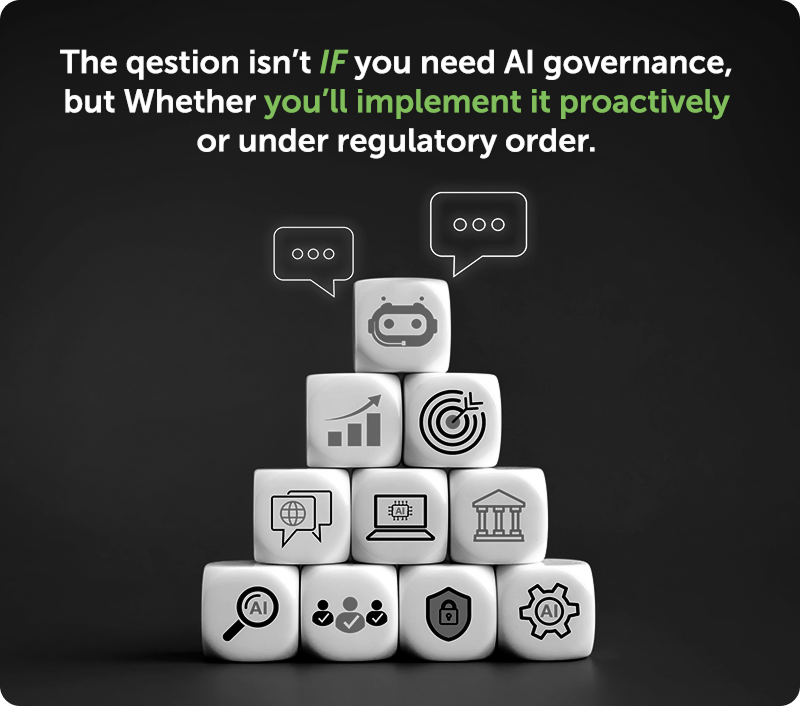
The choice is no longer whether to govern AI, but if you’ll take action do it, or if regulators will force your hand.
Three Forces Creating Unprecedented Urgency:
1. The Private AI Revolution
Forward-thinking competitors are moving beyond generic cloud AI to Private Large Language Models integrating proprietary data within secure infrastructure. Early movers build competitive moats that become exponentially harder to overcome.
2. Regulatory Enforcement Acceleration
SEC examinations now routinely probe AI governance. FINRA guidance extends to all AI applications. Federal Reserve SR 11-7 standards apply to AI-driven decisions. Firms without frameworks face immediate exposure.
3. Client Expectations Transformation
Post-pandemic clients demand proactive, personalized, real-time advice. AI-enabled firms report 20-30% higher engagement. Those without face accelerating attrition.
OUR COMPREHENSIVE AI ASSESSMENT FRAMEWORK

Phase 1: AI & Agent Inventory with Vendor Discovery
AS-IS: Complete inventory of internal AI, autonomous agents, shadow AI, AND third-party vendor AI embedded in platforms
TO-BE: Centralized registry with risk tiers, governance oversight, vendor audit requirements
Value Received: Risk heat map of all AI exposures with remediation priorities
Phase 2: Data Foundation, Quality & Lineage Assessment
AS-IS: Data silos, quality issues, unstructured repositories, PII/PHI exposure in prompts, training data contamination risks
TO-BE: Unified data platform, automated quality validation, privacy-preserving architecture, complete lineage tracking
Deliverable: Data remediation roadmap with quick wins and strategic initiatives
Phase 3: Vendor AI Risk & Third-Party Assessment
AS-IS: Black-box vendor AI, unknown training data, API vulnerabilities, algorithmic audit gaps
TO-BE: Vendor penetration testing protocols, continuous algorithmic auditing, secure API architecture (REST, SOAP, gRPC,GraphQL, WebSocket, MCP)
Deliverable: Vendor risk scorecard with mandatory remediation requirements
Phase 4: Red-Teaming & Adversarial Testing
AS-IS: Vulnerability to prompt injection, jailbreaks, data poisoning, model extraction
TO-BE: Systematic red-teaming simulating real attacks, prompt injection defenses, adversarial robustness testing
Deliverable: Security findings with hardening protocols and defense implementations
Phase 5: Vibe Coding & Output Control Testing
AS-IS: Inconsistent AI tone, off-brand communications, compliance culture misalignment
TO-BE: Vibe coding frameworks ensuring firm voice, output filtering, real-time tone monitoring
Deliverable: Brand protection and communication governance framework
Phase 6: WSP Integration & Regulatory Alignment
AS-IS: Outdated Written Supervisory Procedures, regulatory gaps, examination vulnerabilities
TO-BE: AI-specific WSP sections, SEC/FINRA/Reg BI alignment, global privacy compliance, complete evidence binder
Deliverable: Updated WSPs with examination-ready documentation
Phase 7: Explainability, Bias & Model Risk Management
AS-IS: Black-box decisions, potential discrimination, regulatory explainability gaps
TO-BE: SHAP/LIME implementation, fairness metrics, SR 11-7 aligned validation, audit trail generation
Deliverable: Model Risk Management framework with ongoing monitoring
Phase 8: Security Architecture & Operational Integration
AS-IS: API vulnerabilities, inter-agent communication risks, advisor resistance, client skepticism
TO-BE: Zero-trust architecture, structured logging, super-advisor enablement, change management
Deliverable: Security blueprint with adoption strategy

WHAT LEADING FIRMS ARE BUILDING NOW
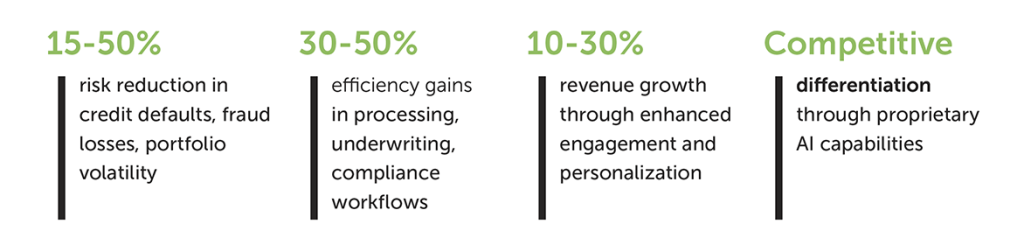
Industry leaders implementing comprehensive AI governance achieve:
What We Deliver: Complete AI Governance Package
Core Risk & Policy Framework
- Model & Agent Inventory — Every AI documented with purpose, data, lineage, owners, risk tiers
- Vendor AI Assessment — Third-party AI audit with penetration testing results
- WSP & Policy Integration — AI governance inserted directly into Written Supervisory Procedures
- Evidence Binder — Complete regulatory exam package with policies, logs, attestations
Technical Security & Testing
- Red-Team Attack Results — Prompt injection, jailbreak, adversarial testing with remediation
- Vibe Coding Framework — Brand alignment controls for consistent communication
- API Security Architecture — Key vaulting, VPC controls, zero-trust design
- Data Governance Protocols — Lineage tracking, privacy controls, PII protection
Explainability & Compliance
- Bias & Fairness Pack — SHAP/LIME explainers, fairness metrics, benchmarks
- Model Risk Management — SR 11-7 framework with validation procedures
- Hallucination Detection — Validation layers preventing fabrications
- Agent Behavior Constraints — Autonomy boundaries preventing drift
Operational Excellence
- Shadow AI Discovery — Complete ungoverned AI inventory with risks
- Observability Framework — Structured logging, monitoring, alerts
- Change Management Toolkit — Training, templates, adoption metrics
- Incident Response Playbooks — AI-specific scenarios and procedures
Critical Components Every Firm Needs NOW
- Prompt Injection Defense — Input validation, sanitization, continuous red-teaming
- Vendor AI Governance — Algorithmic audits, penetration testing, API security
- Agent Autonomy Controls — Boundary constraints, behavior monitoring, kill switches
- Vibe & Output Governance — Tone consistency, brand alignment, compliance culture
- Data Leakage Prevention — Classification, access controls, differential privacy
- Explainable Decisions — Audit trails transforming black boxes to transparent systems
Engagement Options Tailored to Your Needs
Comprehensive AI Risk & Policy Assessment
Duration: 6-8 weeks | Investment: Aligned with value delivered
Vendor AI & Third-Party Risk Sprint
Duration: 3-4 weeks | Immediate risk identification
Red-Team & Security Testing
Duration: 2-3 weeks | Critical security hardening
WSP & Regulatory Integration
Duration: 3-4 weeks | Examination readiness
Private LLM Feasibility Study
Duration: 4-6 weeks | Future-state architecture
The Decision Point: Lead or Be Left Behind
AI laggards facing regulatory scrutiny and client defection
Every month without comprehensive AI governance means...
- Competitors deploy AI you can't match
- Regulators find gaps you haven't addressed
- Clients leave for AI generated advisors
- Risks accumulate without controls
Helping Wealth Firms Embrace AI Responsibly and Strategically™
Act Today
Schedule Your Executive Briefing
Discover how comprehensive AI Review & Policy Assessment transforms regulatory requirements into competitive advantages and positions your firm at the forefront of responsible AI adoption.
Contact us to schedule your confidential consultation and receive our exclusive analysis: “The Private AI Advantage: Why Wealth Managers Must Build Governance Now.”